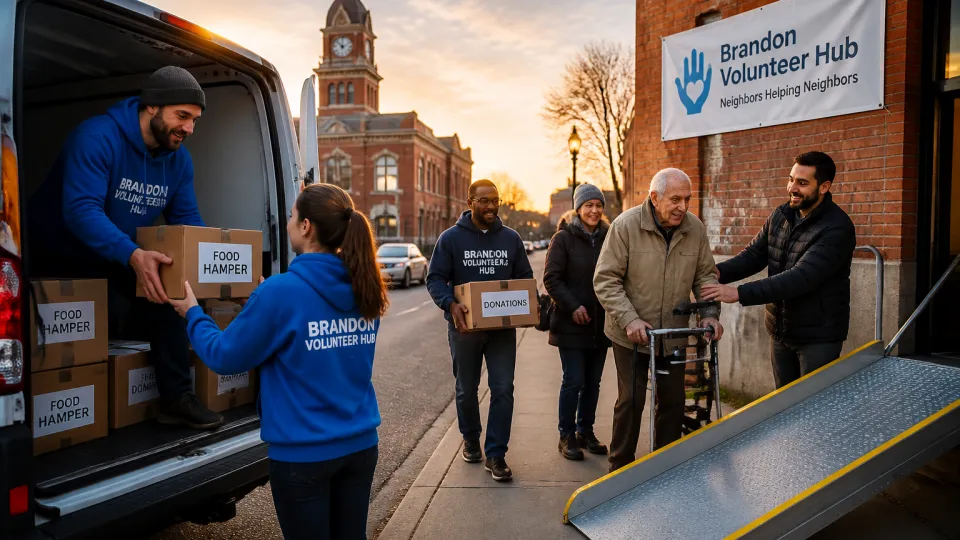
At 6:30 a.m. on a March morning, the fluorescent lights inside the former warehouse on Rosser Avenue reveal a slow choreography: a woman in a bright orange parkade vest tapes labels to boxes of groceries, a teenager folds a map of local neighborhoods, and an older man, cane leaning against a cart, signs a clipboard with a steady hand. This is the Westman Service Collective, a volunteer-led coordination hub that has quietly stitched together services across Brandon and surrounding towns for the last several years.
The Collective began, organizers say, with a practical question: how do you make helping one another ordinary and reliable? Instead of a single program with a single mission, the hub acts like a civic operating system. It matches volunteers with seniors who need rides to appointments, connects high school students with tutoring placements, organizes weekend crews to repair mobility ramps, and runs an inter- courier for donated medical equipment. The work is granular and often invisible, but the effect has been cumulative.
'People call and say, I need a hand folding a ramp for my mom, or my kid needs a quiet place to study,' says Marisol Chen, the Collective's volunteer coordinator, standing beside a whiteboard filled with names and tasks. 'What we do is listen, and then we try to find someone who can help, often within hours. It changes the day for that person, and it reminds the volunteer that their time matters.'
The human scale of the Collective is its power. Take the story of Doris Sinclair, 78, who lives in a bungalow just north of Brandon's downtown. After a minor fall, she could no longer manage the three steps to her front door. Within two days, a group of volunteers led by a retired carpenter, Earl McKenzie, had built a safe ramp and taught Doris how to use a walker more confidently. 'I felt like I was being taken care of by neighbours,' she says, 'not strangers.' The ramp restored independence; the visit restored belonging.
Another thread runs through local schools, where students fulfill community-service hours by tutoring younger children. One initiative, coordinated with Riverdale High, pairs Grade 11 math students with Grade 7 pupils in online and in-person sessions. For the tutors, the experience becomes a lesson in patience and communication; for the learners, it is a bridge to academic confidence. 'My marks went up, but also I felt seen,' says Alyssa, a Grade 7 student in a recent term. 'And I like seeing the same people every week.'
The Collective's approach rejects one-off volunteering in favor of relationships and small systems. Volunteers receive short, practical training: how to do a safe lift, how to use a tablet for virtual check-ins, how to mentor without taking over. Partnerships with Prairie Mountain Health, local schools, and the City of Brandon make the work possible; local businesses chip in van time and storage space. But perhaps most important is the informal economy of favors and personal networks — former clients becoming volunteers, neighbouring towns trading volunteers during busy seasons.
There are, of course, limits. Sustaining a steady volunteer pool in a region with aging demographics is a persistent challenge. Budget constraints mean the Collective cannot offer paid staff for every program, which creates pressure on core volunteers like McKenzie and Chen. The pandemic reconfigured expectations about in-person interactions and digital access, leaving some isolated residents behind even as services expanded online. The Collective has had to experiment: micro-volunteering shifts tasks into one-hour blocks, while training modules on trauma-informed care help volunteers navigate complex social situations.
This pragmatic adaptability points toward a more structural opportunity: embedding volunteer coordination into municipal planning and social service delivery. The Collective's leaders are advocating for a modest municipal grant to fund a coordinator position focused on volunteer retention and data collection. 'We need to understand what actually keeps people involved,' says Chen. 'Is it recognition, flexible scheduling, or clear outcomes? That's how we scale thoughtfully.'
Scaling, they insist, must not erase intimacy. The Collective resists becoming a bureaucratic clearinghouse; it seeks instead to spread the design principles that make local civic action durable: low barriers to entry, clear roles, skills training, and reciprocity. That means encouraging small acts that combine practical utility with human connection — a neighbour helping with grocery delivery and staying for a cup of tea, a high school tutor becoming a confidant.
The moral case for volunteerism is familiar, but the Collective's story reframes it as civic infrastructure. In communities spread across the prairie, where formal services can be thin and distances long, neighbor-to-neighbor arrangements are not a substitute for public investment but a complement to it. They are a way of translating social capital into tangible supports and a laboratory for testing how services might be delivered differently.
On a bright spring day, the Rosser Avenue warehouse hums with activity, some tasks planned weeks in advance and some arising in real time. Volunteers swap stories, trade tips, and leave with the quiet satisfaction that comes from seeing a problem resolved. 'It's small stuff,' says McKenzie, 'but small stuff fixes people's days. And if you can fix someone’s day enough times, you start to fix how a town feels.'
That, perhaps, is the Collective's most important contribution — not merely the ramps built or the meals delivered, but the slow accretion of trust. In Westman, where distances and weather test civic ties, that accumulation may be the region's most durable resource.
As the Collective looks ahead, its leaders are focused on : better data, sustainable funding, and deeper integration with municipal planning. The challenge will be to keep the work human as it grows. For now, the test is simple and local: will a neighbor answer a call for help? So far, in Brandon and across the region, the answer has been yes — again and again, in ways that quietly remake civic life.