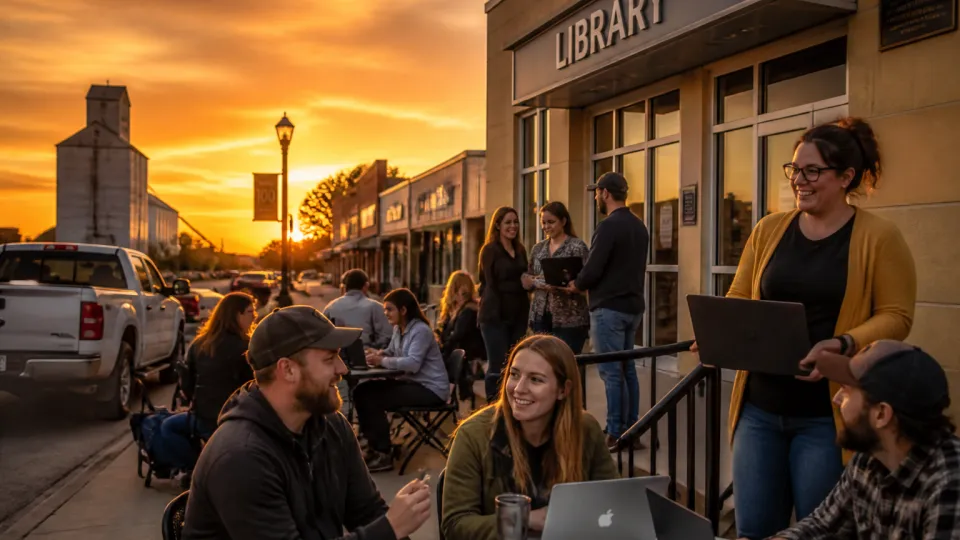
On a damp Tuesday in April, the front room of the Minnedosa Public Library smelled faintly of coffee and disinfectant. A cluster of folding chairs faced a projector screen where Aisha Patel, a technician from Brandon, walked a dozen residents through the basics of video appointments. Nearby, a farmer in wind-streaked rubber boots compared notes with a teenage volunteer about selling seed directly through a regional marketplace.
They were there for Prairie Connect — a grassroots initiative that has stitched together public libraries, local colleges, a handful of independent internet providers and a rotating cast of volunteers to teach digital skills and broaden broadband access across Westman. Its visible presence is the pop-up clinics and evening classes, but the work is quieter and more diffuse: coaching a senior through a video call with a specialist, helping a bakery receive its first online order, or mapping dead zones and lobbying for towers.
"I had been putting off a telehealth visit because I feared the tech. Now I can talk to my cardiologist without leaving town," said Maria Lopez, 68, who lives outside Rivers. "It changed how I think about care. It made it possible."
Prairie Connect emerged out of cumulative frustration — towns that were reliably connected to one another but often not to the networks that undergird remote education, commerce and health care. Brandon University and several library boards hosted initial conversations. Westman Communications, a local ISP with deep roots in the region, contributed technical know-how and occasional bandwidth donations. But the program's momentum came from volunteers: retired teachers, students, and municipal staff who saw daily how connectivity could reduce friction in people's lives.
What distinguishes Prairie Connect from a typical rollout is its attention to the human dimensions of adoption. Training sessions are short, practical and anchored in immediate needs. For farmers, a workshop on soil-sensor dashboards is paired with a session on secure passwords and reading service agreements. For seniors, lessons focus on video calls, prescription delivery apps and navigating government portals. For small-business owners, sessions emphasize photography, online listings and simple bookkeeping software.
Darren McLeod, who runs a mixed grain operation near Virden, initially approached the program with skepticism. "I didn't want to chase the latest gadget," he said. "But when I saw how a small sensor could alert me to a failing pump and save a crop, that changed things. We still talk face-to-face, but now we have tools that let us respond faster."
The results are pragmatic rather than sweeping. In Neepawa, a bakery that struggled to attract lunchtime customers began taking preorders through a volunteer-built storefront and saw weekend revenue increase enough to rehire a part-time worker. In Killarney, a high school student used remote tutoring offered through Prairie Connect to catch up in calculus, opening the possibility of a scholarship to a university she thought out of reach.
Infrastructure remains the stubborn constraint. Some pockets still suffer from inconsistent speeds and the figurative last mile. Prairie Connect's approach has been dual: run lightweight local solutions — community Wi-Fi hubs at libraries, signal boosters in municipal halls — while pressing for longer-term backbone investments with regional planners and policymakers.
"We are trying to hold two things at once," said Dr. Helen Carter, a project lead and faculty member at Brandon University. "Teach people to use what they have now, and make the case for the infrastructure we need next. Too many programs treat technology as the destination rather than the vehicle. We focus on the purpose."
That clarity of purpose has made the program resilient. During a cold snap last winter, the community Wi-Fi at a library in Rivers became a place where families came to charge phones and for children to connect to classes when their home service faltered. Volunteers stayed late, lending laptops and serving hot chocolate. Underpinning those small stories is a broader recalibration of how rural towns imagine economic life: micro-, telework, precision agriculture and distributed education.
Still, the work raises questions about equity. Who has the time to learn? Who can afford devices? Prairie Connect has started a device-recycling program and partners with social services to provide low-cost tablets, but scarcity persists. "We are not pretending that training alone will fix systemic access issues," Dr. Carter said. "But training changes the terms of the conversation. It reminds funders and planners that demand is real and focused."
Looking forward, Prairie Connect's organizers talk about scaling without losing intimacy: regional coordinators who can replicate the model in satellite communities, standardized curricula tailored to rural livelihoods, and better data to demonstrate outcomes to policymakers. They also speak of cultural shifts — a generation of students comfortable juggling online and place-based opportunities, elders who can use technology to sustain social networks, and local businesses that compete without relocating.
In the library back room, as the session wound down, Maria Lopez stayed to help a neighbor install a pill-reminder app. Outside, the last light of evening painted the grain elevator an indifferent copper. What had begun as a series of practical classes felt, after hours of small triumphs and awkward troubleshooting, like a different kind of social infrastructure taking shape: one that combines human patience with signal strength, one that insists technological tools be judged by the life they enable.
"It's not glamour," said Earl Johnson, a retired teacher who volunteers with Prairie Connect. "But it is meaningful. It helps people stay here and live well here. That's worth the work."
Whether that work will translate into sustained policy and investment remains uncertain. What is not in doubt, for now, is that small towns across Westman are learning to shape technology around their lives — and, in doing so, quietly enlarging the opportunities of rural living.