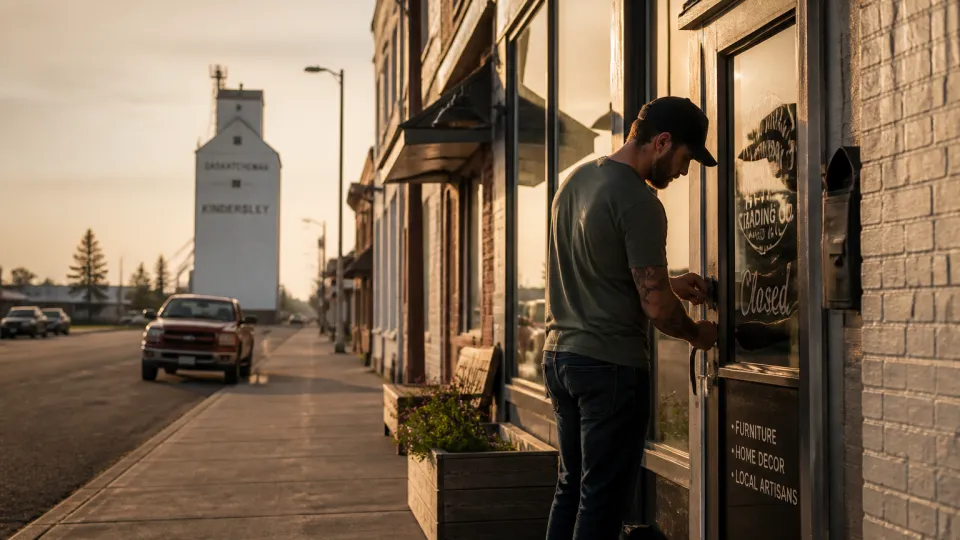
On a cool spring morning outside Brandon, the silhouette of an old grain elevator still marks the horizon. For a century those elevators were shorthand for how this place made its living: bulk commodities, rail schedules and hands-on seasonal work. But beneath that familiar skyline, a quieter, complicated story has unfolded — of families turning barns into laboratories, of Main Streets reinventing themselves, and of a region that has learned to be entrepreneurial not in spite of isolation but because of it.
The history of enterprise in Westman is a catalogue of adaptation. In the early 20th century, meant cooperative grain handling, hardware stores tied to implement dealers, and services that kept harvests moving. Those businesses were practical, built around a predictable cycle: sow, grow, sell, repeat. They anchored communities. They also bred an ethic — a local competence for fixing things, inventing small solutions and leaning on neighbours when weather or markets turned.
By the 1970s and 1980s, globalization and consolidation began to redraw the map. Small elevators closed, family-run dealerships consolidated, and young people found fewer traditional pathways. Yet it was also in these decades that you see the first waves of modern rural entrepreneurship: a beekeeper who started bottling single-origin honey, an equipment mechanic who added custom fabrication for precision agriculture, a woman who turned her grandmother’s recipes into a local bakery that doubled as a gathering place.
Take the example of Mara Jensen (a composite of many local founders), who in the late 1990s turned an underused produce barn southeast of Brandon into a seed-cleaning and small-batch pulse-processing facility. Her customers were local farmers who wanted more value from rotations, regional chefs seeking traceable supply, and distant buyers impressed by provenance. Jensen didn’t break ground with venture capital. She negotiated a line of credit at a bank, leaned on a regional development office for business planning, and hired two seasonal workers from her own town. The business didn’t remake the global market, but it stabilized a local supply chain and allowed several farms to diversify profits — and, critically, anchored employment in a place that had otherwise seen youth leave.
Human stories like hers matter because entrepreneurship here has always been personal. Shops on Brandon’s 18th Street, independent service businesses in Neepawa and Virden, and Indigenous artisans in nearby communities create rhythms of daily life. A butcher who keeps a Saturday morning ritual of coffee with customers; a garage that becomes an informal training ground for young mechanics — these enterprises are economic nodes and social glue.
The modern moment has introduced new tools and new constraints. Broadband has arrived more broadly in the region, though unevenly, and with it the possibility of remote work, e-commerce and digital marketing. Younger entrepreneurs are marrying traditional strengths — agricultural know-how, craft skills — with platforms that let them reach customers in Toronto or Calgary without relocating. At the same time, access to capital, succession planning for family businesses, and the need for affordable housing persist as structural challenges.
Partnerships have become a forward-looking response. Brandon University, regional development organizations, and local business associations have co-created mentorship programs, maker spaces and accelerator-style supports tailored to rural realities. Indigenous entrepreneurship initiatives bring cultural strengths and new markets into the fold, while social finance groups are experimenting with blended funds to support businesses that provide both jobs and social value.
One entrepreneur, Luis Caron, transformed an empty storefront into a staged coworking and artisan market, prioritizing low rent for start-ups and monthly community meals. “We’re not trying to outcompete city coffee chains,” he says. “We’re making a place where someone who wants to try a business can fail cheaply, learn quickly, and try again without losing their community.” That kind of pragmatic experimentation — iterative rather than spectacular — is the most powerful engine of rural vitality.
There is also a real reckoning with climate and soil stewardship shaping new ventures. Farmers are adopting on-farm processing, conservation-focused enterprises and carbon-informed business models that turn ecological responsibility into a marketable attribute. These shifts are incremental but meaningful: they alter what entrepreneurship in Westman looks like, from extractive scale to regenerative practice.
This history — from the elevator to the startup hub, from coop stores to boutique processors — reframes what prosperity means in rural Manitoba. The measure isn't only jobs or GDP; it is measurable in the steady pulse of businesses that keep a library open, support a high school hockey team, or provide the first paycheque for someone deciding to stay.
If there is a lesson for other regions, it’s this: sustainable rural entrepreneurship is rarely the product of a single disruptive founder. It emerges from networks — intergenerational knowledge, supportive institutions, patient capital, and a community willing to tolerate the slow refinements of trial and error. Westman’s future will depend on its ability to make those networks denser, to invest in infrastructure that levels the field, and to honor the local knowledge that has always been its competitive advantage. In the end, entrepreneurship here is less about escaping the past than about carrying forward what works and reshaping the rest with steady, inventive hands.
—
This piece was reported across towns in Westman and in conversation with local business owners, community leaders and regional development practitioners, capturing the lived history and present experiments that are remaking rural entrepreneurship.