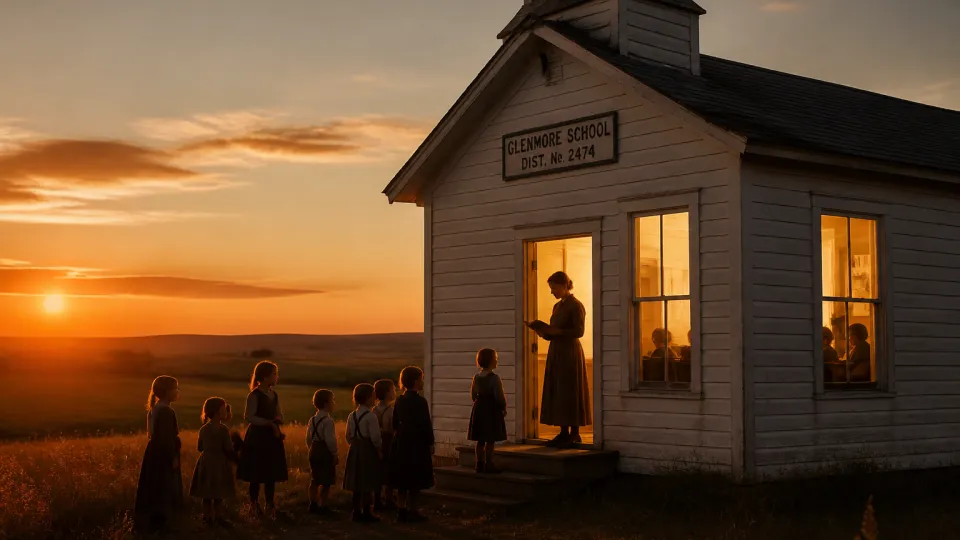
On a wind-scoured afternoon outside Brandon, the silhouette of an old schoolhouse holds its own against a low prairie sun. For decades that modest clapboard building was less a repository of curriculum than a communal hearth: a place where neighbours met, where farmers' children learned their letters between harvests, and where a single teacher stitched together the social fabric of a growing settlement.
That image—of education as public commons—is the lodestar for a region whose schools have continually remade themselves in response to waves of immigration, economic change, and the moral reckoning of Canada’s past. The Westman story is not single-threaded. It moves from one-room classrooms and denominational colleges to consolidated school divisions, colleges, and universities that try, imperfectly, to redress long-standing inequities.
In the late 19th and early 20th centuries, one-room schools dotted the prairie. They were practical answers to a dispersed population: cheap to build, run by teachers who frequently doubled as civic leaders, and steeped in local cultures. Newcomers—Ukrainian, Mennonite, Scandinavian—found ways to preserve language and ritual even as children learned English and arithmetic. Those small schools anchored neighbourhoods; funeral gatherings, agricultural meetings, and political rallies often spilled into classrooms.
Postwar consolidation began to reshape that geography. Buses carried children farther, and larger centralized schools promised broader curricula and better facilities. For Brandon, the emergence of Brandon University and Assiniboine Community College provided fresh anchors. These institutions expanded opportunities for teacher training, nursing, trades and applied learning, and they kept many young people in Westman rather than sending them east. Assiniboine’s trades programs, for instance, have long been tied to local labour needs—plumbing, heavy equipment, ag-—offering tangible pathways into the regional economy.
But progress was not uniform or untroubled. The legacy of residential schools—its rupture of family language, culture and trust—casts a long shadow over any history of education in Manitoba. In Westman, as across the country, the past few decades have demanded uncomfortable work: acknowledging harms, listening to survivors, and building programs led by Indigenous communities themselves. Nearby First Nations such as Sioux Valley Dakota Nation and Waywayseecappo have been central to that conversation. Language revitalization projects, Indigenous-led curriculum development, and campus-based supports aim to create more culturally sustaining spaces for learning. These efforts are less about symbolic gestures than about reweaving relationships between educational institutions and the communities they serve.
Human lives make these shifts legible. Consider the composite of stories shared at community tables: a daughter of prairie farmers who returned from university to teach in her hometown, combining remote learning resources with traditional land-based lessons; a former millwright who retrained through a community college program to teach apprentices; and a young Indigenous parent whose child benefits from an early-years program that blends Dakota language with play-based learning. These narratives underline how education in Westman has been both adaptive and intimately local.
The pandemic accelerated adaptations already underway. Remote classrooms and hybrid models exposed both possibilities and persistent gaps—most notably unequal broadband infrastructure and limited access to quiet learning spaces in rural homes. Library branches in Brandon and smaller towns became de facto learning hubs, offering Wi-Fi, tutoring programs, and adult literacy classes. Community learning has therefore shifted from a physical schoolhouse to a distributed network of supports: post-secondary institutions, public libraries, employers, and family networks.
Looking ahead, the region’s educational resilience hinges on three intersecting ambitions. First, equitable infrastructure: reliable broadband, adequate transportation, and sustained funding for rural schools. Second, curricular and institutional humility: genuine partnerships with Indigenous communities that prioritize language, ceremony, and governance in learning. Third, alignment with the local economy: expanding trades, agri-tech and health-care training while safeguarding pathways to liberal arts and professional programs that keep civic life vibrant.
The stakes are not merely economic. When a school closes or a program disappears, a town loses a place where different generations meet and where civic purpose is nurtured. Conversely, investments in lifelong learning—whether a new apprenticeship intake at Assiniboine or a campus program that supports student parents at Brandon University—rebuild civic capacity.
The old schoolhouse at the edge of town still stands, paint peeling but doors shut for the afternoon. Its presence is a reminder that education in Westman has always been both practical and moral: a set of skills and a way to belong. The challenge now is to design systems that learn from that dual legacy—honouring memory, repairing harm, and preparing young people for a future that will ask them to be both skilled workers and attentive neighbours.
If the prairie teaches anything, it is endurance paired with invention. The next chapter for Westman’s learners will depend on how well institutions, governments and citizens translate that lesson into classrooms, workshops and community centres that are truly for everyone.