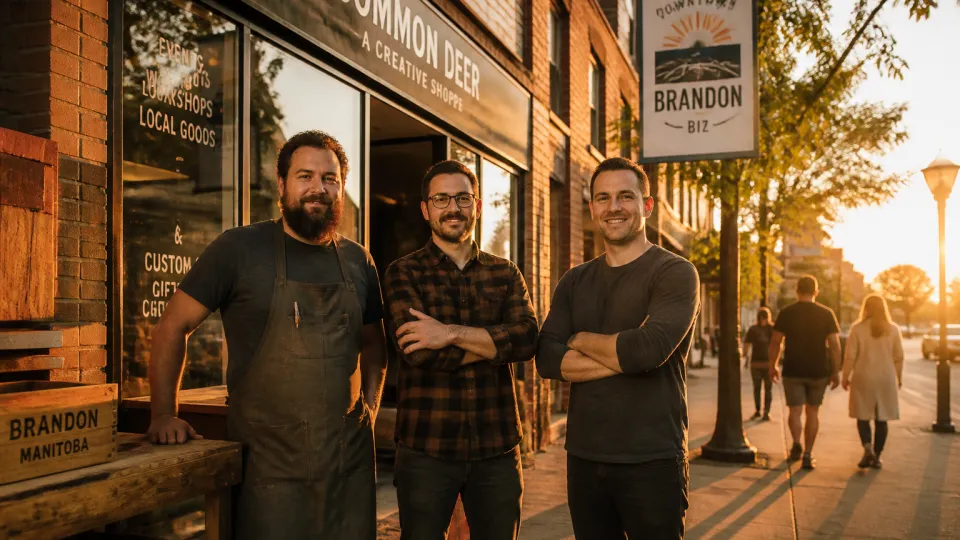
On a late autumn afternoon in Brandon’s downtown, a narrow storefront that once sold bolts of fabric now smells of boiled wool and hot stitchers. Under the skylights of Prairie Loom, a textile studio, spools spin while a young apprentice winds yarn on an old-fashioned wheel. The founder, Sarah Kwan, watches with a careful, satisfied silence.
"People think of as a city thing," Kwan says, hands folded in flour-dusted sleeves. "Out here, it’s also about preserving ways of working that anchor a place." Her studio employs four full-time artisans and hosts weekly workshops that draw participants from as far as Neepawa. Kwan’s business is not large by any metropolitan measure, but its influence—on skill transmission, downtown foot traffic, and the cultural life of the town—is unmistakable.
Across town, Flatland Labs occupies a rehabilitated bank on Princess Avenue. The company, co-founded by Malik Thompson, develops soil moisture sensors tailored to prairie fields. "We started because our neighbors kept asking for something that actually works in heavy clay," Thompson says. Flatland employs eight local engineers and technicians, many of whom are recent graduates who chose to stay in Brandon rather than relocate. Their product helps farmers reduce irrigation costs and informs smarter planting decisions; more quietly, it has anchored a new talent pipeline into Westman’s agricultural economy.
Out beyond Brandon, in a town of 3,000, Hill & Hearth Bakery reimagines the simple loaf as a civic project. Owner Emma Reid partners with nearby grain growers to mill heritage wheats, then offers apprenticeships to high-school students. "We pay attention to where the grain comes from because that reconnects people to the land—and to each other," Reid explains. Hill & Hearth’s Saturday market draws families, revitalizes the main street, and sustains a small network of complementary enterprises—miller, delivery co-op, and a pop-up café.
Taken together, these businesses illustrate the different forms rural entrepreneurship takes: craft and culture, tech adapted to local needs, and place-based food systems. They also expose what remains fragile. Broadband speeds are uneven across the region; when Flatland Labs piloted remote calibration for its sensors, unreliable connections forced in-person visits. Access to capital is uneven: Kwan notes she cobbled together loans and community investment while watching peers in urban centres scale faster.
Yet the impact of these ventures is measurable and personal. Prairie Loom’s apprentices are often younger residents who—having trained in the studio—opt to stay rather than leave for Winnipeg or Calgary. Flatland Labs’ technicians report higher wages than typical rural jobs and the opportunity to work on products with direct agricultural relevance. Hill & Hearth’s apprenticeship program has yielded a registered apprentice who now trains others. These ripple effects change the social architecture of small towns: more after-school activities, more local suppliers, and a revived patience for craft and problem-solving.
Municipal leaders in Brandon frame these changes as part of a larger strategy. "Our role is to remove friction—streamline permits, find vacant buildings, and connect entrepreneurs to mentors," says a city economic development officer, Claire Ducharme. The city’s modest incentives and a nascent coworking hub have helped launch half a dozen ventures in the past three years. But Ducharme acknowledges that long-term success depends on regional networks—shared incubators, pooled training programs, and a coordinated push for reliable digital infrastructure.
There are inevitable trade-offs. A business that succeeds can change a town’s rental market; a tech firm’s demand for skilled labor can create competition for hospitality and care workers. The question for Westman is not whether entrepreneurship is desirable—it already is—but how to guide its growth so it reinforces local strengths and broadens opportunity. That requires nuance: investment in broadband and maker spaces; patient capital that accepts smaller scale; and education partnerships that pair technical training with stewardship of place.
The human stories here resist tidy metrics. Kwan remembers an elderly customer who returned weekly to learn tapestry because it gave her a reason to leave the house. Thompson talks about a farmer who adopted Flatland’s sensor and then volunteered hours at a high school STEM club. Reid notes the shy teenager who now manages the bakery’s weekend rush. These are small transformations, but in places where population decline and service gaps have been a fact of life, small transformations accumulate.
Looking forward, the prospects for Westman hinge on connectivity—digital and human. More than attracting a headline-making startup, the region needs ecosystem work: affordable workspace, reliable logistics, and intermunicipal cooperation that makes scale possible without losing local character. If that work continues, the region’s entrepreneurs will keep doing what they already do well: solving place-specific problems, training the next generation in skills with real value, and creating livelihoods that stay rooted in community.
Back at Prairie Loom, a new apprentice finishes a scarf that will be sold at Hill & Hearth’s Christmas market. The scarf is modest, handwoven in natural tones. Someone will buy it and wear it locally; that ownership of a product and of a place is, perhaps, the most stubbornly practical argument for why entrepreneurship matters in Westman—not as spectacle, but as sustenance for everyday life.