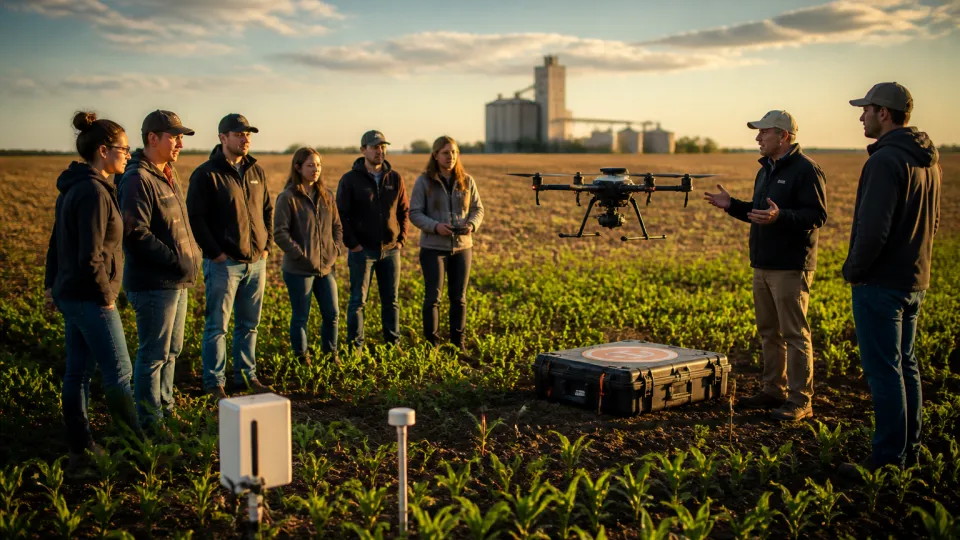
At dawn, the field outside a modest commodity elevator east of Brandon smelled of diesel and brewed coffee. A line of pickup trucks, a battered school bus repurposed as a mobile classroom, and a handful of trailers with tool racks folded into display booths made for a pragmatic kind of pageantry. This was an agricultural showcase, but it did not feel like a Silicon Valley pitch session. It felt like a neighbourly conversation elevated by curiosity.
Organizers had billed the event as a practical test day: sensor networks, autonomous sprayers, cooperative data platforms, and a local seed of something less tangible — new modes of collaboration between farmers, colleges, and small tech firms. It was the sort of gathering that in Westman often begins with a handshake and ends with coffee-stained contracts and a dozen follow-up meetings. What drew people was not novelty for novelty's sake but experiments that promised to ease chronic problems here: labour scarcity, rising input costs, and the fragile economy of mixed grain and pulse rotations.
One early demonstration was deceptively simple. A young engineer, Jamal Singh, crouched over a patch of winter wheat to explain a low-cost soil-moisture sensor his team had developed at Assiniboine College. The device, a cylinder no larger than a coffee thermos, transmits hourly readings to a shared dashboard. 'It tells you when the soil is actually thirsty, not when a calendar tells you to water,' Jamal said. For Evelyn Moore, who farms 1,600 acres north of Brandon and came with her foreman, that data is not an abstraction: it translates directly to diesel saved and days not spent chasing irrigation windows.
Evelyn is emblematic of a generation of prairie farmers who are simultaneously skeptical and pragmatic. She remembers a decade with labour gaps when seasonal workers were scarce and the only option was to buy more equipment or leave fields unharvested. At the showcase she stood near a four-wheeled autonomous implement designed to handle small, repetitive chores. 'I don't want robots to farm for me,' she said, 'but if a machine can open up a window where a young person can learn the business instead of being exhausted all summer, that's worth trying.'
That tension — between efficiency and stewardship, automation and employment — surfaced repeatedly during panel discussions. Dr. Claire Bennett, an agronomist at Brandon University, emphasized that adoption decisions are rarely technological alone. 'We need to think about who controls the data, who benefits from it, and how we train people to interpret it,' she said. Her research group has been piloting shared data commons where neighbors voluntarily pool soil and pest information to get earlier, more reliable regional forecasts. For small farms, the value is collective: a single sensor network can protect dozens of operations from an emerging blight.
The showcase also made room for newcomers to the sector. A student cooperative led by recent graduates offered hands-on workshops for high schoolers and immigrants interested in ag-tech trades. The scene was quietly radical: a room of earnest teenagers learning how to solder sensor boards next to recent migrants who had worked on farms abroad and were now navigating Canadian supply chains. 'People assume is a barrier for newcomers,' said Mariana Alves, who grew up in Brazil and now runs recruitment for a local ag- program. 'But it's actually a low threshold to meaningful work. You can learn to maintain a sensor array faster than you can sit through a four-year degree — and it's work that brings you into community.'
Not everything felt solved. Multiple farmers raised the cost barrier — small innovations can still be out of reach without cooperative financing or public support. There were also questions about consolidation of data by commercial platforms and the potential for inequities when larger operations can afford more sophisticated analyses. Yet the mood at the event was not pitched optimistically; it was cautious and pragmatic. Solutions were framed as incremental: a sensor here, a shared subscription there, a new training program that might retain one more young worker in the community.
The most striking outcome, however, was social. In one corner, a retired combine driver arranged an informal mentoring circle with two young technicians and a soil scientist. They traded jokes, troubleshooting tips, and a story about a failed cover-cropping trial that taught them more than any success. These small human exchanges — the repairs, the late-night phone calls, the pooled truckloads of seed — are the scaffolding by which technology becomes useful.
Looking forward, the Westman region seems poised to do what prairie communities have done for generations: adapt without losing the communal rhythms that make adaptation possible. If local institutions can nudge financing toward cooperatives, if colleges keep opening their labs to farmers, and if data platforms are governed with transparency and local voice, the modest tools demonstrated in that field outside Brandon could ripple into sustained resilience.
The machines and apps were the headline at the showcase, but the more lasting image was a circle of people — different ages, backgrounds, and ambitions — leaning into problems together. That is the innovation that will matter here: not spectacular breakthroughs but a stitched, patient reinvention of how the work gets done and who gets to do it.
For communities across Westman, the question is no longer whether technology can change agriculture; it is whether the change will be shaped by the place and people who live with it.