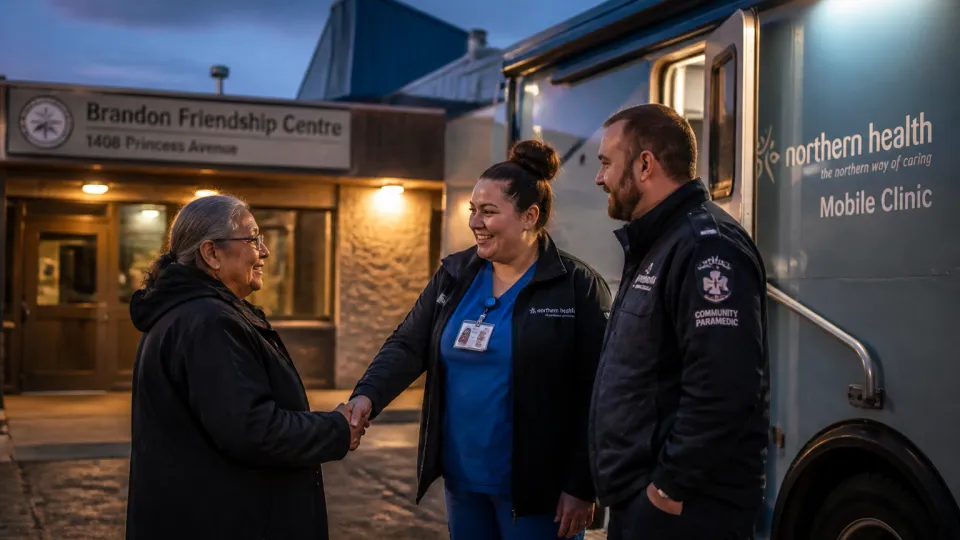
On a raw October morning outside a centre on Brandon's east side, a van with a pale blue stripe opened like a small, deliberate promise. Inside, a nurse practitioner set up a folding table while a community paramedic checked supplies. They were about to run a pop-up clinic: vaccines, chronic-disease check-ins, and a quieter thing that matters as much—time.
"People come because they know us," said Mark Lavoie, a community paramedic who has spent the last four years coordinating mobile visits across Westman. "They come because someone will sit with them, listen, and help make a plan that fits their life here."
This is not spectacle. It is, increasingly, the scaffolding of a regional health system learning to bend toward the realities of rural life. In Brandon and surrounding towns like Neepawa, Virden and Souris, community-driven initiatives—mobile clinics, community paramedicine teams, and local education partnerships—are quietly altering how care is delivered. They respond to a familiar problem: sparse resources, long travel times, and a demographic tilt toward older adults with chronic conditions. But the answer emerging here is not a single silver-bullet program. It is a network of local solutions stitched together by practitioners, educators, and community leaders.
Community paramedicine, one of the most visible of these efforts, repurposes trained paramedics to provide preventive and follow-up care, rather than only emergency extraction. In practice, that means home visits to check on heart failure patients, coordination with family physicians to adjust medications, and connecting isolated seniors with community supports. The measurable outcomes—fewer emergency department visits, better medication adherence—are reflected in local clinics' daily experiences even where long-term data is still being collected.
Mobile clinics have become another pragmatic adaptation. On a weekday they might park outside a high school; on a weekend they’ll be at a farmers' market. The visits are lean and focused: mental-health screenings, wound care, contraception counselling, and vaccinations. "We meet people where they are, literally and figuratively," explained Dr. Asha Kapoor, a nurse practitioner who helped pilot a weekend clinic in Brandon’s downtown. "It's not just about convenience. It's about trust. When you show up regularly, people begin to tell you what really matters."
Those human conversations have produced concrete changes. A middle-aged farmer who had been avoiding the Brandon Regional Health Centre for chronic chest pain was identified at a mobile clinic and fast-tracked to appropriate cardiology assessment. An elderly woman in Virden, previously readmitted to hospital several times for heart failure, reported stability after weeks of paramedic check-ins and medication reconciliation coordinated by her family physician and a community nurse.
Underlying these initiatives is a growing emphasis on workforce development rooted in place. Assiniboine Community College and local health networks have opened stronger pipelines for nursing and health-care aide education in Brandon, emphasizing rural placements and mentorship. "If students train here and see a career, they're more likely to stay here," said Michelle Pierre, a coordinator of community partnerships at the college. Practical training attached to community programs—students accompanying paramedics on home visits, assisting in mobile clinics—turns education into an engine for retention.
Another essential dimension is Indigenous partnership. Westman is home to diverse Indigenous communities, and meaningful progress has required programs that are culturally safe, co-designed, and led by Indigenous health workers. In Brandon, local clinics have begun to incorporate Indigenous wellness practices and to partner with community elders, ensuring that services are not only available but also relevant.
The work is not without friction. Funding remains short-term in many cases, making it difficult to plan beyond pilot phases. Data-sharing across organizations is uneven, complicating efforts to demonstrate impact at scale. And underlying all of it is the provincial challenge of recruiting and retaining primary-care physicians and specialists.
Yet the forward movement is tangible: small projects maturing into predictable services; students choosing local careers; patients whose stories, when strung together, change the contours of care.
"What people want here is a health system that understands where they live," Lavoie said. "They don't want to be shuffled through a system that treats their postcode like an accident. They want continuity. They want relationships."
There is a broader lesson in Westman’s experiments. Systems designed for dense urban settings fail at the margins not because they are wrong, but because they are incomplete. Rural communities demand different architectures: distributed teams, mobility, local training, and partnerships that respect culture and context. When those elements come together, the result is less the heroic rescue and more the steady, patient work of keeping people well where they live.
For Brandon and its neighbouring towns, the next decade will be a test of whether these nascent networks can be sustained and scaled. That requires stable funding, thoughtful policy around rural-health workforce incentives, and continued collaboration with Indigenous partners. The human stakes are clear: fewer late-night rides to emergency departments, better-managed chronic disease, and the quiet dignity of care delivered in a familiar place.
On that October morning, as the van folded up its table and a woman from the neighbourhood hugged the nurse goodbye, it felt less like a program ending and more like an ordinary act of belonging. It is, perhaps, the simplest measure of success: a health system that shows up, again and again, until the community trusts it enough to lean on it.