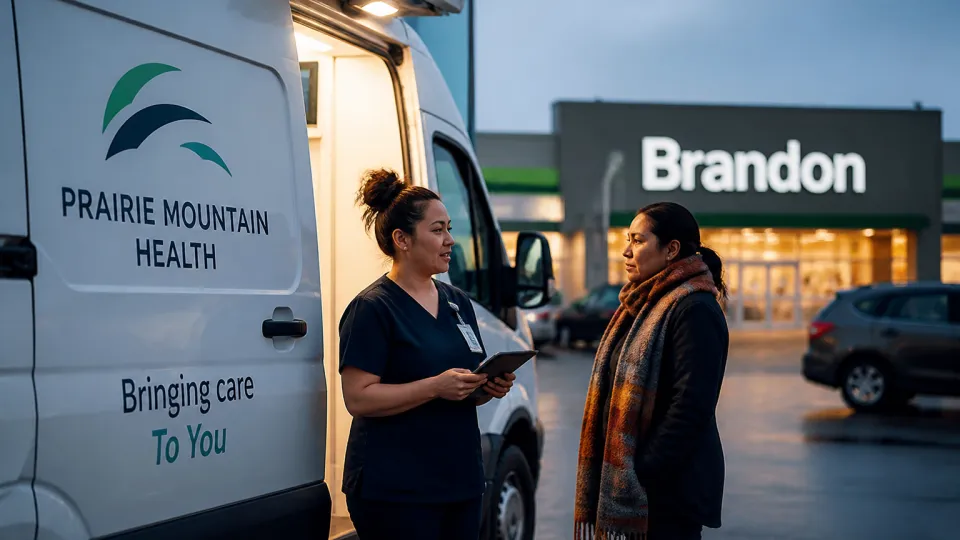
When Maria Côté first climbed into the white outreach van two winters ago, it was because the cough she had ignored for weeks finally became impossible to balance with a single bus route and a day of shift work. The van, painted with a map of Westman towns and the logo of a local health partnership, was parked behind the grocery store where she buys her groceries. Inside, a nurse practitioner took her temperature, listened to her lungs, and arranged a same-week follow-up at a community clinic.
"If that van hadn't been here, I probably would have waited until it was worse," Maria told me, wrapping a wool scarf around her neck. "It's not just convenience. It's hope."
Across Brandon and the surrounding patchwork of towns and farms, that van is one of several pragmatic experiments in rural care that have quietly reshaped how people access health services. What began as a collection of stopgap responses to long-standing gaps has migrated into an ecosystem of community-driven projects: mobile clinics, community paramedicine, integrated mental-health hubs, and partnerships with Indigenous organizations. Together they are revealing a different logic for health delivery—one built on proximity, relationships and practical improvisation.
The story of Westman's reinvention is both modest and urgent. Brandon Regional Health Centre continues to be the clinical heart of the region for emergencies and specialty care, but everyday health is increasingly happening in living rooms, school gyms, band offices and farmers' markets. Community paramedics in several municipalities now make scheduled home visits to check vital signs and medication adherence for elders who would otherwise face long drives and weathered roads. One program coordinator described a recent visit to an octogenarian who said simply, "You are my clinic today." The comment landed like a soft indictment and a compliment: the health system arrives where people live.
Mental health, too, has become a priority shaped by local realities. A small coalition of therapists, Indigenous counsellors and youth workers formed a drop-in hub downtown after several suicides among young adults in nearby towns prompted community alarm. The hub does not promise cure; it offers an entry point. "People come for coffee and stay for a conversation," a counselor said. "They start to trust us and then we connect them to longer-term supports." The hub's model—low-threshold, culturally responsive, and peer-led—has attracted attention from neighboring municipalities looking for alternatives to emergency-only responses.
There are concrete advantages to this ground-up approach. First, it shortens time to care. A diabetic patient who would have had to wait for a clinic appointment can see a nurse practitioner at a pop-up clinic three days later. Second, it embeds cultural safety: initiatives that include Indigenous health workers and elders have changed the tone of care for Indigenous residents, improving both uptake and trust. Finally, it leverages local capacity: volunteers and retrained staff from Assiniboine Community College and other training programs provide the human scaffolding for many efforts.
But these innovations are fragile. Funding is patchwork—municipal grants, short-term provincial pilots, donations, and the sheer will of organizers. When a mobile unit's generator failed last winter, scheduling was interrupted for weeks. Recruiting clinicians willing to work outside urban centers remains a persistent challenge. "We can do a lot with ingenuity," a nurse leader in Brandon told me, "but we also need stable investment and policy that recognizes care happens beyond hospital walls."
The human element binds these initiatives. I met a paramedic who now spends two afternoons a week checking on frail patients at home, carrying a blood pressure cuff and a box of PPE. "I started as an ambulance driver," she said, "but what stays with me are the stories—people telling me they're worried about heat in the summer or their neighbour's mental state. You can't triage those calls the old way." In another town, a young Indigenous outreach worker who grew up locally described how including traditional practices alongside clinical screening changed a patient's willingness to follow through with medication and counselling.
So what might scaling look like? Community leaders in Westman are calling for three shifts: sustained provincial funding targeted to community-based roles; formal recognition of community paramedicine and outreach work as billable, funded services; and expanded partnerships with local post-secondary institutions to create career pathways for rural health workers. Importantly, they want policy that treats these programs not as temporary pilots but as foundational infrastructure.
These changes won't erase systemic challenges—workforce shortages, long-term care deficits, and socio-economic barriers remain stubborn—but they point to a pragmatic ethic: invest where people live and build care around relationships. For Maria, the outreach van meant a diagnosis and a treatment plan; for the community, it is a test case for what rural care can be when it is designed by the people it serves.
In the end, the small performances of care—paramedics pausing for a neighbourly check, an outreach worker sharing a tobacco tie and a conversation—add up. In Westman, healthcare is less about a single breakthrough and more about a reorientation: toward proximity, trust and the labor of sustaining ties. That may be the most durable prescription for rural places that have long been asked to do more with less.