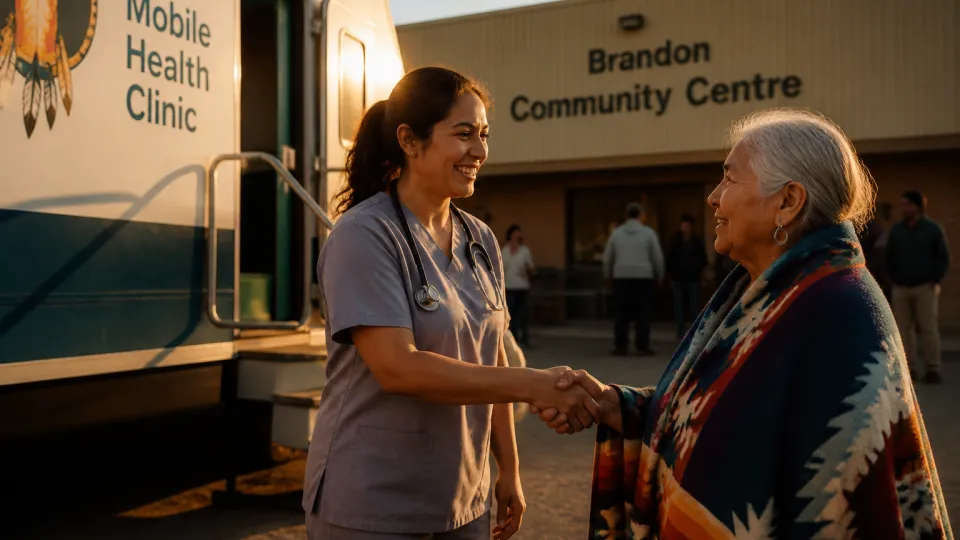
It is just after dawn when the mobile health van pulls up to the parking lot outside the centre in Brandon. The vehicle is unassuming: white, a municipal decal, a ramp that folds down like a small bridge. Inside, a nurse checks the schedule on a tablet, then stacks the last of the flu shots in a cool box. To a passerby it is a pragmatic piece of municipal equipment. To the neighbourhood it has become a daily promise — that someone will listen, that someone will try.
"People come here because it's familiar," says a nurse practitioner who has worked on outreach routes across Westman for five years. "They talk in the parking lot, not in the emergency department. We’ve learned how to make care fit into their lives, instead of the other way around."
Across Brandon and its surrounding rural communities, that inversion—placing health services where people can access them and shaping them to local rhythms—has quietly become the centerpiece of several community-driven initiatives. These programs are not a single silver-bullet policy. They are an ecosystem: mobile clinics, community paramedicine, culturally safe wellness hubs co-designed with Indigenous partners, and local navigators who translate both language and the experience of care.
The human stakes are immediate. In the small farming towns that rim Brandon, winter weather, long distances and thin public transit mean a simple blood pressure check can balloon into a full-day ordeal. For elders living alone, the barrier is often not distance but trust. "After my husband died, I stopped going to the clinic," says Margaret, a retired teacher who now meets the outreach nurse at the market every other Wednesday. "I thought nobody would understand. But she remembers my favourite tea. That helps."
These programs have emerged from a mixture of municipal initiative, philanthropy and provincial funding, but their power is local: they are staffed by people who live here, trained to read not only charts but community grievances and grief. Community paramedicine teams, for instance, have expanded the remit of first responders to provide routine follow-ups, chronic-disease management and post-discharge checks. That shift keeps people healthier at home and frees up the Brandon Regional Health Centre for acute care.
Equally transformative are the relationships with Indigenous communities. Clinics and wellness spaces that started as stopgap services have matured into partnerships where local Elders, health workers and clinicians sit at the same table during planning sessions. "When care is designed with families and Elders, not just for them, uptake changes," says a community organizer involved in one such collaboration. "It becomes care that reflects local languages, customs and priorities."
Consider the story of a middle-aged farmer who, after a heart scare, began receiving scheduled remote-monitoring check-ins and home visits from a community paramedic. He had missed appointments for years; he feared judgment. After months of patient outreach, he started attending group sessions at a nearby wellness hub where an Elder led conversations around nourishment and grief, and a nurse taught medication management. Today he tends his fields again and keeps a simple log of symptoms on his kitchen counter. "It's not how we thought we'd get help," he says, "but it's what worked."
The gains are tangible yet subtle: fewer non-urgent trips to the emergency room, better medication adherence, fewer missed specialist appointments because a local navigator coordinates travel and childcare. Quantifying these improvements remains an ongoing challenge. Data systems are fragmented, and measuring the value of trust is not as neat as counting injections. Still, regional administrators point to steadily rising usage of outreach services and a decline, in some communities, of repeat emergency visits for problems that could be managed at home.
Scaling these local successes, however, means confronting structural barriers. Workforce shortages are acute: recruiting clinicians to rural practice requires incentives and a sense of professional support that many small towns currently lack. Funding cycles are short, which makes long-term planning difficult. Broadband gaps constrain telehealth; privacy and data sovereignty concerns complicate information sharing with Indigenous partners.
Yet the people building these initiatives are pragmatic and strategic. They are training community health workers from within local populations, embedding cultural safety training into continuing education for clinicians, and piloting shared-care agreements between primary care clinics and the regional hospital. They are also experimenting with blended funding—mixing municipal, provincial and philanthropic dollars—to protect core services from political shifts.
If there is a lesson here, it is that rural healthcare renewal in Westman is less about importing urban models and more about amplifying local intelligence. The mobile van, the paramedic, the Elder’s session and the navigator’s text messages are small interventions. In combination, they remake the geometry of care so that it radiates outward from the people it serves.
Looking ahead, leaders in Brandon hope to convert pockets of into a durable network: shared data platforms that respect local governance, a trained cohort of community health workers, and provincial policy that prizes continuity over episodic relief. Those are heavy lifts. But the morning routine at the clinic — the cups of tea, the patient who arrives early, the nurse who knows the child’s birthday — suggests a sturdier foundation than any policy memo could create: a community that chooses, daily, to care for itself.
"This work is slow," the outreach nurse says, tucking a bandage into a sleeve. "But it’s honest. And when people see someone show up, again and again, they start to believe that care is for them, too."
For Brandon and its neighbouring towns, that belief may be the most consequential innovation of all.