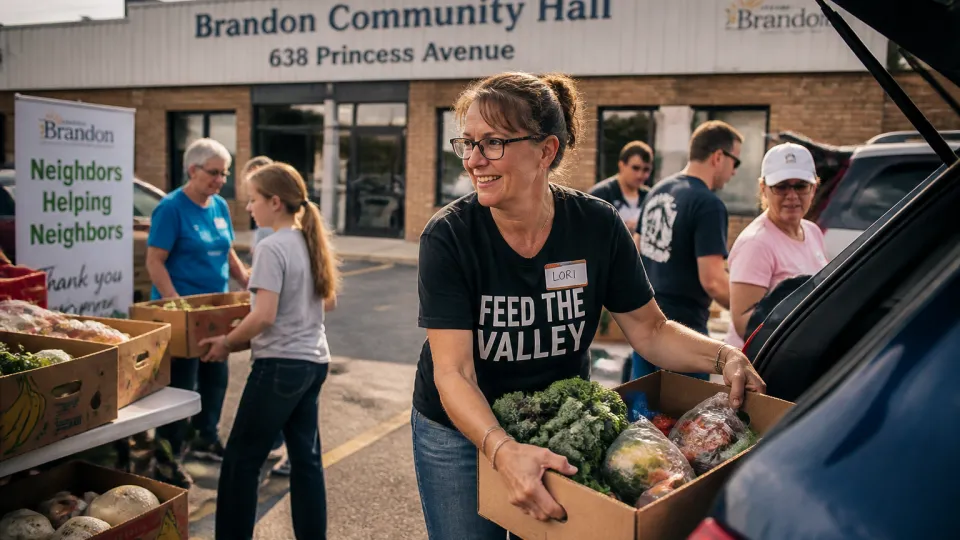
On a late March morning at a modest hall on the edge of Brandon, several tables are already stacked with cardboard boxes of produce. A woman in her seventies methodically double-checks a list while a university student toggles a spreadsheet on a laptop. Around them, people flow in and out—families collecting food, retirees offering quiet instructions, newcomers asking questions in a mix of English and Ukrainian. The scene feels familiar to anyone who relies on the unseen labor of volunteers: calm, efficient, held together by habit and a stubborn, generational ethic of service.
What is less visible is how the forces that make that ethic possible are changing. Across Westman, from the agricultural towns that ring Brandon to the smaller hamlets along the Trans-Canada, volunteers remain the scaffolding of local life—running food banks, driving seniors to appointments, staffing festivals and emergency response. Yet the patterns of who volunteers, why they do it, and how long they stay are shifting in ways that both sustain and strain the network of help that communities have long depended on.
"We used to have people sign up for the same shift every week for years," says a volunteer coordinator who has worked with several Brandon-area charities. "Now we see more people who want short, meaningful tasks—two hours, once a month, or a project-based commitment. That has real implications for scheduling and institutional memory."
This transition mirrors broader national and provincial trends: overall volunteer rates have fluctuated over the past decade, shaped by an aging population, changing workplaces, and the disruptive aftershocks of the pandemic. In Westman, the problem is local and embodied. Older volunteers—many with decades of experience—remain deeply committed, but they are retiring from heavy lifting. Younger residents, including students and newcomers, bring energy and new skills but more episodic availability. The result is a hybrid volunteerism that demands different forms of management.
Take the local food distribution effort in Brandon. When floods threatened parts of the region years ago, neighborhood committees and church groups mobilized volunteers around the clock. That all-hands-on-deck ethos has fortunately proved resilient: neighbours still rally in emergencies. But day-to-day operations—inventory management, grant applications, volunteer training—require continuity. Organizations report spending an increasing share of their limited budgets on staff who can coordinate volunteers, maintain databases, and run background checks. Those are often invisible costs, funded by grants that are neither guaranteed nor long-term.
The human stories reveal the stakes. Evelyn, 72, has run a community kitchen for more than two decades. "I love it," she says, "but it's getting harder. People help during the holidays, but the steady helpers are thinning out." Across town, Liam, a 26-year-old software developer who came to Brandon for a job, volunteers on weekends teaching digital literacy. "I want my time to matter," he explains. "Micro-projects let me see outcomes quickly, and I can fit them around work. But the organizations I want to support need sustained volunteers, which can be frustrating."
Volunteering is also changing in character. Skilled, short-term contributions—legal clinics run by retired lawyers, accounting help from small-business owners, marketing advice from younger professionals—have become more common. This skills-based volunteering elevates capacity but can create mismatches: organizations still need routine hands-on support that doesn't require professional training. Meanwhile, informal mutual-aid networks that blossomed during the pandemic—neighbours texting to offer groceries or childcare—have faded in some places as life returned to normal.
There is , too. A handful of Westman initiatives have begun to rethink volunteer infrastructure: centralized matching platforms, shared training modules across charities, and intergenerational programs that pair students with older mentors. Municipalities, recognizing the economic value of unpaid care, are experimenting with small budgets for volunteer coordinators at local agencies. Businesses in Brandon are increasingly offering paid volunteer days, making corporate resources available for community projects.
Yet these promising steps do not fully close the gap. The region's service needs—ranging from rural transportation to mental-health outreach—are rising even as the pool of steady volunteers narrows. The emotional toll of sustained volunteer labor is another concern; burnout among long-term volunteers can lead to abrupt service disruptions when a key person steps back.
If Westman is to preserve the services that stitch its communities together, it will require a more intentional approach. That means investing in the often-unseen infrastructure of volunteerism: training, coordination, recognition, and pathways that convert episodic interest into lasting commitment. It also means acknowledging the diversity of motivations—social connection, skill development, civic duty—and designing roles that respect different availabilities.
The evidence is human and subtle. When a volunteer finds purpose in teaching someone to use a smartphone, or when a retired mechanic passes on not only tools but trust to the next generation, the community is strengthened in ways that no single policy can quantify. Westman's challenge is to harvest those moments, building systems that make them easier and more sustainable.
Over the next decade, the shape of service in Brandon and its neighbours will be determined not just by budgets but by imagination—how communities reconfigure roles, share coordination resources, and translate sporadic goodwill into enduring public goods. The quiet revolution in volunteerism is underway; its success will be measured in small, cumulative acts: the uninterrupted food box on a kitchen table, the steady hand that drives an older neighbour to an appointment, the student who returns year after year to teach the same class. Those acts keep the fabric of Westman whole. They deserve both our gratitude and our deliberate stewardship.