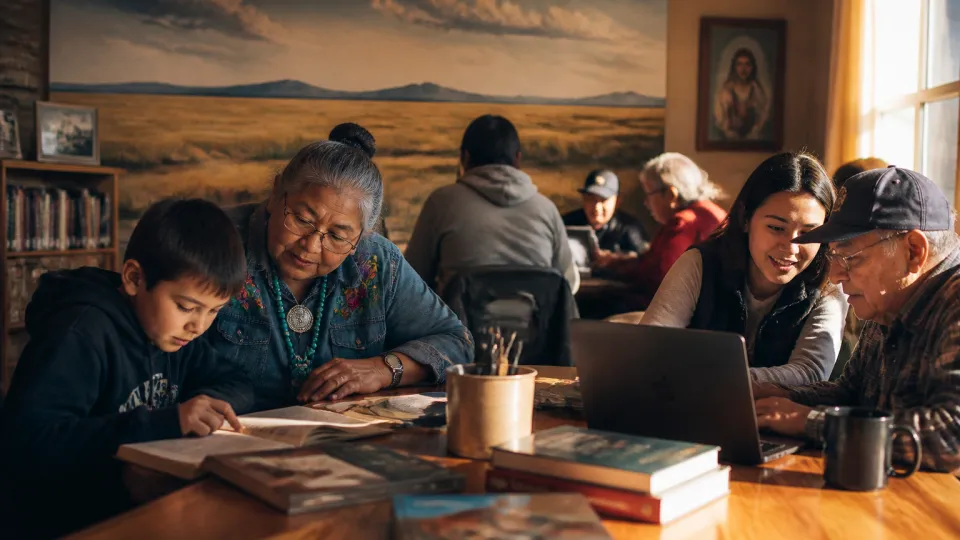
On a damp Tuesday morning in central Brandon, a nine-year-old named Noah and Elder Mary Sinclair sat side by side at a scarred wooden table, calibrating a cheap microscope between them. Noah, who wrestles with reading at school, was describing the tiny plant cells he’d just seen; Mary translated the moment into a story about the river that fed their ancestors’ gardens. It was the kind of exchange that happens not in a formal classroom but in the porous spaces where lives meet: the back room of a former bakery, now the Prairie Learning Exchange.
The Exchange is the human answer to a statistical question. Brandon and the surrounding Westman region have long faced uneven access to educational resources — shrinking rural schools, rising numbers of newcomers, and intergenerational gaps between academic curricula and local knowledge. Launched three years ago by a coalition of volunteers, Brandon University faculty, Westman Immigrant Services, and retired educators, the Exchange converted a city storefront into a hybrid learning space offering after-school tutoring, adult literacy classes, Indigenous knowledge circles, and a small maker space.
"We kept hearing the same thing: people were showing up wherever learning looked most like them," says Sarah McIntyre, the Exchange's coordinator. "So we made it as familiar and useful as possible. That meant pots and plants, as much as phonics and job applications."
What distinguishes the Exchange from conventional tutoring programs is its insistence on contextualized learning. A typical afternoon might begin with a Grade 6 math session focused on budgeting for a garden, followed by an English class where newcomers practice job interview answers, and close with an evening cultural gathering led by local Elders. Students come for discrete help — multiplication tables, résumé formatting — and leave with a broader sense of belonging and purpose.
Teachers and volunteers emphasize measurable outcomes. According to the Exchange’s annual report, over 200 residents used the space in the last year; among K–8 participants, 68 percent showed one or more grade-level improvements in reading or numeracy within six months of regular attendance. For adult learners, the space has helped dozens complete high-school equivalency testing and connect to employment or training at nearby Assiniboine Community College.
These numbers, while small in absolute terms, are important for a city of Brandon’s scale. "It’s not just about test scores," says Dr. Derek Kowalski, a professor at Brandon University who led the program evaluation. "It’s about lowering barriers to access and decoupling learning from the anxiety people associate with formal systems."
Human stories illustrate that point. Take Eva Hernandez, a single mother from a recent immigrant family, who found the Exchange through a newcomer orientation. "I needed help with English for work," she says, "but what I got was a place where my daughter could do homework while I learned, and I met other mothers who knew how to help with childcare and job searches. I passed my first certification last month." Or consider retired teacher Joan Peters, who volunteers twice a week. "I thought I was finished with teaching," she admits. "But here I learned how to listen differently — to honor an Elder's way of explaining a concept, or to let a teenager lead a project."
A deliberately collaborative governance model has been central to the Exchange’s durability. A steering committee of community members, educators, university students, and local employers meets monthly. Employers, from the downtown co-op to a nearby agri-tech startup, help design short, skill-focused courses so that learners gain immediate employability. Local Indigenous leaders guide cultural programming and ensure that programming respects protocols and knowledge-sharing boundaries.
remains the program’s chief concern. The Exchange survives on a patchwork of small municipal grants, foundation funding, and grassroots fundraising. That precariousness shapes decisions: organizers invest heavily in volunteer training to magnify limited paid staff, and they prototype fee-for-service workshops — computer literacy classes for seniors, workplace safety modules for small businesses — to generate modest revenue without excluding low-income participants.
Looking forward, the Exchange aspires to be more than a neighborhood experiment. Leaders are negotiating satellite collaborations with rural schools in Westman and exploring digital programming to reach families in the surrounding farms and towns. There is also a quiet advocacy agenda: translating local successes into policy proposals that recognize community-run, culturally responsive learning as a complement to formal education.
"If we want education to be resilient, it has to be braided into daily life — into kitchens, workplaces and Elders’ stories," McIntyre says. "That doesn’t replace schools. It makes them part of a living ecosystem."
For Noah and Elder Mary, the microscope was a small victory. Noah read aloud a sentence about chloroplasts and looked up to find Mary’s gentle nod. Around them, the Exchange hummed — a place where learning was practical, relational, and unfinished. In a region negotiating economic shifts and demographic change, such spaces don't just teach; they reimagine what education can be when it grows from the people it serves.
The question for Brandon and the broader Westman region is whether the experiment can be translated into systemic supports — funding models, policy recognition, and partnerships — that allow these porous, human-centered learning spaces to thrive beyond the lifetime of any single grant or volunteer cohort. For now, the Prairie Learning Exchange stands as evidence that, with thoughtful design and community ownership, education can become both a tool for individual advancement and an instrument for civic repair.