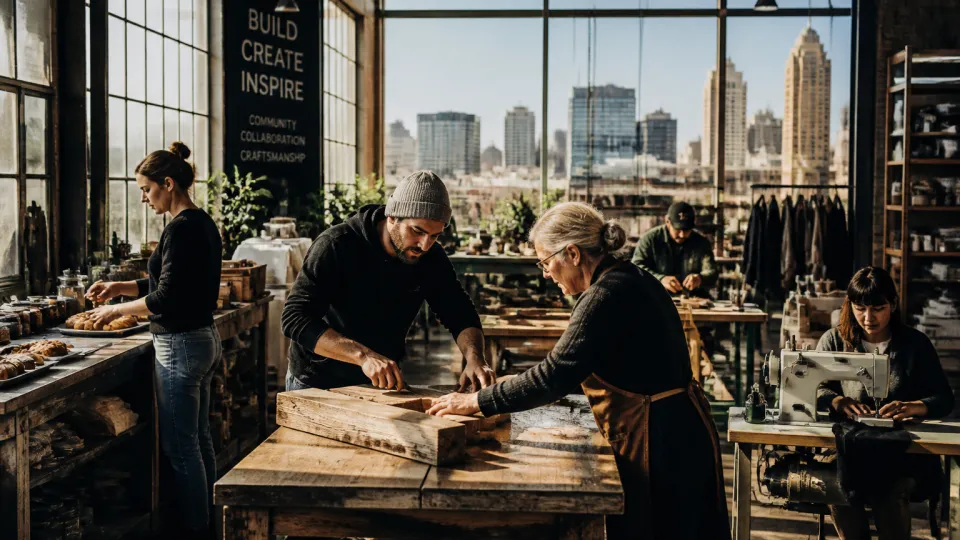
On a gray late-winter morning, the old rail-side warehouse at the edge of downtown Brandon smells of espresso and sawdust. Light slants through high industrial windows onto a series of workbenches: one holds a CNC router, another a row of sewing machines, and a third is crowded with loaves from a small-batch bakery proofing beside tins of canola-based soap. A hand-painted sign over the door reads Prairie Commons, but the people inside call it the Grainery.
The Grainery began as a pragmatic answer to a familiar rural problem. Credit is tight, specialized equipment is expensive, and the path from an idea to a viable product often ends at an unfulfilled promise. What started as a conversation between Maya Singh, an agricultural engineer who moved to Brandon from Winnipeg, and Tom Lavallee, a Métis carpenter and machinist, became a cooperative makerspace where shared tools and coordinated training make feasible.
'We didn't want to start another shop,' Maya says, handing a customer a loaf stamped with a little wheat logo. 'We wanted to change who could start one. That meant lowering the cost of entry and building a social scaffold—mentors, markets, and a network.'
That scaffold is tangible. Assiniboine College runs a modular evening class in the Grainery teaching Basic Food Safety and Shop Safety; a retired machinist, Earl Benson, runs a weekly lathe clinic; and a cohort of newcomers to Brandon operate a cooperative food micro-business. Together they share a freight elevator, a commercial cold room, and a digital storefront that aggregates their products to buyers in town and Winnipeg. Access to these shared assets has, in under three years, allowed a dozen micro-businesses to graduate from experimental to profitable.
here is not a flashy product but a set of frugal, reciprocal practices. Instead of each woodworker buying a dust-collection system, the Grainery invested once and opened bookings. Instead of a single baker leasing a commercial kitchen, three rotating bakers split the cost, allowing one to focus on gluten-free sourdough for local cafes while another develops fortified prairie blends for school lunch programs. The makerspace also partners with area farmers who drop off surplus grain or seed spent from pressing; those materials become compost, packaging material, or an ingredient in a line of high-fiber crackers marketed as 'Westman Shelf' products.
For Sofia Perez, a newcomer who fled economic instability in El Salvador, the Grainery was less an incubator than a lifeline. She trained in the kitchen, learned to scale recipes, and now supplies pastries to two downtown coffee shops. 'When I arrived I had the recipe and the will, but not the oven or the permits,' Sofia says. 'Here I learned the rules and found the people who would buy my first batch.' Her story is one of many: youth learning carpentry from elders, farmers experimenting with value-added products, and displaced workers retraining as machinists for the first time.
The community effect is measurable beyond anecdotes. The shared model reduced startup costs by a factor of three for Grainery members, according to the cooperative's internal accounting, and the downtown address has helped foot traffic pick up on an otherwise quiet block. More subtly, the makerspace has created a social rhythm: a morning rush of students and seniors, mid-day deliveries from partner farms, and evening classes where ideas are tested and recombined.
That recombination—cross-pollination between disciplines—is the makerspace's quiet innovation. It catalyzes product ideas that no individual would have conceived alone: a dining-ware line milled from reclaimed grain-bin planking; a line of plant-based room diffusers using prairie herbs gathered by local youth; a mobile repair program that keeps agricultural equipment running between harvests. Each of these keeps value in Westman rather than exporting it to larger urban centers.
Still, the Grainery faces constraints. Municipal zoning, access to affordable industrial power, and the constant negotiation of shared governance all require attention. Maya and Tom are pragmatic about growth: scaling without losing the cooperative ethos is their foremost concern. 'If we become just another landlord, we lose the thing people come here for,' Tom says. They are piloting a satellite program with a small town in the Riding Mountain corridor, testing a light-touch model that sends a Grainery trailer with tools and a facilitator for six-week rotations.
Looking forward, the makerspace points to a broader shift in how Westman thinks about economic resilience. Rather than solely courting large employers, communities can stitch together small-scale manufacturing, food processing, and repair services that are locally rooted and adaptive. Policy that supports shared infrastructure—affordable industrial electricity, access to small grants for co-ops, and streamlined food and safety permits—could multiply these experiments across the region.
Back in the warehouse, Sofia wraps a box of pastries bound for a local school fundraiser. Earl tunes an old lathe that will shape the next batch of cutting boards. Outside, the snow crunches, and at a nearby café a barista slides a Grainery loaf across the counter. The makerspace is not a miracle cure for rural decline, but it is a pragmatic invention: a place where tools, knowledge, and trust circulate, and where a community learns to make more of what it already has. That quiet making, people here hope, will keep more talent, more ideas, and more value right where the prairies meet the city.