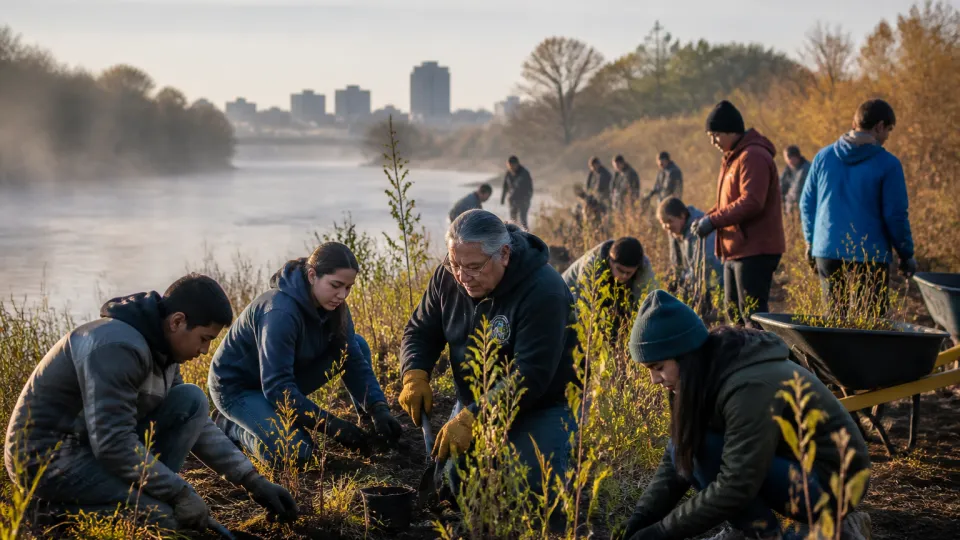
At first light, the Souris River looks as if it remembers another century. Mist curls off slow water; reeds and poplar trunks stand like a patchwork of histories. On the bank, a small knot of people bends to the earth. There are rubber boots, a battered wheelbarrow, and a chorus of low, practical conversation about roots and soil. They are planting willows and dogwood to knit the bank together, but what they are doing feels bigger than the sum of saplings and spade-work. It is a rehearsal for a different relationship between a prairie city and the land that cradles it.
The group is part of the Prairie Roots Collective, a community initiative begun three years ago in Brandon and expanding into neighbouring Westman communities. Its work spans riverbank restoration, an urban composting pilot, and a series of workshops where Indigenous knowledge-keepers, farmers, municipal staff and university students translate ecological stewardship into everyday practice. The project is unglamorous in the best way: slow, rooted, and insistently local.
“I grew up fishing here,” says Noah Chiu, a Brandon University student who helps coordinate volunteer crews. “I watched the bank wash away a little every year. You don’t notice the loss until one spring it’s different. We needed to stop fixing things with trucks and start fixing them with people.”
Prairie Roots began after a particularly bad thaw in 2021 accelerated erosion along urban sections of the Souris. A handful of neighbours organized a cleanup and shored up a collapsed path. The response was practical and immediate, but it also surfaced a larger opportunity: if residents could divert organic waste and rebuild riparian habitat simultaneously, the city could reduce flood risks, improve water quality and build local climate resilience.
The Collective now reports tangible outcomes. Volunteers have planted roughly 2,500 native shrubs and trees and stabilized close to eight kilometres of vulnerable riverbank. Their urban organics program, run through neighborhood drop-offs and a small-scale municipal partnership, has diverted some 30 tonnes of household food scraps from landfill in the first year. Brandon University’s environmental science lab monitors invertebrate diversity at restored sites and has documented a steady uptick in pollinator activity where native plantings have taken hold.
Numbers tell a part of the story; the human side tells the rest. On a recent Saturday, the planting crew included a retired grain farmer who has spent his life on the land, a single mother juggling evening shifts and a toddler in a pink snowsuit, an elder who brought tobacco and a prayer, and university interns tracking survival rates of transplants. “We’re not just planting willows,” the elder said quietly. “We’re planting a memory of how to care.”
That intergenerational work is deliberate. Prairie Roots built governance structures that share power—community councils oversee site selection, and an advisory circle includes Indigenous knowledge-keepers who guide species choice and timing to align with seasonal cycles. “Modern restoration practices can miss the obvious,” says Dr. Hannah Morales, a Brandon University ecologist who consults with the Collective. “An alder planted at the wrong time will look good in a grant report but fail in its second year. Working with land-based knowledge anchors the science.”
The Collective’s composting program has had its own surprises. What began as a pilot behind a community centre quickly turned into a small local circular economy. Households drop off food scraps; apprentices from a local training program turn them into finished compost; community gardens and a few small farms buy or trade the soil amendment. The result: less methane from landfill and more soil resilience on urban plots and marginal fields.
But the work is not without friction. Funding is patchwork—municipal seed grants, small philanthropic gifts and crowdfunding for specific seasons. Volunteers ebb with the calendar; winters are especially lean for manpower. And the region’s climate variability means some plantings fail, requiring patience and rethinking rather than headlines.
Prairie Roots is explicit about those limits. Its strategy is not to promise quick fixes, but to build durable processes: training programs for local contractors in ecological planting, a replicated model for community-scale compost hubs, and an advocacy arm pushing for municipal policy changes such as expanded organics collection and green-infrastructure subsidies. The Collective has begun conversations with neighbouring municipalities—Neepawa and Minnedosa have sent delegations to observe—signaling a desire to scale in ways that respect local conditions.
There is a subtler payoff emerging: new civic rhythms. On workdays, people who rarely meet otherwise are elbow-deep in the same clay. Town halls that once revolved around development concessions now include conversations about where stormwater goes and how parks can be engineered for both play and flood mitigation. “We’re learning to think in seasons,” says Councillor Lisa Martin, who has supported municipal pilot funding. “That changes planning. It changes how we budget and how we imagine growth.”
Looking forward, Prairie Roots is betting on translation: turning experimental fixes into municipal policy, apprenticeships into jobs, and creekside plantings into ordinary maintenance. The effort reframes resilience not as an emergency fund but as a set of hands that know how to repair a bank, compost a kitchen, and listen to each other.
On the riverbank, a willow’s fragile branches are taped to stakes; volunteers sprinkle soil, tamp with gloved hands, and pause to watch a pair of kingfishers flash over a sliver of open water. The work is small in any one moment; accumulated over seasons, it rewrites the margins of a place. For Brandon and the wider Westman region, that slow rewriting may be the most powerful and practicable strategy they have.
“Resilience isn’t dramatic,” the elder said, watching the saplings. “It’s what you teach your neighbour to do.”