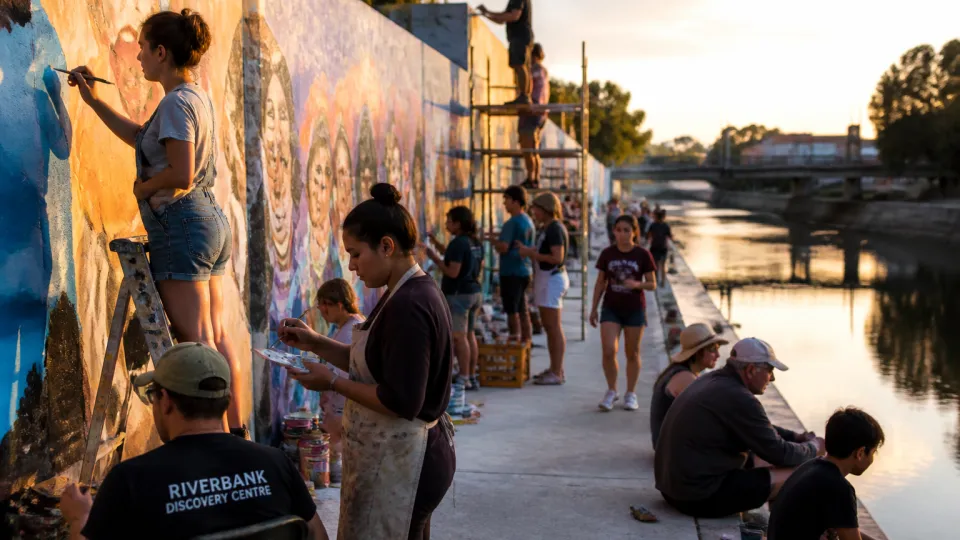
On a late spring morning, sunlight pooled across a former bakery on downtown Brandon's main street. Brushes clicked against jars. A boom box hummed an old country tune while a teenager traced the outline of a mural that would stretch the length of the block. At a folding table near the window, Margaret Sinclair, 78, sat with a notebook and a thermos of tea, telling a story she had not told out loud in decades. The room smelled of paint, coffee and something else — the small, specific scent of a remaking itself.
That room belongs to the Riverbend Arts Collective, a grassroots initiative started in 2020 by six local artists and organizers who wanted to respond to the twin shocks of economic downturn and pandemic isolation. Their idea was simple and stubborn: convert underused downtown storefronts into accessible studios and program space, hire local artists as mentors, and reach outward with public art and community workshops. Five years on, what began as a patchwork of pop-ups now functions as a durable node of cultural life in Westman.
The collective's work unfolded along three intertwined lines: place-making, apprenticeship and storytelling. The place-making piece was visible — color returning to brick facades, window displays that doubled as galleries, and murals that turned banal alleys into destinations. A Riverfront Mural Project commissioned 14 works across Brandon and nearby towns in the first two years, each conceived in collaboration with neighborhood groups. One mural, painted with schoolchildren from a north-end elementary school, depicts a ribbon of the Assiniboine River curling around stylized local wildlife and a ledger of names gathered from the community's oral histories.
Apprenticeship proved to be the quiet engine of the work. The collective created a paid summer apprenticeship program for artists aged 16 to 25, providing studio time, basic business training and access to clients for commissions. Earl White, 22, who joined the first cohort, remembers arriving unsure whether art could be more than a hobby. He left with steady commissions to paint storefront signs and a small online shop. 'Before this program I painted in my bedroom', he said during a recent visit. 'Now people bring me projects and the confidence to say yes.'
Storytelling tied the visual work to memory. The collective hired a small team to run an intergenerational oral history project that trained teenagers to record elders talking about local traditions, immigration, farming life and the changing river. Those recordings were sampled into a multimedia installation at the downtown farmers market, where shoppers could walk through narrated scenes while viewing the photographs and textiles that accompanied them. For many elders who participated, the experience was quietly transformative. 'My grandchildren were sitting there, listening to me talk about the way summers used to be', Margaret said. 'I felt heard in a way I never was before.'
The initiative has not been without friction. Funding cycles are short, fundraising takes time and volunteers burn out. Small business owners initially worried that murals and studios would mean less foot traffic for them during construction. Lila Chen, who runs a bakery two doors down from one of the studios, said she was skeptical at first, but later noticed more customers and a fuller evening economy. 'The street feels alive again', she said, 'and that matters for business and for people.'
Measured impact is modest but meaningful. The collective reports more than 1,200 participants in workshops and programs, 24 public artworks installed in Brandon and surrounding towns, and roughly 50 apprenticeships and continuing mentorships offered since 2020. Beyond those numbers are patterns: storefront vacancies filled, teenagers describing art as a viable pathway, elders reconnecting with neighbours, and a downtown that stays animated after office hours.
City leaders have started to listen. A municipal cultural strategy adopted last year identified small-scale creative infrastructure as a priority, and the Riverbend Collective has been part of consultations about adaptive reuse incentives and simplified permitting for mural work. For the collective, municipal acknowledgement is necessary but not sufficient. Program director Maya Lemoine insists that the next phase must shift from episodic grants to stable operational funding, partnerships with area schools and regional touring shows that bring work to Virden and Neepawa.
What makes this effort notable is not that it brought art to a small city — many communities do that — but that it reframed art as civic infrastructure. When a mural anchors a block, when a youth apprentice earns a first commission, when a grandmother hears her own voice played back in a market pavilion, the outcome is less decoration than social durability. The arts become a language for people to see and be seen.
Looking ahead, the collective plans to incubate a permanent community arts space that would house studios, a small performance venue and a mobile arts trailer to serve rural hamlets. The obstacles remain: securing long-term funding, avoiding cultural burnout, and preserving the grassroots ethos as the initiative scales. Yet if the last five years are any guide, the model is both resilient and replicable. In a region where economies have long been tied to land and harvest, Riverbend's work suggests that cultural harvests — stories, murals, apprenticeships — can be equally sustaining.
On the street outside the former bakery, a gust of river air lifted a sheet of paper where a child's painted handprint had dried. Margaret Sinclair folded her notebook back into her bag, smiling. 'This is how a town remembers itself', she said. 'We are making a map, one mark at a time.'