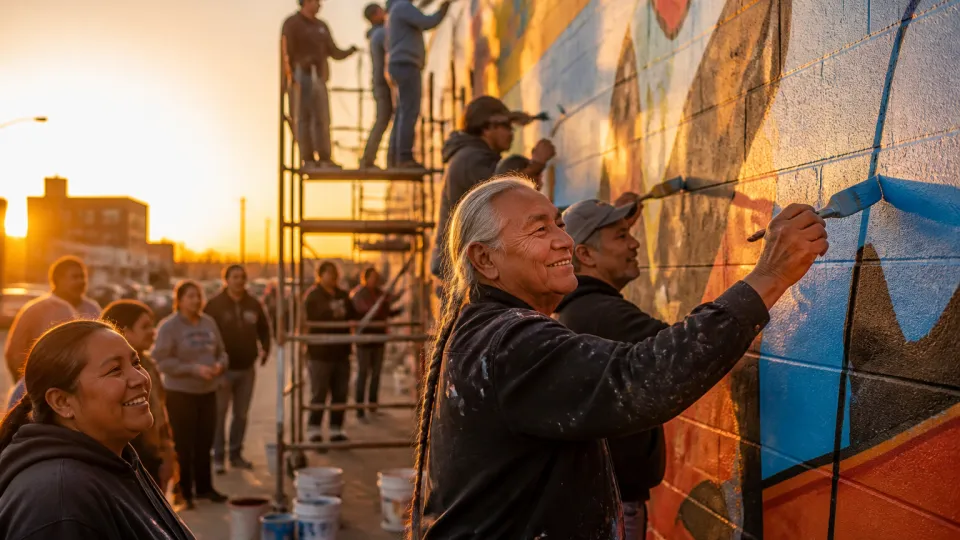
On a rain-softened evening last spring, a small crowd gathered beneath scaffolding outside a boarded storefront in downtown Brandon. Brushes dripped, laughter ricocheted against brick, and an elderly woman in a bright scarf leaned in to stitch a beaded border onto a painted panel. The wall they worked on was not a commissioned monument or a corporate placemaking project; it was the outcome of a weeklong community residency organized by local artists, university students, and elders from neighbouring rural municipalities.
That mural, a layered palimpsest of memory and aspiration, captures a central truth about Westman’s cultural life: art here no longer sits safely inside galleries or auditoriums. It has spilled into streets, storefronts, and kitchens — into the tactile work of community-making. What began as a response to funding cuts and pandemic dislocation has matured into a distinctive local ecosystem where collaboration, improvisation, and cross-generational exchange are remaking how people live, earn, and imagine public life.
The Art Gallery of Southwestern Manitoba and Brandon University have been crucial nodes in this shift. Within the last decade, the gallery has broadened its programming to include itinerant exhibitions and community-curated shows that foreground Indigenous artists and local makers. Across town, university curators and students have partnered with neighbourhood groups to convert unused spaces into pop-up studios, offering low-cost access to equipment and mentorship. The result is a porous boundary between academic arts training and grassroots practice — a circulation of skills and audiences that once passed each other by.
“People are tired of the idea that art only belongs in a white cube,” said a curator at the regional gallery. “We’re seeing artists insist on being part of civic life, not apart from it.” That insistence is tangible: public art projects now routinely include workshops for youth, beadwork collaborations with elder knowledge-keepers, and evening gatherings where food and storytelling are as important as the finished canvas.
Economic pressures, however, complicate the gains. A generation of practitioners reports a persistent squeeze: studio rents rising in response to downtown revitalization, shrinking hours for part-time cultural workers, and a patchwork of grants that rarely cover overhead. For many, the choice is pragmatic — teach a class, take a retail job, or move to a larger centre for stability. Yet, these constraints have also produced creative strategies. Artists and collectives are pooling resources, sharing studio space in repurposed warehouses, and launching subscription-based models for local collectors who want to sustain practice rather than simply purchase a single work.
Indigenous cultural resurgence is another defining thread. In spaces both formal and improvised, Métis and First Nations artists are reclaiming narratives that were long marginalized. Workshops in language-infused textile arts, public land-based ceremonies integrated into plein-air projects, and curatorial collaborations that place Indigenous protocols at the center of exhibition-making have shifted expectations. These practices do more than diversify programming; they reorient audiences by insisting that art is inseparable from land, history, and social responsibility.
Festivals and performance series, too, have evolved. The once-seasonal rhythm of large events has given way to a year-round constellation of smaller, mission-driven gatherings that prioritize equity and local talent. Organizers say this reduces overhead and makes cultural participation more accessible for low-income and rural residents who cannot travel for three-day festivals. Digital platforms — born of pandemic necessity — have settled into a hybrid role: livestreams and online archives extend reach, while in-person encounters retain the visceral quality that sustains belonging.
For municipal leaders, these developments pose both opportunity and policy puzzles. Cultural activity is increasingly recognized as an engine for downtown vibrancy and youth retention, yet support often lags behind rhetoric. Long-term change, artists and administrators agree, will depend on practical remedies: affordable studio and live-work spaces, municipally backed purchase programs that guarantee artists some stable income, and integrated cultural planning that links arts strategy to housing, transportation, and Indigenous reconciliation efforts.
At the heart of the story are individuals — a muralist who holds evening workshops for teenagers, a Métis beadworker teaching patterns to local schoolchildren, a young composer whose weekly salon at a coffeehouse draws a hesitant but loyal crowd. These gestures are small in isolation, but together they constitute a cultural infrastructure made of human relationships and repeated encounters.
Looking forward, the challenge for Brandon and Westman is to translate the momentum of grassroots ingenuity into durable systems that value labor and nurture intergenerational practice. That will require patience and a willingness to reimagine what public investment looks like: not only new venues or headline acts, but sustained, day-to-day support for studios, mentorship, and the rituals that knit a community together.
If the mural on that rainy evening is any indication, the region’s cultural future will be less about spectacle and more about the slow work of belonging. In a time of rising uncertainty, those painted panels — the hands that made them and the people who gather to see them — are the clearest evidence that art in Westman is not just surviving; it is quietly, insistently renewing civic life.