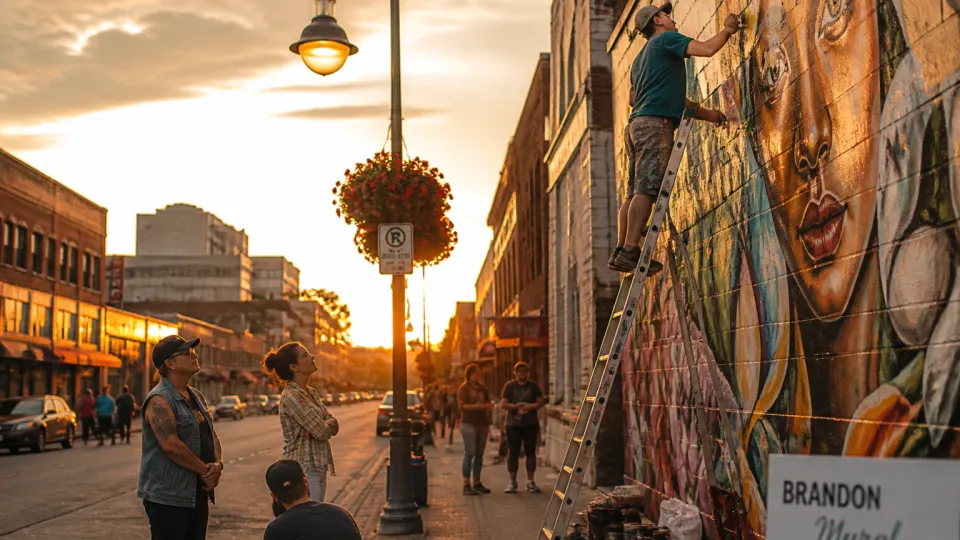
On a rain-soft Sunday in late June, a half-dozen teenagers stood beneath a scaffolding on Rosser Avenue, paint-smudged and deliberate. They weren't hired hands or art students practicing technique; they were local high schoolers, some of whom had never set foot inside a gallery, painting a mural that traced the river as a braided ribbon of memory and reclamation.
"When we started, I didn't know what I was doing," said Kayla Peters, 17, rolling a stroke of teal along the riverbank. "Now people stop and ask what it means. I tell them it's ours—how we remember this place. That feels important."
That mural, commissioned through a collaboration between the Art Gallery of Southwestern Manitoba and a neighbourhood association, is one small node in a broader cultural shift unfolding across Westman. Over the last five years, Brandon and surrounding towns have quietly built a network of projects that treat arts not as ornament, but as civic infrastructure: places for learning, economic experimentation, and the work of reckoning with history.
At the heart of that network is the Art Gallery of Southwestern Manitoba (AGSM), whose exhibitions increasingly foreground regional and Indigenous voices. "We had to move beyond being a repository," said Maya Sinclair, a curator at AGSM. "Our role is to activate spaces—bring artists into conversation with schools, with Elders, with farmers. That changes what a gallery can be."
Sinclair's point is visible in initiatives that fold the gallery into the fabric of daily life. Last winter AGSM organized a series of community-led workshops where Elders taught beadwork and story-mapping to middle-school students. In the same season a local sculptor, Julian Kwan, set up a residency at a grain elevator turned pop-up studio in Virden, inviting neighbouring communities to a two-day installation project that culminated in a communal lantern walk.
These projects are not simply aesthetic exercises. They carry practical effects: students who participate report higher engagement with school; artists find new audiences for work; small businesses report increased pedestrian traffic on event nights. "We see an uptick in people staying downtown for lunch or visiting shops after shows," said Naomi Fischer, owner of a café near the Centennial Auditorium. "Arts events are bringing different kinds of people into the core, and they stick around."
A distinctive feature of Westman’s cultural renewal is its emphasis on Indigenous-led initiatives. Brandon sits on Treaty 2 territory and the traditional lands of Cree, Saulteaux, Dakota, and Métis peoples. Local organizations have begun to center that reality through public art and programming. One project—an intergenerational weaving circle run by Métis artist Lillian Courchene—pairs schoolchildren with Elders to revive sash-making techniques. "It's about language and rhythm, about what our hands remember," Courchene explained. "When kids take those sashes home, they carry a story that schoolbooks can't teach."
The arts ecosystem in Westman is also pragmatic. Brandon University is a steady incubator of talent, but it is the porous exchange between campus and town that matters most: practicum placements in community theatres, music students organizing pop-up concerts in care homes, digital media classes producing short documentaries for rural histories. "There is an appetite for collaboration," said Professor Daniel Ortiz, who teaches community-engaged practice. "Students get field experience; the community gains capacity."
Challenges remain. Funding cycles are brittle, and many communities rely on the goodwill of volunteers. Performance spaces are aging, and artists often lack affordable studio space. Yet here, constraint has nudged creativity. Pop-up shows in storefronts, artist co-ops in unused municipal buildings, and micro-grants administered by local funders have multiplied the number of points where people encounter art.
The human effect is cumulative and concrete. For someone like Kayla, who once counted herself disengaged from school, the mural project reframed possibility. For Courchene, it is the sight of a child tying a sash the right way that marks progress. For shopkeepers, it is a calendar of events that keeps customers walking downtown on slow days.
Looking ahead, leaders across Westman are sketching a future that stitches together cultural vitality with economic resilience and truth-telling. They are exploring artist studios in mixed housing developments, digital archives that preserve oral histories, and touring circuits that move rural shows between towns rather than centralizing them in one city. Importantly, they are asking whose histories get to be visible, and how art can be a space for repair rather than spectacle.
"Art doesn't fix everything," Sinclair said, "but it alters the terms of conversation. When people gather around making—whether it's a play, a mural, a song—that's where relationships get rewired. That's how a place changes from the inside."
In Westman, that rewiring is ongoing and uneven, propelled by individuals who treat the creative act as a civic one. The murals, residencies, and workshops are visible signs; the deeper change is quieter: a network of relationships, a broadened imagination of who belongs in public life, and a fledgling belief that small acts of making can alter the course of a community.
When the summer sun finally broke through the clouds over Rosser Avenue, residents lingered to watch the teenagers finish the mural. A woman in her seventies ran her palm over a painted curve of the river, and smiled as if she had been reminded of something she had almost forgotten. The mural will fade, be repainted, perhaps replaced. But for a moment, the town had gathered around creation, and something in the rhythm of the place had shifted.