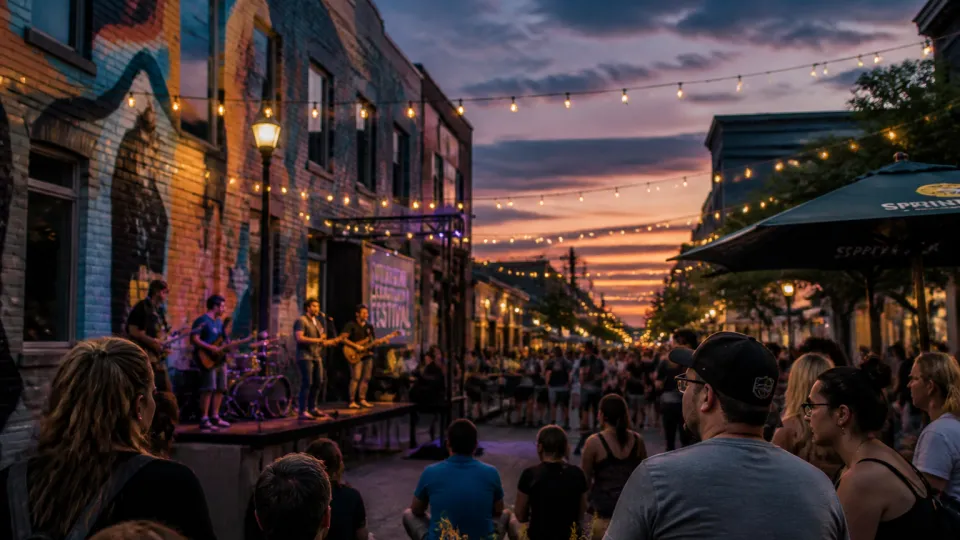
On a warm July evening, a crowd gathers under string lights beside the Assiniboine River. People who grew up in Brandon shoulder-to-shoulder with newcomers, teenagers painted in bright festival streaks, elders in winter coats, all waiting for a singer to step onto a modest wooden stage. Someone hands out hot coffee, a child dances barefoot. It is small in scale but vast in consequence: a culture-making moment that stitches individual lives into a shared civic story.
This scene—recurring across summers, gallery openings and evening rehearsals—captures a particular truth about arts in Westman. For more than a century, cultural life here has not been peripheral ornamentation; it has been a primary means of belonging, civic repair and economic reinvention. To trace that arc is to read Brandon’s social history: the university classrooms where students first learned to compose and curate; the gallery rooms where regional and Indigenous artists found audiences; the volunteer-led festivals that kept nights alive even in lean years.
Brandon University sits at the center of that history. Its School of Music and small-but-ambitious arts programs have educated generations of teachers, performers and arts administrators who stayed in the region. Classrooms and practice rooms have doubled as incubators—students play in symphonies, design sets for local theatre, and collaborate with visual artists on public commissions. Those connections are practical and affective. A music student who spends a winter tutoring youth in band becomes, in time, the teacher who anchors the town’s after-school arts offerings. The institutional heft of a university, in a small city, anchors both career pathways and volunteer networks.
Complementing that institutional presence are grassroots organizations that animate everyday culture. The Art Gallery of Southwestern Manitoba, local theatre companies, and music collectives have long functioned as civic laboratories. They host exhibitions and productions, yes, but they also allocate time and space for difficult conversations—about land, language and belonging—that municipal boards rarely touch. Indigenous artists and elders have increasingly taken the stage in these spaces, asserting Dakota, Ojibway and Métis perspectives not as adjunct programming but as central to the region’s identity. That shift has been moral and architectural: performances and exhibits reframe public buildings; curriculum in schools is revised; community engagement practices change.
Festivals—informal, itinerant and often volunteer-led—have been the connective tissue. The Brandon Folk Festival, local seasonal markets, and pop-up gallery nights have drawn rural people into urban space and introduced urban aesthetics back to the countryside. Festivals have been engines of intergenerational exchange. As a longtime volunteer once put it, 'You don't just come for a show; you come to belong.' Those belonging moments matter for retention: people who feel culturally rooted are likelier to stay, to start businesses, to raise families locally.
The arts have also been an economic lever, especially in the last two decades. When commodity cycles hit farming communities and downtown storefronts shuttered, creative enterprises—studios, small galleries, independent music venues—filled gaps. Artists repurposed old warehouses as studios; cultural tourism brought weekend visitors; workshops and residencies created steady seasonal income for local inns and cafés. Municipal planners began to look differently at cultural policy, recognizing that liveability—vibrant streets, cultural events, public art—attracts talent and investment.
Challenges remain. Funding fluctuations and the concentration of resources in larger urban centers have left organizations precarious. The pandemic exposed vulnerabilities: performances canceled, audiences physically distanced, revenue streams evaporating. Yet resilience showed, too. In Westman, artists pivoted to outdoor concerts, recorded collaborations, and community radio—keeping relationships alive when buildings were closed. Those improvisations have left lasting changes in practice, encouraging hybrid models that expand reach beyond the region.
The human stories behind these institutional and economic shifts are quietly persistent. Elders who returned to teach traditional song, a bakery owner who sponsors a youth choir, a Black and Métis poet who organizes bilingual readings—these are the people who translate lofty policy debates into everyday culture. Their work is often invisible in city budgets but visible in the way a downtown alley becomes a place for conversation after dark.
Looking forward, the most generative possibilities are those that center reciprocity. Partnerships between the university, Indigenous communities, local government and grassroots organizations can build infrastructure that is less fragile—shared rehearsal spaces, stable arts education funding, and public art policies that prioritize community process. Investments that value both tradition and experimentation will help avoid two pitfalls: cultural tourism that flattens nuance, and institutional insularity that alienates newcomers.
The arts in Westman have always been both mirror and engine: reflecting struggles and aspirations while shaping the civic capacity to meet them. If the recent past teaches anything, it is that creativity is not a luxury for the prosperous; it is a public utility for a resilient place. The volunteers who hang the lights for the next evening performance know this intuitively. So do the students unpacking instruments, the elders telling stories, and the teenagers dancing barefoot by the river. Their work—sustained, ordinary, and fiercely communal—will write the next chapters of Brandon's civic life.