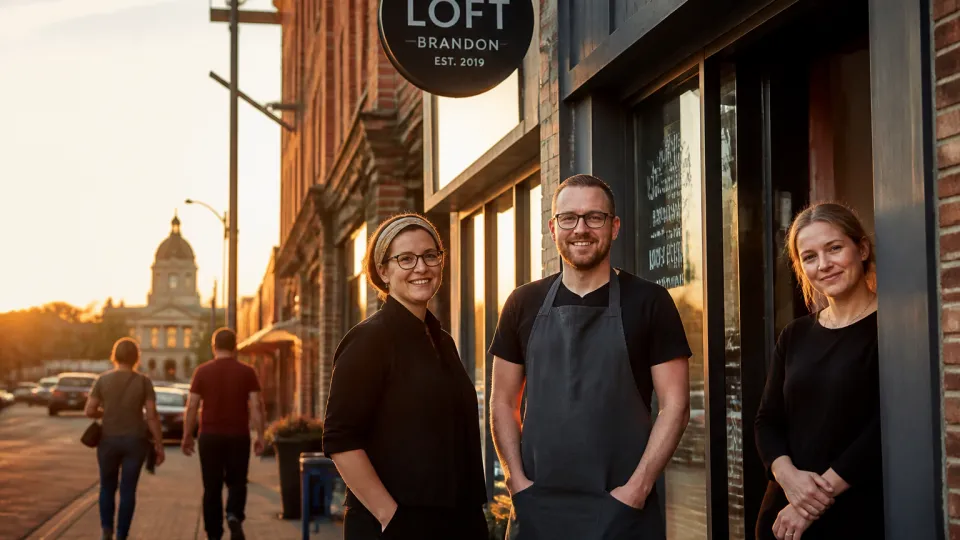
At dawn, the east-facing windows of a converted storefront on Rosser Avenue glow like an invitation. Heat fogs the glass. The smell of proofing dough curls out into the street, and a young woman with flour on her forearms balances a tablet displaying grain-moisture readouts next to a tray of sourdough. It is a strange domestic tableau — a bakery counter, a lab notebook, a startup whiteboard behind the till — but it captures a simple truth about Brandon and the surrounding Westman region: reinvention often looks unromantic, practical, and quietly communal.
The businesses that have anchored this revival are not overnight successes; they are iterative responses to overlapping stressors — the pandemic, shifting supply chains, and a long rural exodus of opportunity. What binds them is an insistence that local commerce can be both commercially viable and socially regenerative.
Take GrainSense Technologies, founded by Dr. Amir Patel after years working with agronomy data. People in the region knew the problem well: bins would show acceptable readings at harvest and then, weeks later, pockets of spoilage would appear, leaving farmers with invisible losses. Amir’s team developed low-cost, wireless sensors that cling to a bin wall and report moisture and temperature trends to a phone app. He didn’t fly to Silicon Valley to sell the idea; he parked at commodity elevators, showed a demo, and listened.
“People here are conversational buyers,” Amir told me over coffee. “They’ll ask how a tool changes their day. We had to show not glamour but predictability.”
GrainSense now works with cooperative elevators across Westman and contracts with Assiniboine College on seasonal student placements. The sensors have changed the rhythm of grain management: instead of emergency phone calls in the night, farmers get early notices and a checklist. For younger operators, the data has become a teaching tool, making decades of tacit knowledge explicit — and keeping more grain in local markets rather than being sold at fire-sale prices.
Another experiment in place-based resilience is Common Thread Co‑op, a social enterprise that took over an underused garment shop and reimagined it as a training kitchen and adaptive-clothing workshop. Founder Maya Ortiz had worked in urban social enterprises and returned to Brandon intent on combining workforce development with dignity.
“We wanted to design jobs, not just jobs training,” Maya said. “That meant fair wages, flexible hours for parents, and products with a real market.”
Common Thread stitches garments for local care homes, produces scalable items for regional retailers, and runs an incubator for fashion entrepreneurs. What began as six employees has grown into a 28-person co‑operative, many of them women re-entering the workforce. The co-op’s adaptive clothing line — garments designed for mobility and ease of dressing — was picked up by a provincial long-term care procurement pilot. The financial benefits were meaningful, but equally important was the social ripple: for trainees, a paycheque came with a sense of purpose and skill certification.
Then there is Brandon Breadworks, a family-run bakery that pivoted hard in 2020. When in-person orders collapsed, Sarah Chalmers turned the bakery’s delivery truck into a mobile food hub. The truck did grocery runs for seniors, distributed surplus baked goods to the food bank, and became a neighborhood pickup site for an online artisan market Sarah helped organize for 30 local producers.
“Pivot isn’t a graceful word,” Sarah admitted. “It’s messy. But when your neighbour can’t get milk, you find a way.”
Her market is now a year-round digital platform that integrates local supply with flexible logistics. It has indirectly supported other innovators: GrainSense growers found new regional buyers; Common Thread supplies local care facilities via consolidated orders; small-scale farmers can list directly for community-supported orders.
What unites these stories is not a single or funding source but a cultural practice — an ethic of mutual problem-solving. Local institutions matter. Programming from the college, municipal procurement tweaks to favor regional suppliers, and informal networks of mentorship have scaffolded early-stage risk.
Looking ahead, the question for Westman is scaling without losing texture. Amir wants GrainSense to remain hands-on, investing in local service teams rather than remote call centers. Maya imagines replicating the co‑op model in other towns while keeping governance firmly local. Sarah is converting the bakery’s back room into a shared-use commissary so more food entrepreneurs can take the same first leap she did.
If there is a policy lesson, it is modest: durable rural revitalization grows where small bets are shaped by local knowledge and where municipalities accept modest, catalytic risk. The entrepreneurs in Brandon are not chasing a mythic ‘tech hub’ identity. They are quietly building the scaffolding of a diversified, humane economy — one sensor reading, one garment hem, one loaf at a time.
And in the morning light on Rosser Avenue, a tablet buzzes with an alert from a grain bin; a trainee threads a needle; a delivery driver backs the Breadworks truck down the block. Each sound is small. Together they are the rhythm that keeps community going.