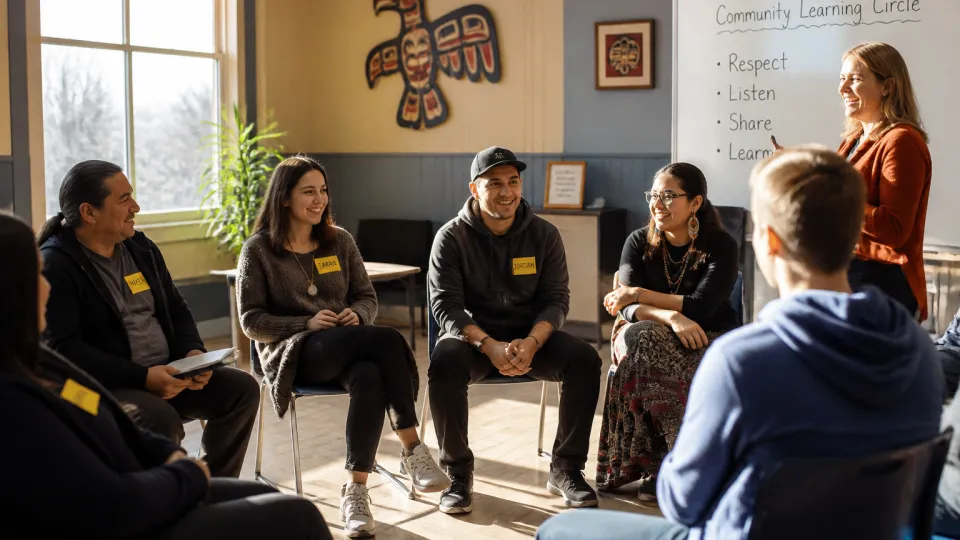
On a Monday evening in late April, the meeting room at Brandon Public Library filled with the kind of gentle bustle that often precedes something quietly consequential: the murmur of coats settling, the hiss of a steaming carafe, the rustling of handouts. Sticky name tags dotted the crowd—"Amina," "Tom," "Marie"—and people who might not otherwise cross paths sat shoulder to shoulder. The event was billed as a "Community Learning Exchange," a collaboration among Brandon University, Assiniboine Community College and the library. But what unfolded felt less like a conference and more like a patchwork conversation about what learning means in a region remaking itself.
Early on, the exchange broke into a kind of arithmetic: one part retraining, one part cultural education, one part civic repair. Amina, a 32-year-old newcomer who arrived with a child and a limited résumé, spoke about a six-week digital skills workshop she completed at the library. "I learned to make a résumé that employers actually read," she said, smiling while balancing a cup of tea. "Before this, I thought learning stopped in school. Here, it started again."
Across the room, Tom, a third-generation grain farmer, described a different reinvention. He had enrolled in a short micro-credential course through Assiniboine Community College focused on precision agriculture technologies. "I learned how to read satellite maps," he said. "That helps me make better decisions about seeding and fertilizer, and it keeps the farm viable for another generation." Tom's talk was practical, but threaded through it was a deeper anxiety familiar to many rural Manitobans: the need to adapt to a shifting economy without losing identity.
What ties these stories together is not merely survival, but a deliberate reshaping of educational architecture. Brandon's institutions have been experimenting with hybrid models—short, employer-aligned credentials, community-hosted literacy sessions, and Indigenous-led oral history workshops—that meet learners where they are. At the exchange, an elder named Marie led a workshop on land-based pedagogy, describing how intergenerational learning had always been central to her community. "We share knowledge the way we share food," she said. "Learning is walking together."
These programs are modest in scale but significant in impact. Brandon University has expanded community-engaged research initiatives, pairing students with local agencies to work on age-friendly planning, digital inclusion, and newcomer settlement. Assiniboine's trades outreach brings high school students into hands-on labs, while the library's maker nights and coding bootcamps provide low-barrier entry points for adults. In many cases, success is measured not by diploma counts but by incremental shifts: a new job, a digital banking account, a teenager deciding to pursue welding.
There are still structural barriers. Childcare, patchy rural broadband, and transportation persist as obstacles that programs alone cannot erase. At the exchange a panel on equity drew a blunt assessment: "We can build great offerings, but if parents can't afford child care or if a neighbourhood lacks internet, those offerings are invisible," said a community organizer. It was a reminder that education policy must operate in concert with social supports.
Yet the grassroots solutions are revealing. One initiative connects employers with micro-credential graduates through a revolving "tasters" program—short internships that give both employers and learners low-risk ways to test-fit. Another pairs elder-led storytelling circles with literacy programming, generating materials that are both culturally rooted and practically useful for learners. These partnerships are not new in principle, but their scale and intentionality are: institutions are ceding control, permitting community groups and learners themselves to shape curricula.
What does this mean for Westman's future? In the near term, it translates into more people like Amina and Tom finding footholds—employment, confidence, and social connections. Over the long run, the pattern suggests a civic model of education that is relational rather than transactional: learning as a practice distributed across libraries, colleges, workplaces, and kitchens. It is a model that acknowledges rural realities—distance, seasonal work, caregiving—and adapts credentialing and scheduling accordingly.
The exchange closed with a simple exercise: participants wrote one learning goal on an index card and passed it to a neighbour. Those cards—aspirations ranging from "learn accounting basics" to "teach my grandson story songs"—felt like a ledger of communal hope. "Education here is not a pipeline," a library staffer observed as volunteers stacked the cards. "It's a net."
True transformation will require policy attention to the frictions that persist: broadband investment, childcare subsidies, and incentives for employer-engagement in rural areas. But the incremental, often improvisational work underway in Brandon points to another truth: communities that treat learning as a shared act of civic repair will find pathways to resilience. The quiet exchanges that begin in a crowded library on a Monday night may not make headlines, but they are the hard architecture of a future in which opportunity is woven, not handed down.