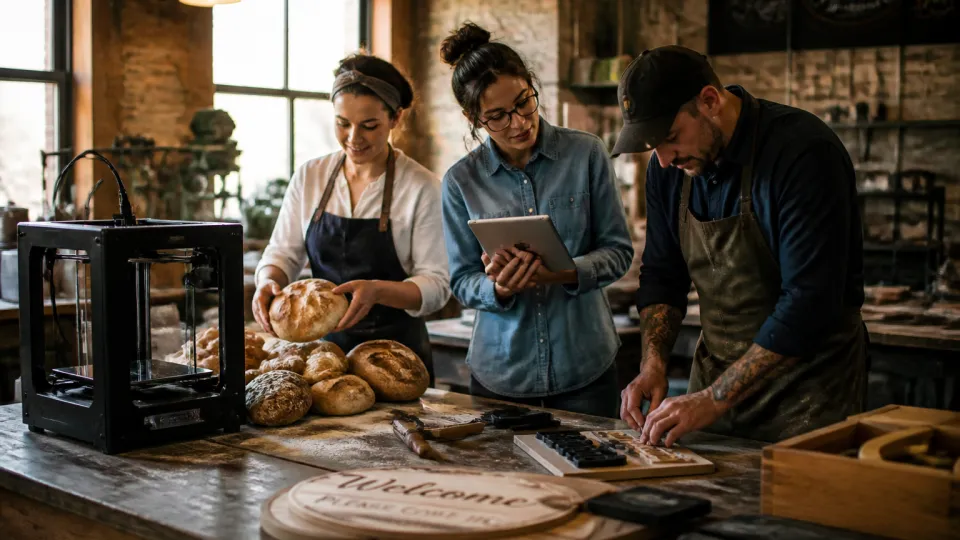
On a damp spring morning, the front door of a downtown Brandon storefront opens to the smell of baking bread and the quiet hum of a 3D printer. That unlikely combination — artisanal craft and digital prototyping — is the workaday reality inside the Westman Cooperative, a initiative that has become a quietly disruptive force in the region’s economy.
What began two years ago as a series of conversations over coffee and council meeting agendas has become a functioning ecosystem: a shared workspace, a micro-manufacturing shop, mentorship programs, and a network that links rural producers to urban markets. Its premise is simple and resolutely local. Instead of expecting businesses to go it alone, the cooperative stitches together capacity — from design and packaging to distribution and digital marketing — so that independent operators can compete with larger chains without losing their identities.
Maya Sinclair, a Métis designer who moved home from Winnipeg to launch a small line of wool accessories, remembers the year she nearly folded. "I had product and a story, but no route to scale. Shipping alone was bleeding me dry," she said. Through the cooperative she found a shared fulfillment service and connected with a packaging designer who produced compostable labels that aligned with her brand. Today, Maya’s designs are sold in three boutiques across Westman and shipped nationally.
The cooperative’s hands-on approach is what sets it apart. Rather than offering one-off workshops, organizers created project-based “sprints” that address concrete bottlenecks. A local bakery that wanted to expand wholesale capacity was paired with an industrial designer and a culinary operations student from Brandon University to rework its production line. The result was modest but meaningful: faster throughput, standardized packaging, and a reconfigured storefront that freed space for a community table where neighbours now meet.
Stories like these reveal how innovation in small towns often looks less like flashy disruption and more like pragmatic problem-solving — a new way to balance the economics of scale with the values of place. "Innovation here is incremental and relational," said Claire Hargreaves, one of the cooperative’s volunteer coordinators. "We’re not trying to invent the next big app. We’re asking: how can a hardware store, a tailor, and a pastry chef share resources so all of them thrive?"
Part of the cooperative’s early success came from its insistence on listening. Organizers ran listening sessions in Brandon, Neepawa and Virden, gathering storefront owners, farmers, students and municipal staff. Common threads emerged: access to affordable production space, help moving from local markets to online platforms, and training that respected existing knowledge rather than replacing it.
That listening led to practical solutions. A micro-manufacturing bay now offers CNC routing and laser cutting hours at subsidized rates. A digital clinic staffed by volunteer marketers pairs businesses with students for website redesigns and social media strategy. A courier cooperative leverages bulk shipping rates, helping rural producers reduce costs without sacrificing service.
The human dimension is visible in the trade-offs people make. Tom Reynolds, who has run a family-owned hardware store for forty years, initially resisted the idea of change. The cooperative helped him launch an online catalogue for specialty orders and introduced him to a neighbouring retailer with complementary inventory, enabling both businesses to broaden offerings without excess stock. "I was worried about losing what folks love about this place," Reynolds said. "But innovation didn’t erase that — it protected it."
Critically, the cooperative has become a site for intergenerational exchange. Students from Brandon University’s courses find real projects; older business owners bring practical wisdom. Indigenous entrepreneurs are involved in guiding product development that respects cultural protocols. In one project, a local flax processor worked with a descendent craftsman to develop a yarn product line that revived a fading agricultural byproduct while creating new market value.
The effort is not without tension. Funding is piecemeal, reliant on municipal seed grants, local philanthropy and modest user fees. Scaling beyond Brandon to the wider Westman region requires more robust infrastructure — better broadband in outlying communities, freight solutions that make small-batch shipping economical, and stable capital for shared equipment. Organizers are candid about these limits; their strategy is iterative and rooted in partnerships, not quick fixes.
Looking ahead, the cooperative’s roadmap is surprisingly ambitious: a satellite hub in a nearby town, an apprenticeship program linking tradespeople with digital fabrication skills, and pilot contracts with regional food distributors that could open institutional markets for small producers. The goal is not to make Westman a tech enclave but to weave practical modern tools into the fabric of small-town economies.
In an era when headlines often equate innovation with scale and velocity, Brandon’s experiment offers a quieter model: one where resilience is built through networks, where amplifies craft rather than erases it, and where community priorities shape economic change. For the people who live and work here, that balance matters.
As the cooperative’s doors close at the end of the day, hands still dusted with flour and wood shavings, the sense is not of a town catching up with change but of a place choosing how it changes. That deliberateness — the willingness to reimagine Main Street while keeping its soul — may be the region’s most enduring innovation of all.