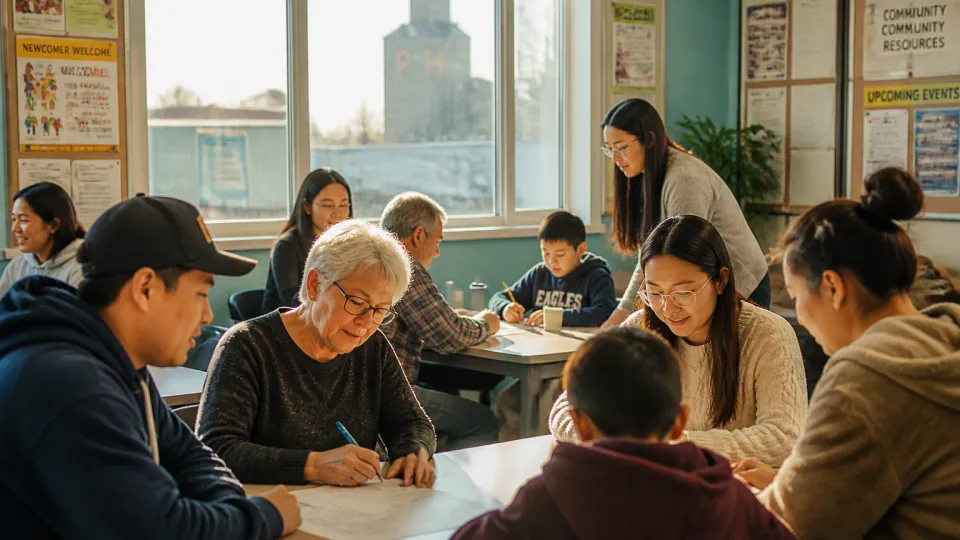
On a late autumn morning in downtown Brandon, a classroom at a neighbourhood hub hums with a quiet optimism. At one table, an older man learns the basics of email from a recent high school graduate. At another, a mother practicing for her GED reads aloud to her kindergarten-aged daughter, who colors beside her. The space looks like a classroom and a living room at once: mismatched chairs, steaming mugs on the windowsill, a bulletin board of job postings and child-care schedules tacked beneath upcoming course listings.
That mixture — of formal instruction and the informal, lived realities of people’s lives — is where Westman’s newest experiments in learning are finding traction. Across Brandon, educators and organizers are reframing education not as a sequence of isolated institutions but as a networked public good. The result is a reshaping of opportunity from the ground up.
'Learning here has to make sense to the whole person,' says a program facilitator who runs evening adult literacy classes at a community centre. 'People come with jobs, children, mortgages, and histories. If we don’t meet that, they won’t stay.'
From town halls to college labs, partnerships are spreading. Brandon University and Assiniboine Community College increasingly collaborate with the Brandon School Division and local non-profits to co-design programs that bridge secondary education, post-secondary credentials and immediate labour-market needs.
Consider the new trades pathway that partners evening courses at Assiniboine with work placements coordinated by the city’s workforce development office. Students who once cycled through under-resourced employment programs are now finishing certificate courses and stepping directly into apprenticeships with local firms. For 28-year-old Dillon, who had been laid off from seasonal agricultural work, the carpentry cohort became a lifeline.
'It wasn’t just learning how to use a saw,' he says. 'It was learning how to be on time, how to talk to supervisors, how to plan for overtime. That combination got me a permanent spot on a crew.'
In classrooms that remain firmly K–12, teachers are adapting curricula to local realities. Rather than abstract units divorced from students’ lives, projects now orient around Westman’s economic and cultural landscape: water stewardship with nearby rivers, agricultural science tied to local farms, and oral-history projects connecting students to elders in their communities. Those projects do more than engage; they produce skills and civic attachments that are visible in the neighbourhoods themselves.
There is also an emerging focus on adult learning that acknowledges multiple barriers — childcare, transportation, digital access — and removes them. A small coalition of non-profits and schools now offers stipended child-minding during evening classes, transit vouchers for participants from outlying municipalities and loaner laptops for multiweek courses. The uptake has been dramatic: wait lists outnumber seats in several cohorts.
The work is not without friction. Funding cycles are short, and provincial policy often privileges standardized metrics over the slower, qualitative changes community educators see: confidence, networks, and incremental workplace readiness. A principal in south Brandon describes the tension this way: 'We can measure test scores, but it’s harder to measure how a parent learning to read at 35 changes the way a kid sees school at 8. That’s the transformation that sticks.'
Indigenous inclusion has become a central concern. Several schools have invited elders into classrooms to teach language and land-based knowledge, not as token gestures but as integrated elements of the school year. These programs are small and unevenly resourced, yet they signal an appetite for education that acknowledges historical wrongs and prioritizes cultural continuity as part of learning.
The human stories emerging from this ecosystem are the clearest proof of its value. A young mother who completed a night certificate in early childhood education is now employed at a daycare she helped design. A recent immigrant who attended English-as-a-Second-Language workshops at the community hub now volunteers as a translator for newcomers. A high-school dropout returned as an adult to mentor teenagers navigating the same decisions he once faced.
Looking forward, local leaders describe three priorities: scaling partnerships so programs are sustained beyond pilot funding; aligning training with regional labour forecasts so credentials meet demand; and deepening supports that keep adults in learning pathways — childcare, mental-health services, flexible scheduling. Municipal and provincial alignment on funding and data-sharing will be necessary to make these priorities durable.
The stakes extend beyond individual advancement. As Brandon and the broader Westman region confront demographic shifts, automation and changing agricultural markets, education that is anchored in the community becomes a strategic asset. It helps retain young people, repurpose local labour, and stitch newcomers into civic life.
In a modest classroom with a view of the prairies, the work is granular: one lesson plan, one cup of coffee, one child’s hand on their parent’s paper. Yet taken together, these moments form a different logic of education — one that measures success in resilience, networks and shared opportunities. If Brandon’s experiments continue to spread and gain structural support, the city won’t just be teaching skills; it will be remaking the fabric of everyday life.
'This is what education looks like when it’s honest about where people are,' the literacy facilitator says. 'It’s messy and it takes time. But it changes how we live together.'