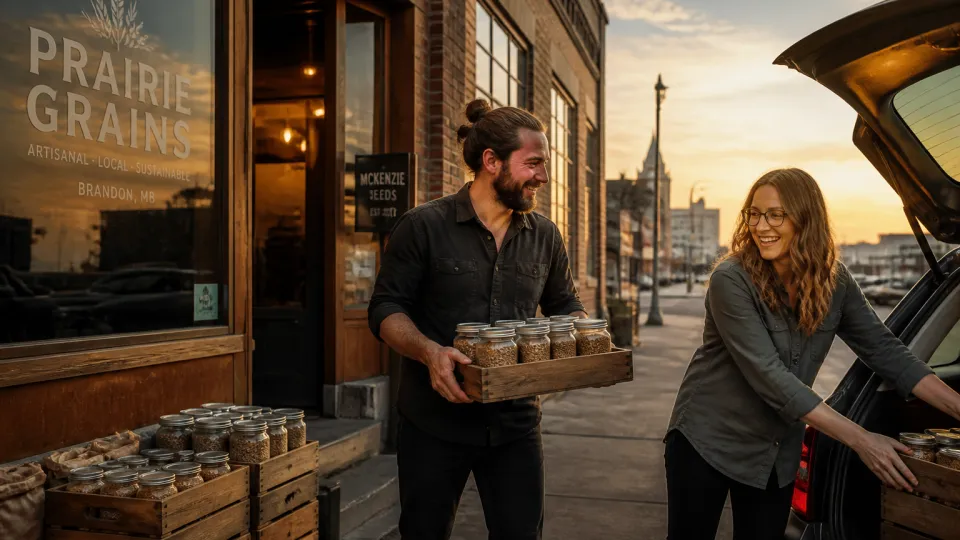
The day I met Maya Singh she was loading jars of hand-milled buckwheat into the trunk of her car outside a refurbished brick storefront on Brandon’s 10th Street. It was 7:30 in the morning, raw light slicing across the Prairies, and Maya — once a field agronomist and now the founder of a small food-processing co-op — talked about yield, shelf life and logistics with the same calm conviction she once reserved for soil tests.
Maya’s business is not an anecdote; it is a signal. Across Westman, entrepreneurs are quietly reconfiguring the rural economy, stitching together agricultural know-how, digital tools and infrastructure to create enterprises that are locally rooted and outward-looking. The forms they take vary: a remote software consultant operating between client calls and a family farm; a social enterprise employing newcomers to process local grains; a makerspace housed in an old elevator where welders and graphic designers share tools and ideas. What unites them is a recognition that place can be a competitive advantage rather than a handicap.
Several converging trends explain why. First, improved connectivity and remote work norms have lowered the cost of geography. A brand strategist in Brandon can pitch a client in Toronto without boarding a plane. Broadband investment, patchy as it still is in pockets of rural Manitoba, has been the single most consequential infrastructural change for local entrepreneurs. Where reliable internet exists, the economy pivots: service-based firms, creative professionals and tech-enabled startups can blossom without moving to a metropolis.
Second, farmers and rural residents are exploiting value chains that used to lock them into commodity price swings. Rather than shipping raw grain, a growing number of local ventures process, package and market specialty products — small-batch flours, fermented foods, craft malting and artisanal oils. These businesses often start as household experiments and scale through farmers markets, co-ops and regionally distributed grocery shelves. In doing so they recapture margins and anchor more of the production cycle in place.
Third, community institutions matter. Brandon University and Assiniboine Community College, along with local chambers and business accelerators, are adapting curricula and supports to the realities of rural . Programs that pair technical training with business mentorship, or that help a farmer understand e-commerce logistics, create the translation layer entrepreneurs need. Equally important are informal networks: a retired machinist mentoring a CNC operator, a community volunteer coordinating childcare so a pair of founders can attend a trade show.
But the rise of rural entrepreneurship is not a tidy success story. Barriers remain structural and stubborn. Access to capital is the most obvious: bank lending criteria and investor networks are still biased toward scale and density. Many promising projects stall because they lack patient risk capital. Workforce shortages are acute: hospitality, skilled trades and caregiving often operate at capacity, constraining growth for businesses that want to hire. Housing availability and affordability — paradoxically — can be a constraint when small towns suddenly attract new residents.
There are also cultural obstacles. Risk tolerance in tight-knit communities can be low; failure reverberates socially as well as economically. Some entrepreneurs describe a tension between and expectation: creating something new in a town that remembers how things used to be requires diplomacy as much as ingenuity.
Yet where entrepreneurs have found levers to pull, the community payoff is tangible. A small food processor can create a dozen year-round jobs and raise demand for local grain varieties. A digital consultancy can keep young professionals in the region, sustaining schools and shops. Shared workspaces and maker hubs become civic places where skills cross-pollinate and ideas find customers. Crucially, these ventures deliver services and goods that make rural life more viable and attractive — child care, fresh food, cultural venues — rather than merely extracting value.
Looking ahead, the region’s resilience will depend less on individual grit and more on systems: patient capital vehicles tailored to rural risk profiles; targeted broadband and transportation investments; partnerships between post-secondary institutions and industry that prioritize applied skills; and regulatory frameworks that permit creative reuse of buildings and land. Municipal leadership — nimble zoning, procurement that favors local suppliers and incentives that reduce upfront costs — can multiply the impact of small ventures.
The entrepreneurs I spoke with were pragmatic about scale. They did not imagine Westman as a Silicon Prairie overnight. Instead, they described a slow accretion: one enterprise employing twenty people, another anchoring a fledgling supply chain, a third attracting a cluster of compatible firms. In this vision, prosperity is less a singular boom than a mosaic of interlocking livelihoods.
Back on 10th Street, Maya handed me a jar stamped with a regional logo. "People ask me why I don’t expand to Winnipeg," she said. "I tell them: I like knowing the farmer two fields over. That’s my market advantage. It’s not romantic — it’s practical." Her answer captures the new rural calculus: competitive advantage derived from relationships, place-based knowledge and the patient work of building institutions around enterprise. If Westman’s next decade is to look different, it will be because communities like Brandon are learning how to combine those resources into something durable and generative.