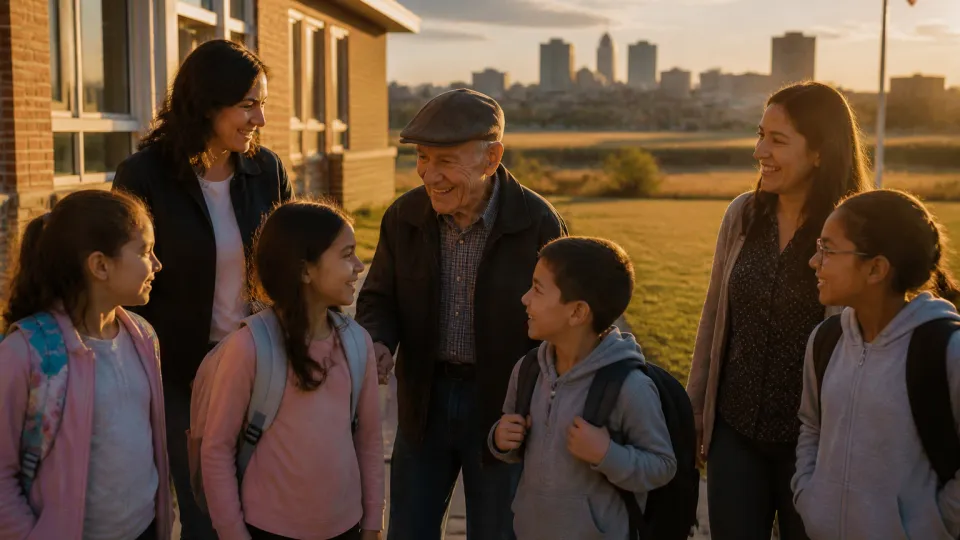
On an overcast Tuesday in late April, a line of children and parents snaked down the block outside a modest brick school on Brandon's east side. A chorus of winter boots and backpacks — a communal rhythm more intimate than the city's arterial noises — marked the threshold between home and classroom. Inside, desks had been clustered into islands. A whiteboard displayed today’s invitation: build something that solves a problem in your neighbourhood.
The work happening in those clusters is not merely one teacher’s experiment. It is the visible edge of a quiet transformation taking root across Westman: education conceived not as a discrete, institutional product but as a community project. From after-hours digital-literacy courses at the public library to a mobile makerspace that visits rural towns, educators and residents are inventing new pathways that meet people where they are.
"The old model assumed children would sit and absorb and then carry knowledge out into the world," said Maya Brown, a Grade 5 teacher who has taught in Brandon for a decade. "We’re turning that inside out. The community is the curriculum now — its problems, its stories, its people."
Brown’s classroom participates in a partnership that stitches together Brandon University, Assiniboine Community College and a string of neighbourhood organizations. A professor brings a simple climate-sensor kit. A college trades-student mentors show how to solder. An elder visits to teach place names in Anishinaabemowin. The result is not only a lesson in circuits but a practical exercise in local stewardship: students map stormwater runoff, prototype rain gardens and present neighbor-centered solutions at community meetings.
For many adults, those same partnerships have opened doors that traditional pathways had left closed. Aisha Khan, 32, returned to formal study after a decade caring for her children and working part-time. She first enrolled in evening digital-literacy classes offered in the library’s basement. Within months, Khan had completed a certificate in community-support work through a compressed program co-delivered by Assiniboine and a local service agency.
"I wanted something that fit my life — not the other way around," Khan said. "They told us, ‘Bring your experiences.’ They meant it. I felt seen as a person, not a test score."
Those experiences matter in Westman, where the economy and geography demand an education system that can pivot. Rural communities in Manitoba contend with labour gaps, transportation barriers and an aging population. In response, a mobile makerspace — literally a van outfitted with 3-D printers, hand tools and laptops — has become a fixture at farmers’ markets, community halls and schoolyards. The van’s roster of projects is pragmatic: equipment repair clinics, basic programming lessons for local businesses, and co-designed prototypes for agricultural problems.
"We don’t tell farmers how to farm," said Sam Ortega, coordinator of the Mobile Makerspace. "We ask, ‘What keeps you up at night?’ Then we try to build an affordable tool with them. That approach creates trust and actual solutions."
Measuring success in this landscape is less about test scores than about the slow accretion of capacity: an adult learner who finds meaningful work; a student whose prototype reduces a neighbour’s costs; a community that adopts new practices for climate resilience. Those are the things residents point to when asked whether the work is worth doing.
Still, this community-centered model bumps up against structural realities. Funding cycles are short and siloed. Transport and broadband remain uneven across Westman’s wide terrain. "If we want to scale what’s working," said Dr. Peter Hargreaves, a sociologist at Brandon University who studies rural education, "we need policy that recognizes learning as an ecosystem: schools, post-secondary institutions, service providers and families all need stable investment and connective infrastructure."
There is political will, in pockets. Local councils have increased support for community learning initiatives; alumni networks from both Brandon University and Assiniboine are fundraising for scholarships tied to locally driven projects. But those efforts are incremental, and the future will depend on whether provincial and federal funding regimes can move from single-issue grants to multi-year investments that underwrite collaboration.
Beyond resources, the ethos of the work is quietly revolutionary. It asserts that education ought to be accountable to place — to the economy, ecology and cultural life of Westman — not only to standardized benchmarks. It understands learning as a terrain of relationships: younger and older people teaching one another across generations; tradespeople, scholars and elders pooling expertise; students learning that their work can shape civic life.
On a spring evening at a community hall in Rivers, a small town sixty kilometres east of Brandon, a group of high-schoolers demonstrated a low-cost soil-moisture sensor they had assembled with a volunteer mentor. Neighbours applauded. An elderly farmer came forward and asked, in a voice that carried both skepticism and curiosity, whether the device might survive a season in a real field. The young inventor smiled, handed over the prototype, and said, "Let’s test it together."
That exchange — pragmatic, hopeful, imperfect — captures the project’s essence. If education’s purpose is to help communities adapt and thrive, Westman’s experiment charts a humane path forward: one where learning is made with the places it hopes to serve, where expertise is shared, and where the measure of success is not a single score but the quiet strengthening of civic life.
The question now is whether that fragile, relational work can be sustained and scaled without losing its local character. For people in classrooms, on farms and in adult-education evenings, the answer is not theoretical. It will be written, small and cumulative, in the projects they build together.