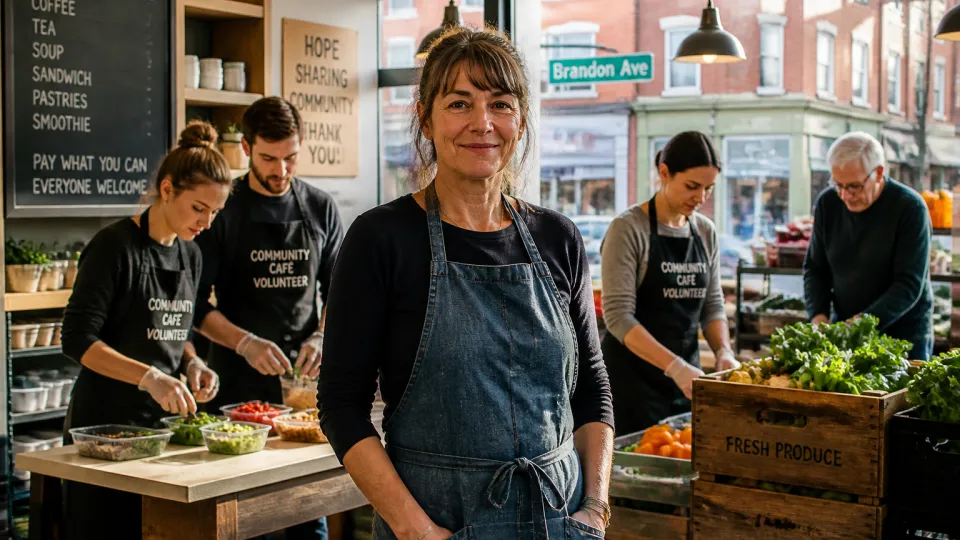
On a damp November morning in Brandon, the lights of the Prairie Lantern Café come on before dawn. The barista shifts a chalkboard sign from 'Open' to ' Kitchen' and slides open a back door where crates of donated potatoes and loaves from local bakeries await. Maya Desai, the café's owner, maps out stations on a laminated kitchen roster the way some people lay out blueprints: soup here, sandwiches there, volunteers assigned in neat columns.
'It began as a practical answer to a problem,' she says. 'People needed food. Volunteers wanted to help. We had a building and a stove.' Those simple elements—space, time, and resolve—have, over six years, been stitched into an unexpected civic fabric.
Maya is an entrepreneur in the familiar sense: she built a local brand, negotiated leases, trained staff, and survived the churn of small-business life on Princess Avenue. But there is a second ledger beneath the profit-and-loss sheets: a long list of volunteer shifts logged, partnership agreements signed with Brandon University and the United Way of Brandon and District, and a scholarship fund now administered through the Brandon Chamber of Commerce.
When the pandemic arrived in 2020, Prairie Lantern pivoted overnight. The dining area closed; the kitchen did not. Maya launched the Brandon Community Table, coordinating food distribution with the Brandon Friendship Centre and the Brandon Regional Health Authority. Within a year the Table served more than 18,000 meals, drew in 230 volunteers, and repurposed the café's retail hours for community service. The café's register still rang with takeout orders, but the real accounting became lives steadied: seniors who needed hot dinners, students working part-time who missed shifts, families coping with job loss.
'We didn't set out to be an emergency food provider,' Maya says. 'But we were a node people could find.'
Her approach was granular. Instead of one-off hot meals, she prioritized relationships—matching volunteers with recurring shifts, training kitchen leads from among immigrant community members, and using surplus goods to assemble culturally appropriate meal kits. A weekly Punjabi supper, initiated at a volunteer's suggestion, became a space for newcomers to share recipes and find English practice partners.
Maya's service model moves beyond immediate relief to economic and civic integration. In partnership with Brandon University’s Small Business Development Centre, she started an apprenticeship pilot for students interested in hospitality and . Over three years, twelve apprentices completed the program; nine are now employed locally, and three have launched their own micro-businesses in Westman.
'What Maya offered was legitimacy,' says Dr. Helena Frost, a coordinator at the university. 'An apprenticeship at a busy, community-oriented café teaches much more than coffee pulling. It teaches civic responsibility.'
She also sits on the board of Habitat for Humanity Brandon and has chaired the fundraising gala for Westman Hospice for two consecutive years, personally helping to raise over $150,000 for palliative-care programming. The fundraisers blend commerce and care—auctions featuring local artisans, menu items sourced from small farms in the region, and volunteer-driven hospitality that reduces overhead and raises community participation.
For many, Maya's work matters because of whose lives it touches. There is Darren, a former construction worker furloughed in 2020, who found not only a reliable source of income washing dishes at Prairie Lantern but later enrolled in the apprenticeship and is now attending night classes in business management. There is Fatima, a newcomer from Syria, who began volunteering at the weekly meal and eventually coordinated the café's multilingual outreach. 'When I didn't know how to use the bus, someone from the café walked me to the stop,' she says. 'They taught me about schedules. They taught me I could belong.'
Maya's own story threads through these encounters. The daughter of immigrants who opened a small convenience store in Winnipeg, she learned early that business can be a stage for social investment. She carried that ethic to Brandon a decade ago, a city she chose for its scale and the visible gaps between civic institutions and everyday lives.
Now, Maya is turning her attention to —in operations and outcomes. Prairie Lantern will retrofit its kitchen to reduce waste and energy use, supported by a grant from a provincial small-business fund. More strategically, she is working with the Chamber to replicate the apprenticeship model as a certified pathway for trades and hospitality across Westman. 'We don't want to be the only place doing this,' she says. 'We want to show a way.'
There is also an intentionally generative quality to her work: the scholarship fund she seeded is structured to be advisory, with past apprentices helping to select recipients. She is planning a social enterprise storefront where bakery profits will subsidize community meal programming and create intentional job placements for people experiencing employment barriers.
What makes Maya's story resonant is less the scale of any one initiative than the weaving together of habit, resource and care. In a region where institutions often feel distant, the Prairie Lantern model imagines business as meeting place, employer, training ground and lifeline. It is a reminder that volunteerism is rarely a single act of generosity; it is more often infrastructure—daily, ordinary, and sustained.
'You keep doing the next right thing,' she says, as if that explains everything. What it explains instead is how a small enterprise in Brandon retooled its purpose and, in the process, nudged a community toward a different way of seeing its needs and capacities. It is not the end of a story but a template: modest, practical, and insistently human.