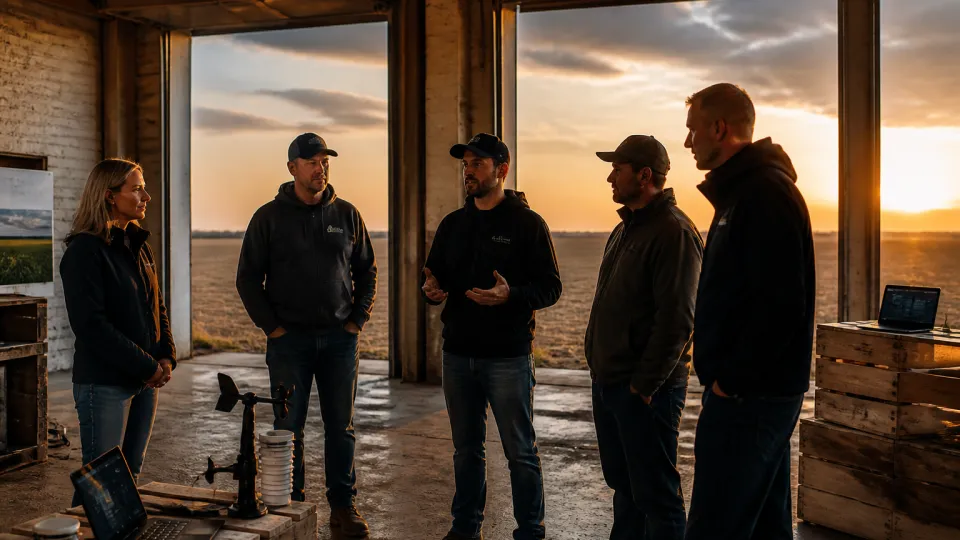
On a cold March morning in Brandon, the door of a converted grain warehouse lifts to admit light and the smell of coffee. Inside, rows of soldering benches sit beside wooden pallets reclaimed from nearby farms. Laptop screens display colour-coded fields; a whiteboard maps the season ahead. This is PrairiePulse, a five-year-old company that began as a weekend tinkering project and has since become a small hub of technological and social experimentation at the edge of the Westman landscape.
PrairiePulse did not arrive fully formed. It began, says founder Maya Thomas, as a practical answer to two stubborn problems she watched in the region: the financial squeeze on family farms and the tendency of rural youth to leave for urban opportunity. "I kept hearing the same question — how do we get better information without buying a machine that costs the price of a house?" she told me, standing between a rack of printed circuit boards and a wall of seed catalogues.
Their solution was deliberately modest. Instead of selling an expensive sensor suite, PrairiePulse developed a modular kit that retrofits existing farm infrastructure: inexpensive soil-moisture probes that clip to a probe rod, vibration sensors that monitor old combines, and a low-power gateway that funnels anonymized data to a local server. The real design choice was the user experience — an app that speaks in practical terms a farmer understands, and an installation model that trains local technicians rather than shipping crews from the city.
The impact has been immediate and human. In the nearby RM of Whitewater, third-generation farmer Gord MacLean remembers the first season he used the system. "We were budgeting for a bad year, thinking we'd have to spread costs thinner," he said, wiping his hands on a rough work shirt. "The sensors told us where our worst patches were. We saved maybe twenty percent on fertilizer in that field and, more importantly, we didn't miss that window for irrigation when it mattered." Gord's laugh is quiet, relieved; the saving translated into a postponement of a loan, and the ability to hire an extra hand for harvest.
Hiring locally is a through-line in the PrairiePulse story. The company collaborates with Assiniboine College to create a semester-long apprenticeship where students learn soldering, field deployment, and data ethics. Brandon University geography students analyze anonymized datasets for capstone projects, connecting theory and place. "It's not just about building gadgets," said Elise Banner, the college instructor who helped design the curriculum. "We're building capacity — people who can fix things, interpret data, and decide what to do with it for their community." Several apprentices have stayed, working as technicians or spinning off their own service businesses that maintain sensors in more remote communities.
, in this case, is as much social as technical. PrairiePulse is structured as a social-enterprise, channeling early revenue into subsidized installations for co-operatives and community gardens. They host monthly "field nights" in their warehouse, where farmers, students, and curious neighbours come to talk about pests, data privacy, and adaptive seeding. These gatherings have become, in the words of one attendee, "small town science salons," places where practical knowledge and new tools meet.
There have been setbacks. Harsh winters damage hardware; sometimes data streams drop out in the flat, wide fields of Westman. The has had to negotiate the politics of data ownership — farmers are wary of handing over the intimate metrics of their land — and PrairiePulse responded by storing data on regional servers and offering clear human-centered consent agreements. When a large corporate player offered to buy the startup outright, the team declined: the founders feared losing the local governance that has been key to their trust-building.
The economic footprint of PrairiePulse is modest but meaningful. The downtown warehouse has become a small employment hub, and the apprenticeship pipeline keeps technical skills in Brandon. For farmers, the value is cumulative: more predictable costs, fewer emergency repairs, and incremental efficiencies that add up across seasons. For the community, the company has become a locus where young people can see a future that ties technical work to place.
Looking forward, PrairiePulse aims to scale across Westman by partnering with co-operatives and regional service providers rather than chasing venture capital. They are experimenting with winterized sensor housings, and with a farmer-led data cooperative that would allow producers to pool insights without surrendering control. The model they are testing is one of measured diffusion: released slowly, accompanied by people who can explain, repair, and translate.
The story of PrairiePulse is less a tale of disruptive invention than of careful adaptation. In a region often written about in terms of decline or consolidation, the company offers a different vocabulary: incremental, place-based innovation that stitches together local knowledge, technical learning, and civic trust. In the warehouse, as the sun moves across the prairie and a fresh cohort of apprentices tabs sensors onto rods for a field demo, there is a sense of work that is steady, useful, and rooted in the communal landscape it seeks to serve.
"We didn't invent farming," Maya said at the close of my visit, "we just tried to make it a bit easier to listen to. If that keeps another kid in Brandon who wants to build and fix things, then it's doing its job." The machines on the benches hum softly; outside, the prairie keeps its slow weather and its stubborn possibilities.