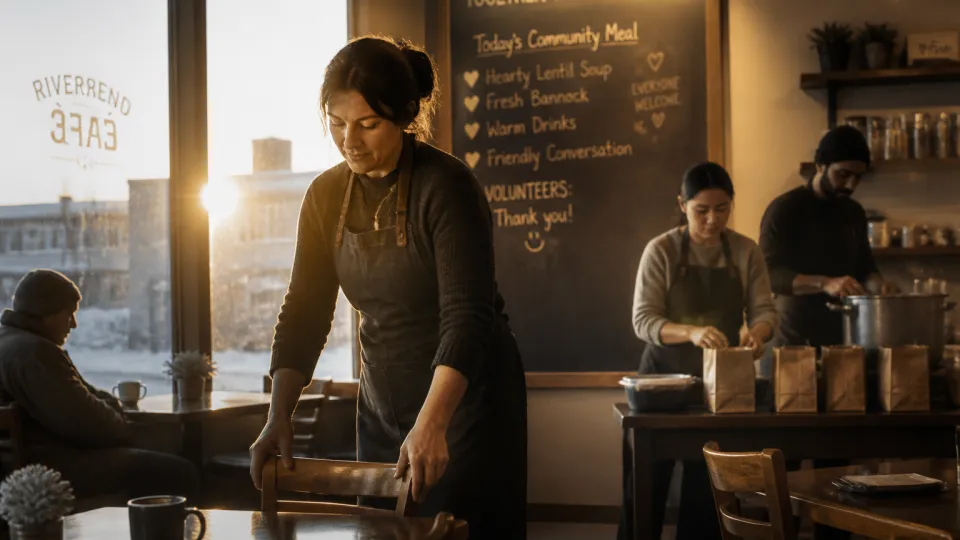
At 5:30 a.m. the lights at The Common Table are always on. In winter, when Brandon’s prairie sky is still a flat, indifferent blue, Elena Vargas moves through the small café with the deliberate economy of someone who has learned to anticipate need. She sets out enamel trays, checks the soup simmering on the back burner, and pins the day’s roster to a bulletin board already pocked with hand-drawn flyers, volunteer phone numbers, and a faded map of Westman.
This is not the scene of a charity kitchen. It is the heartbeat of a business that has quietly redefined what a local entrepreneur does in a mid-sized prairie city. Opened in 2016 with a modest loan and a lot of borrowed equipment, The Common Table started as a simple neighborhood café. Over eight years, under Vargas’s leadership, it became a training ground for newcomers, a delivery hub for seniors, and a staging ground for an array of volunteer initiatives that have filled gaps in Brandon’s social services.
Vargas came to Brandon twelve years ago from Oaxaca, Mexico. She remembers arriving with two suitcases and a handful of restaurant references. "I wanted a place to belong," she told me, stirring a pot of stew that would later be portioned and sent to three isolated households. "Food was the way I found it." What she discovered, she says, was reciprocal: the needed what she offered—consistency, warmth, a place where people could learn real work and be treated with dignity.
The first pivot came in 2017, when a local settlement worker asked if Vargas would host a barista training for newcomers who had culinary experience but no Canadian credentials. Vargas agreed to teach on slow afternoons between lunch rushes. The program was informal at first: an hour of espresso theory, a day of practice, then work shift experience. Within two years, that modest course evolved into a partnership with Assiniboine Community College, which now recognizes the café’s workplace placements as part of a certified hospitality practicum. "Elena gave me my first Canadian reference," said Jaspreet Kaur, who moved to Brandon in 2018 and now manages a hotel kitchen. "She taught me not just how to make coffee, but how to keep my head when the line gets crazy."
Volunteerism threaded through these efforts naturally. Vargas instituted a "Pay-It-Forward" board in 2019: patrons could buy a coffee or sandwich in advance for someone else. The board became a ledger of kindness and, more important, a mechanism for delivering hot meals to people who would otherwise go without. During the pandemic, that ledger swelled into a coordinated effort to deliver meals to seniors isolating at home. With help from local high school students and the Brandon Friendship Centre, Vargas organized a volunteer rota that, over 18 months, delivered more than 3,200 meals.
Not all of her initiatives are visible in numbers. Once a month, tradespeople show up on a Saturday for "Fix-It for Seniors," where they repair leaky faucets, secure handrails, and build small ramps. The program began because Vargas noticed an older woman struggling to get into the café on a wet day. "Small obstacles accumulate," she explains. "They keep people away from coffee and conversation, and that costs us all." Volunteers like Mark Reid, a retired carpenter, say the work keeps them connected. "I’ve learned their stories as much as I’ve learned their needs," he told me. "It’s humbling and useful."
Vargas’s approach is pragmatic. She does not ask the city for grand funding packages; rather, she leverages her day-to-day operations, the unpaid hours of volunteers, and modest grants from civic organizations. Her model acknowledges an uneasy truth: rural and regional towns often depend on informal infrastructure that is resilient but fragile. When the pandemic strained public services, The Common Table’s nimble volunteer network filled immediate gaps—rides to vaccination clinics, hot meals for shelters, and a weekly mentorship circle for teen newcomers.
There have been costs. Vargas rarely takes a vacation. The café operates on thin margins. Volunteers sometimes burn out, and funding for small training programs is never secure. Yet the returns are not merely economic. People talk about trust: newcomers find references and friendships; seniors get out of their houses; young volunteers learn how to steward community resources.
When asked what keeps her going, Vargas gestures to the bulletin board, to a photograph of a child holding a cookie and grinning, to messages from clients who have found work or a steady place to sit. "It’s not about being a hero," she says. "It’s about being steady. If the door is open and the soup is hot, people show up to help each other."
Looking forward, Vargas wants to formalize the café’s apprenticeship program and secure a small municipal grant to expand the Fix-It initiative into neighboring towns. She is candid about scalability: the balance between running a viable business and maintaining a willingness to be messy, responsive, and human. It is a paradox of civic —the very informality that makes such projects effective also makes them difficult to sustain at scale.
What The Common Table offers Brandon is not a blueprint that can be pasted into every town; it is a demonstration of how proximity, trust, and the modest rhythms of daily service can knit a community together. In a region where institutional resources are stretched, local entrepreneurs like Vargas are not substitutes for public investment. They are nevertheless critical connectors—people who turn commerce into care, and whose small daily acts create a ripple effect that alters how neighbors see and rely on one another.
Outside, the prairie light brightens and a school bus rumbles by. Inside, a volunteer ties an apron and a newcomer practices tamping espresso with a steady, learned hand. The door opens, someone comes in wet from the cold, and the day proceeds on the momentum of quiet, sustained service.
"I am still learning how to do this," Vargas says. "But I know what keeps people here. You put the table, you make room, and you keep it clean. Then you invite everyone to sit."