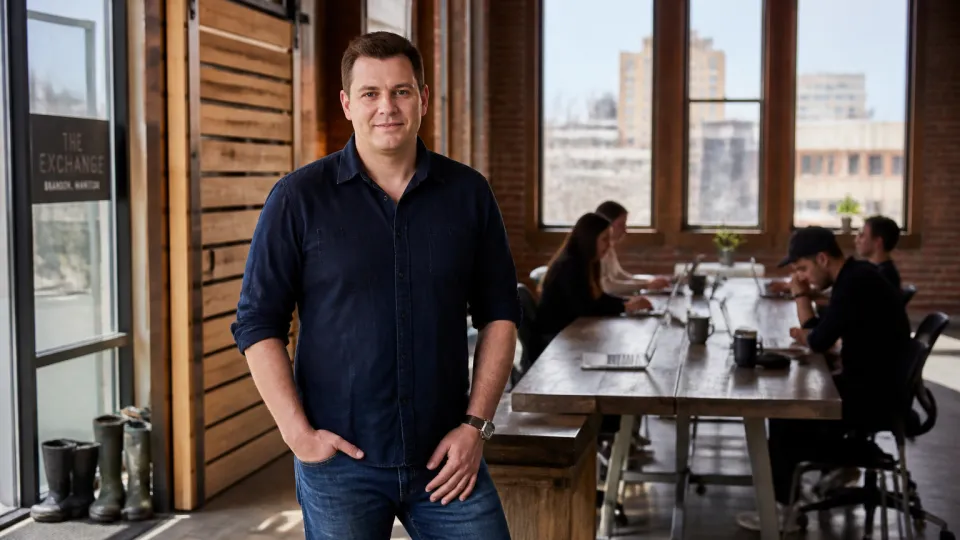
When the morning freight still shook the foundations of the old brick depot, Morgan Ellis would let the door swing open and watch steam rise off the platform. Today the depot is PrairieNode, a co‑working and digital training space in downtown Brandon where sunlight cuts through industrial windows onto mismatched desks and a scattering of work boots. Farmers drop by between fields. Teenagers come after school. Small retailers reserve meeting rooms. The room hums less like a start‑up accelerator and more like a municipal living room where pragmatic tools get made.
Ellis, 36, returns the small-town welcome in kind. Born in Souris and educated in computer science in Winnipeg, Ellis left for a decade of software engineering and product work in Toronto. Rather than transplant a metropolitan hub, Ellis chose to translate technologies for placemaking rather than displacement. 'We wanted tools that fit the rhythms of Westman life,' Ellis says. 'Not flashy prototypes, but things people can use tomorrow.'
That orientation — toward adaptation and trust — has shaped PrairieNode's projects since it opened in 2018. One early success involved Lina Morales, who runs a bakery on Princess Avenue. Lina had relied on walk-in customers and a paper ledger; online ordering felt distant and risky. Working with a student intern supported by Brandon University continuing education, Lina set up a simple website, a pickup schedule and a local delivery radius. Within six months she could staff a consistent second shift and hire a high school student. 'It wasn't about replacing what I loved,' Lina says. 'It gave me time to be in the bakery again.'
The interventions are not all consumer convenience. In partnership with regional producers, PrairieNode piloted field sensors that measure grain moisture and barn temperature. One farmer, Kyle MacLeod from the Virden area, recounts how a sensor flagged elevated moisture in a stored oat bin late in the harvest rush. A phone alert — nothing more complicated than that — allowed him to rotate the bin and avoid spoilage. 'I wouldn't call myself techy,' MacLeod admits, 'but this saved a load that would have been a real hit to the bottom line.' What matters, he says, is that the tech fits his calendar, not the other way around.
That fit was earned, not assumed. PrairieNode runs evening digital literacy workshops at the Souris hall and weekend clinics at the Brandon seniors centre. Ellis emphasizes slow, hands‑on learning: walk someone through a video call until the gesture becomes second nature; set up a business profile together so the owner recognizes the faces that show up. 'There is skepticism here, often for good reason,' Ellis says. 'People have had experiences where digital transitions meant losing control. We try to build control back in.'
PrairieNode also works with educational institutions. Internships with Brandon University and Assiniboine Community College have given students real projects: digitizing farmers' records, designing low‑bandwidth dashboards, and running UX tests with small business owners. These placements are converting outmigration into a different kind of circulation — students return for co-op terms, then for permanent roles. 'Talent is local, if you give it room to grow,' Ellis points out.
None of this has been easy. The region still contends with intermittent broadband and the uneven cadence of grant funding. Projects stall because a fibre extension gets reprioritized or because a volunteer retires. Ellis speaks candidly about those constraints: 'We work on a shoestring with municipal partnerships. The system isn't built for slow, persistent change, but that's what small towns need.' The work, therefore, is as much political as technical — convening town councils, advocating for municipal broadband, articulating measurable but modest outcomes.
The community impact is not only economic. Seniors who learned to use video calls reconnected with relatives; a local youth arts collective livestreamed a performance to a care home that could not otherwise attend; a family physician in Brandon reports that remote follow‑up with rural patients reduced travel strain and improved medication adherence. Ellis frames these as dignity projects — that reduces friction and restores agency.
Looking forward, PrairieNode is moving toward a data cooperative model that would let farmers, small businesses and civic groups control their own datasets rather than relinquish them to opaque platforms. Ellis imagines a regional dashboard that aggregates weather, market and infrastructure signals to help planners and producers make decisions without sacrificing privacy. The cooperative is still a sketch on a whiteboard, but the ambition mirrors the ethos that brought the depot back to life: incremental, collective, practical.
Walking out of PrairieNode at twilight, the depot's brick face takes on a warm amber. Trucks pass on the highway toward the fields; a student types at a corner table; Lina locks up after a late‑afternoon rush. The technological uplift Morgan Ellis champions is not a cure‑all but a series of small refusals — to centralize power, to assume one‑size‑fits‑all solutions, to equate progress with displacement. In Westman, that refusal looks like people learning to use new tools on their own terms, and slowly, quietly, remaking what prosperity can mean in a small town.