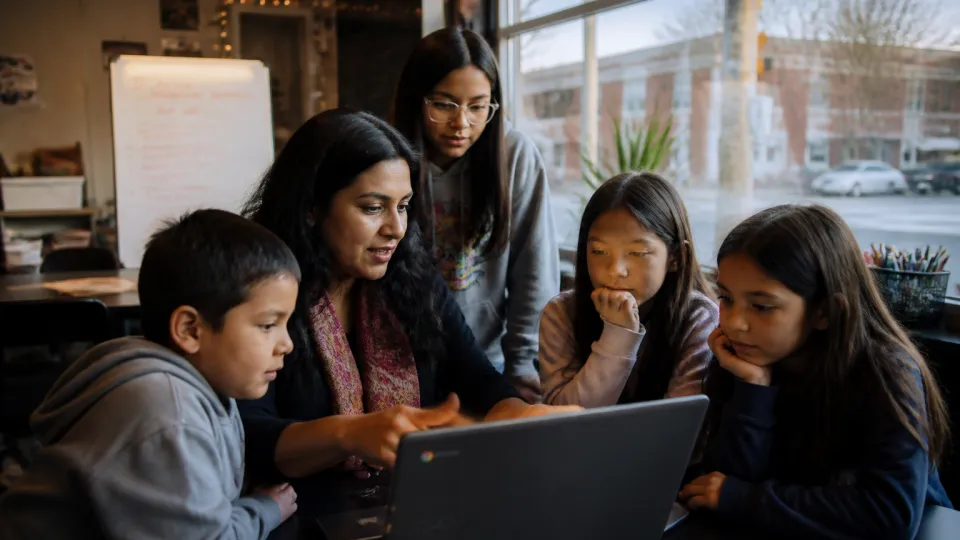
On a midwinter morning, the heat pumps hum and a stack of donated coffee mugs crowds the counter of a long-ago grocery storefront on 18th Street. Through the tall windows, delivery trucks move past the grain elevator and the steady, unremarkable choreography of Brandon life. Inside, a dozen people sit shoulder to shoulder: a high-school student debugging a website, a newcomer from Syria rehearsing an interview, and a retired farmer leaning over a tablet to learn precision-agriculture software.
“At first I thought if I could open the doors, people would come,” Anika Sharma says, folding her hands and laughing softly. “What I didn’t know was how fast the room would start to feel like a classroom for every kind of life.”
Sharma, 38, founded Prairie Learning Lab six years ago after a decade teaching adult-education classes and working with settlement agencies. The lab is not a single program but a handful of practices stitched into one place: short technical courses, partnerships with local schools and businesses, pop-up workshops in nearby towns, and a gentle, relentless attention to how people learn in real life.
Her model is modest in infrastructure and ambitious in intent. Where larger institutions often standardize learning by content, Prairie Learning Lab standardizes access—flexible scheduling, pay-what-you-can pricing, on-site childcare, and mobile workshops that travel to farming communities. The lab’s offerings have ranged from a week-long bootcamp that turned unemployed youth into entry-level IT technicians to a night class where senior citizens learn to manage digital banking and health portals.
There is a clear through-line to Sharma’s approach: education should amplify local opportunity. “We teach skills that connect to work here,” she says. “Not an abstract notion of success, but the kinds of things employers and leaders actually need.” That has meant designing short micro-credentials with Brandon businesses, pairing learners with mentors, and sending instructors to community halls in Rivers and Neepawa.
The results are small but tangible. Tom Reynolds, a 52-year-old grain farmer from south of Brandon, took a two-day “FarmTech” workshop last year and later adopted satellite-guided planting that reduced seed costs and fuel use. “I’ve farmed for thirty years,” he says, “but I didn’t know how a smartphone could talk to my tractor. Now my son and I plan fields together—on a screen. It saved us time and money, and it’s opened conversations we didn’t have.”
Sharma’s lab also reaches newcomers in ways larger programs sometimes miss. Partnership with Westman Immigrant Services and a mentorship program with Brandon University means newcomers have both practical training and a social map. “Anika doesn’t just teach; she opens networks,” notes Dr. Laura King, who directs a workforce development initiative at Brandon University. “That’s the real lever for long-term change.”
The Lab’s pedagogy is quietly iterative. Instead of formalized curricula rolled out once a year, instructors prototype week by week, asking learners what works and what doesn’t. A coding class pivoted to project-based learning after students said they needed portfolio pieces for applications; an English-language workshop became an primer when women from rural communities asked how to sell preserves at farmers’ markets. These shifts keep the work rooted in context rather than in a prescriptive ideal.
Sharma’s own story informs that pragmatism. Arriving in Brandon as a student in her twenties, she balanced studies with part-time work and childcare. “I learned how education fails you when life is messy,” she says. Her business model reflects those margins: a sliding-scale fee structure, evening hours, and an explicit focus on learners balancing multiple responsibilities.
Community impact is not only measured in certificates. It’s visible in the small, relational exchanges—the mentor who helps a newcomer find childcare so she can take a daytime course, the employer who hires a lab graduate after seeing his portfolio, the elder who teaches Indigenous land practices in a workshop and hears young farmers ask hard questions. Prairie Learning Lab reports more than 650 participants in five years, but the deeper markers are the informal networks and micro-economies those participants have begun to produce.
Still, the work is far from finished. Sharma speaks candidly about constraints: unstable funding, the challenge of scaling without losing intimacy, and the persistent digital divide in dispersed rural pockets. Her next step is a distributed model—a converted school bus fitted with laptops and a satellite connection that will take workshops to towns where public transit is rare and broadband is patchy. She is also trialing stackable micro-credentials jointly with local employers so that short courses convert directly into recognized qualifications.
“We’re trying to stitch an ecosystem,” Sharma says. “It’s not just about what someone knows at the end of a workshop—it’s about whether that knowledge plugs into a real livelihood here.”
In Brandon’s pragmatic, weathered economy the work feels less like reinvention than repair: building systems that respect the rhythms and constraints of people’s lives. As the Lab expands its bus route and pilots credentialing partnerships, the gamble is that small, context-driven learning experiences can shift trajectories. For many in Westman, those shifts are already measurable in a hired learner’s first paystub, in a farmer’s quieter season, and in a newcomer’s confidence in a job interview. For Sharma, the metric remains human: whether the room feels full when the doors open. So far, it does.