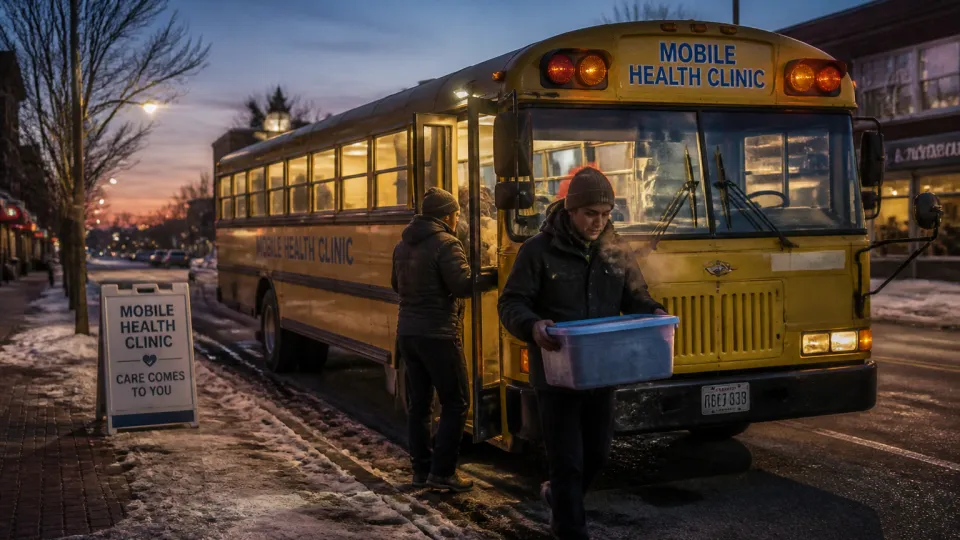
At dawn on a January morning, a faded school bus idles near the grain elevators on Brandon’s west side. Heat huffs at the windows; a kettle whistles on a tiny counter inside. The bus is painted a calm teal and lettered with a name that has become quietly familiar across Westman: Prairie Health Collective. Nora Patel unlocks the door, checks a cooler of vaccines, and folds out a chair for an afternoon homebound visit. "We show up where people already are," she says, pausing to lace gloves. "That’s the point."
Patel’s story is, in one sense, unremarkable: a childhood in a working-class immigrant household, nursing school in Winnipeg, then years on emergency wards and clinics. But unremarkable things get reconfigured when they meet stubborn possibility. In 2018, frustrated by repeated stories of people left waiting or turned away — seniors who couldn’t get rides, young parents squeezed between shifts, Indigenous elders whose histories made clinical spaces feel unsafe — Patel began sketching a different model. She wanted care that was portable, culturally responsive, and modestly priced for a region where geography and poverty often decide life chances more than diagnosis.
The bus was a scrap that cost less than a used van. Patel tinkered with wiring and scored donations: a portable exam table from a retired clinic, touchscreen tablets for intake, a chest of culturally relevant brochures translated into plain language. She recruited volunteers—retired nurses, social work students, and local paramedics—and in under a year the pilot was serving three neighborhoods a week. The Prairie Health Collective was not just a mobile clinic; it became a connector: a place to apply for benefits, a phone charger hub, the first point of contact for people who would otherwise wait until their conditions were urgent.
What sets Patel’s approach apart is how she measures success. "It’s not just how many needles or vaccines we give," she says. "It’s whether someone sleeps better because they have their medicine, whether a parent learns to check blood sugar, whether an elder trusts the next provider." To that end, the Collective embedded a training program for community health workers drawn from the neighborhoods they serve. Trainees—many with lived experience of addiction, poverty, or housing instability—learn clinical basics alongside communication skills and boundaries. Since 2019, more than sixty community health workers have been trained, Patel reports, and many now work part-time with the Collective or have moved into other regional clinics.
The initiatives have concrete effects. In a six-month pilot with two Brandon family practices, the presence of the mobile unit and community workers reduced non-urgent emergency visits among enrolled frequent users, freeing triage nurses to focus on acute cases. Patel is careful not to overclaim: data are early, and she frames numbers as conversation starters. Still, anecdotes multiply. A man named Darren, who struggled with uncontrolled diabetes, began meeting a community worker at weekly coffee-stop clinics. With regular glucose checks and a phone call when medication ran low, he avoided the hospital admission that had become his winter routine. "They come and they don't judge you," Darren told a local reporter. "That matters."
Patel has been intentional about partnerships. She consults with Indigenous Elders to design culturally safe practices, provides harm-reduction supplies in collaboration with local shelters, and schedules vaccine clinics at places of worship. The Collective also piloted telehealth pods in two rural hamlets: soundproofed booths equipped with secure video links to Brandon specialists, reducing long bus rides for routine consultations. "We try to stitch the health system into the social fabric," Patel says. "It’s about lowering the barriers—transport, language, shame—that keep people from care."
Running a social enterprise in a province where health budgets are tight has required creativity. The Collective mixes fee-for-service contracts, modest municipal grants, and sliding-scale fees, but Patel argues the real resource is human capital. "Trust isn’t funded in budgets," she says, "it’s earned by showing up consistently." That consistency has also drawn attention from policy-makers in Winnipeg. Officials have toured the bus and asked about scalability, and Patel now sits on a provincial advisory group looking at rural health . Her pitch is practical: invest in community health workers, support mobile infrastructure, and fund culturally safe training."
Looking forward, Patel wants to move from reactive care to prevention: expanded chronic-disease education, school-based mental health programming, and a satellite hub in a neighboring town that lacks evening clinics. She is candid about limits—the staff are stretched, winter weather compromises travel, and changing provincial priorities can derail pilots—but she trusts the slow work. "Systems change is messy and incremental," she says. "But when a neighbor doesn’t wait hours in an emergency room because we met them first, that’s real."
In the warmth of the bus, with a kettle’s steam threading through the hum of a refrigerator and a handwritten schedule tacked to the wall, the argument for place-based, person-centered care feels simple and stubbornly human. Patel’s enterprise has not solved rural health inequities, but it has made that discrepancy visible and negotiable. For a region where distance has often been an unacknowledged determinant of health, the Prairie Health Collective represents less a silver bullet than a persistent, calibrated refusal to accept inaccessibility as fate. "We’re trying to make healthcare a relationship," Patel says, and in Brandon, that relationship is starting to change how people get seen, heard, and helped.