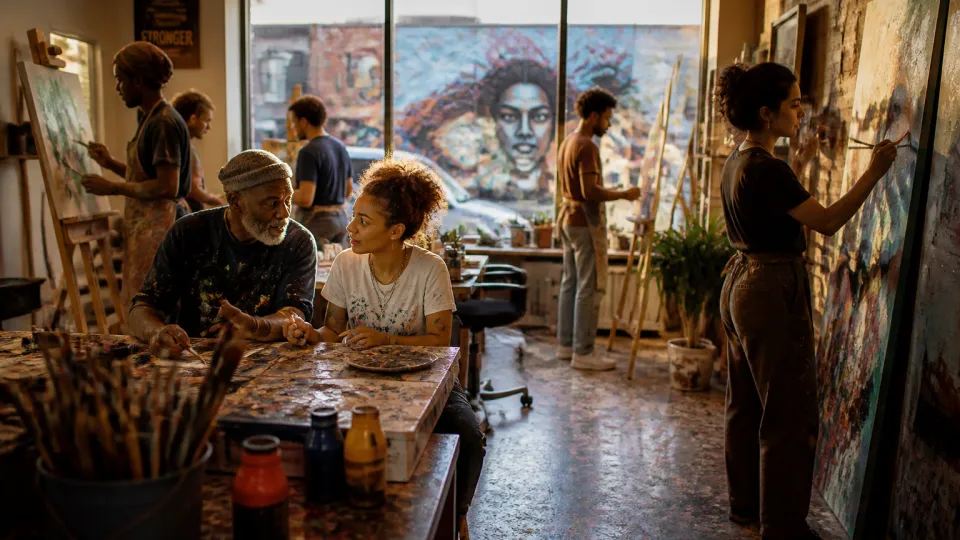
They came for soup and a kiln, for an exhibition opening and a repair workshop, for a place where a teenager could learn to lace a canvas stretcher and a retired teacher could offer a reading. The storefront, once a windowless drizzle of peeling paint and pawnshop signs, now buzzed with layers of attention: the hush of someone glazing pots, the urgent laughter of kids constructing cardboard instruments, the dry, satisfied applause when a poem landed.
What moved the crowd was not just the mix of activities but the fact that the space had been claimed deliberately as something civic. It belongs to the Prairie Light Collective, a initiative that began five years ago with a single seed grant and a stubborn belief: that can be more than an amenity for the affluent—they can be infrastructure for belonging.
"We kept calling it a laboratory," says Maya Thompson, the collective's director and a painter who returned to Brandon after a decade in Winnipeg. "Not because we wanted to experiment with art for art's sake, but because we wanted to experiment with what public life might look like when creative practice is treated as essential."
The Prairie Light approach is pragmatic and granular. Instead of one flagship gallery, the collective has negotiated short-term leases on vacant commercial units across Brandon and two smaller towns—turning them into studios, pop-up galleries, rehearsal rooms and a monthly repair cafe. They run an apprenticeship program—Lumina—that places young people in mentorships with makers and theatre technicians, and they commission murals in partnership with local businesses. Most importantly, their programming intentionally mixes ages, languages and incomes.
Take the ceramics program. Earl McKenzie, 68, worked his whole life in farm equipment sales. After his wife died, he found himself building birdhouses—then cups—and eventually asking for studio access. "I thought art wasn't for me," he told me as he pulled a wet mug from the wheel. "But here, somebody said 'we'll show you' instead of 'you can't.' That changed everything." His work now sits on the shelves of a coffee shop in downtown Brandon, where the extra sales help pay for kiln maintenance and a bursary fund.
Or consider Sofia Alvarez, 17, whose family emigrated from El Salvador seven years ago. Her first English teacher sent her to a Prairie Light youth mixer, where she encountered a sound technician who taught her to route audio for live shows. "I was so scared to speak up," Sofia recalls. "But when I pushed the fader, people clapped for me—not because I was loud, but because I made something happen." She is currently apprenticing with a touring light designer and hopes to study technical theatre at Brandon University.
These personal trajectories matter because they aggregate into measurable local effects. Shop owners report longer dwell times on blocks where pop-ups operate; a municipal survey last year suggested an uptick in foot traffic and a modest drop in vacancy rates in targeted corridors. More abstractly, public safety conversations have shifted: residents who once framed empty storefronts as blight now describe them as civic assets that require stewardship.
Funding has been a patchwork—municipal seed funding, private donations, ticket sales and an experimental revenue-sharing model with local businesses—but it is also the collective's primary vulnerability. "We're still figuring out how to scale without losing what makes us relational," Thompson admits. Volunteers burn out; municipal grant cycles are short; and rising rents threaten the very spaces they rescue.
To confront these fragilities, Prairie Light is pursuing a two-pronged strategy. First, it is institutionalizing a small endowment through a mix of philanthropic pledges and business partnerships; second, it is formalizing partnerships with Brandon University's arts faculty to create stable apprenticeship pipelines and shared studio resources. Both moves underline a wider point: when arts work like public services—teaching, repair, mentoring—they require diverse, long-term support.
The work also forces a reconsideration of what cultural value looks like in a prairie city. Prairie Light's projects are not glossy; they are often uneven, full of compromise, and animated by people who want to belong rather than impress. That ordinariness is the feature, not the bug. In an age when cultural programming can become a tool for gentrification, this collective aims to redistribute capacity.
Looking ahead, the collective envisions a regional "arts trail" linking Brandon with smaller towns—studio stops, nightly performances on grain elevators repurposed as projection surfaces, a mobile makers' van that brings equipment to remote schools. Such ambitions are both logistical and symbolic: an admission that creative life in Westman is not confined to a single downtown block but scattered across fields, basements and kitchen tables.
The story of Prairie Light is not a tidy success narrative. It contains unresolved tensions about funding, displacement and the difficult labor of sustaining volunteer goodwill. But it also contains something harder to quantify—a network of relationships that reroute meaning and possibility. On a rainy evening, with clay under his nails and a teenage sound tech nervously cueing a folk trio, Earl summed it up simply: "It's like the town finally has a mirror. And in that mirror, people see each other differently."
Not every community will replicate Prairie Light's exact model. But the lesson it offers—about treating art as a practice that knits civic life rather than decorates it—feels timely and durable, a small, patient redesign of what public life might be in the wide prairie between cities.