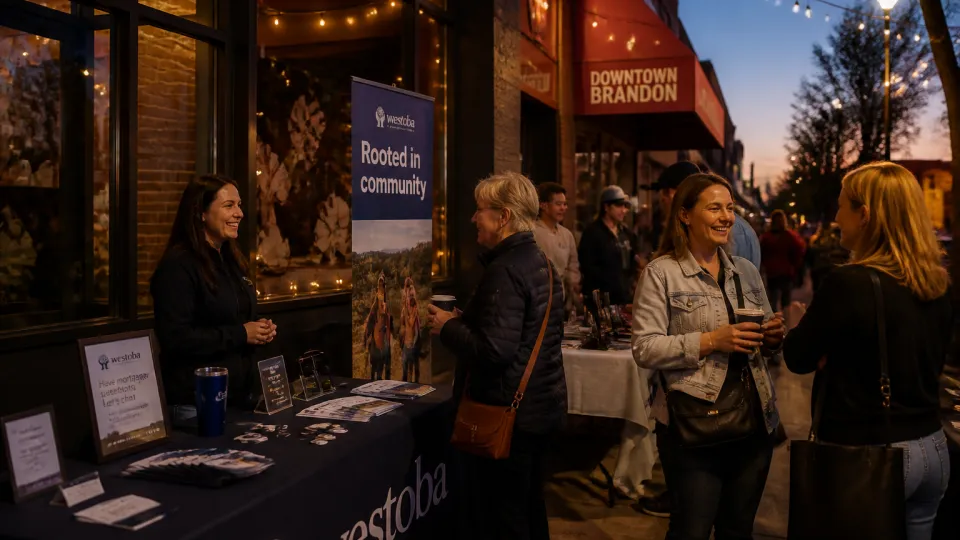
The air outside the hall on a cool spring evening smelled of frying onions, fresh coffee and new cardboard. Under strings of borrowed bistro lights, folding tables displayed everything from hand-woven wool scarves to 3-D-printed irrigation sensors. People leaned in close to ask questions, hand over business cards, and trade small, hard-won advice: where to find a reliable bookkeeper, how to get a permit for a food trailer, which grant officer actually answers the phone.
This was not a trade show staged by a chamber of commerce alone. It was a weekend-long gathering in Brandon that drew entrepreneurs from across Westman — Neepawa florists experimenting with direct-to-consumer markets, Virden welders repurposing oilfield equipment into agricultural tools, and Minnedosa graduates who had coded soil sensors in university labs and decided to bring them back home. The event's rhythm mirrored the improvisational economy it celebrated: a mix of earnest hustle, practical inquiry and mutual support.
"We used to think your options were leave or stay and keep doing the same thing," said Ida Martin, a textile maker who runs Prairie Loom out of a refurbished storefront in Neepawa. "Now it's: how do we stitch new work into the things we already love? That's what keeps people coming back to these towns." Her hands—callused from the loom—paused over a sample blanket as she spoke. "People don't just buy from me. They want a story, a job for their neighbor, a reason to go downtown."
The entrepreneurs at the festival represented a wide range of models. Some are micro-businesses built on family labor and local supply chains: a fourth-generation potato processor in Carberry that now sells branded, small-batch crisps online; a bakery in Rivers that trains high-school students during summer months. Others are the province's quietly ambitious rural tech initiatives—startups that pair agronomy know-how with inexpensive sensors and subscription software to help small farms squeeze more yield from less input.
The human stakes behind these ventures were clear. Evelyn Cross, who started Riverbank Bakery after layoffs shrank employment in her town, told me she didn't see a choice. "I needed a job that would let me be a mom and still contribute financially," she said. "Opening a bakery felt risky, but it also brought customers back downtown. The school bus drivers stop for coffee now; grocery sales are up Tuesday mornings. That ripple matters more than the paperwork."
That ripple is the story of rural in Westman: individual creativity that becomes civic infrastructure. When a storefront fills, the block looks less abandoned; when a youth hires a friend, migration slows. That logic drives investment decisions at the municipal level now. Mayors and economic-development officers attend pitch sessions not because they're dazzled by projections but because they are trying to protect the social fabric of their towns.
Yet here is often born of scarcity. Access to capital is uneven; many entrepreneurs rely on credit cards, community-loaned sums or family equity. Broadband, still patchy beyond Brandon and some larger towns, constrains e-commerce ambitions and remote-service models. Supply chains built for large operators do not fit a craft candle maker packaging tins in a church basement. "We solve problems with ingenuity because we have to," said Miguel Alvarez, a 29-year-old developer from Minnedosa whose firm retrofits irrigation controllers with low-cost sensors. "But ingenuity without scale and without networks can feel like banging your head against the wall."
What changes that dynamic is collective infrastructure: a shared repurposed storefront, a coworking hub that offers bookkeepers' office hours, a procurement agreement with a regional hospital to buy local foods. In Brandon, organizers are experimenting with pop-up retail weeks where multiple vendors rotate through a single, subsidized space. In smaller towns, farm co-ops are pooling marketing resources to reach urban food buyers in Winnipeg and beyond.
There is also a quiet but consequential cultural shift: entrepreneurship is no longer framed as a solitary, risk-embracing youth project. Retirees mentor youth coders; school curriculum includes basic bookkeeping; municipal procurement officers deliberately source from local suppliers. "The most sustainable businesses here are the ones that bind people together," observed Dr. Lila Thompson, a regional economic researcher who attended the festival. "They address local needs and reuse local assets—skills, buildings, social trust."
Looking forward, the picture is cautiously optimistic. If broadband continues to improve and if flexible, patient capital becomes more available, these enterprises can graduate into employers that anchor stability rather than precarious piecemeal work. Policies that target procurement, provide co-investment for shared spaces, and reduce red tape for micro-retail would magnify the existing momentum.
But the deeper change is cultural. Across the hall that evening, a high-school student from Souris asked a veteran potter how she priced her wares. The potter's answer—about time, value and what the town could afford—was not simply a lesson in accounting. It was a transmission of civic judgment: when a community decides what it values, it shapes the market it gets.
Rural entrepreneurship in Westman is, in that sense, less about a new industry and more about a new conversation. It recognizes scarcity as a condition to be negotiated, not a fate to be accepted. The entrepreneurs filling Brandon's hall were not just occupying market niches; they were rehearsing how to live together, economically and socially. In five or ten years, the success of that rehearsal will look less like a skyline of startups than like main streets that host a wider range of work—and communities where leaving is no longer the only way forward.