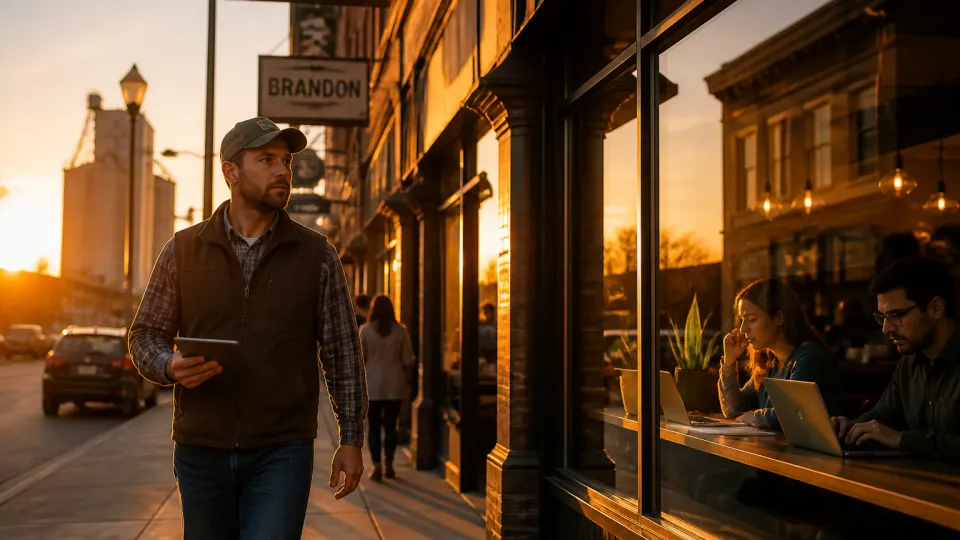
At 6:30 a.m. a farmer in the bright chill outside Neepawa unlocks his pickup, scrolls through a field map on his tablet and adjusts the day’s seeding plan. A few blocks away, in downtown Brandon, a retired teacher learns Zoom at the public library with the help of a student volunteer. These are quiet, ordinary signals of a larger reshaping: Westman’s small towns are adopting in ways that change work, social life and civic expectations.
The last half-decade has been catalytic. The pandemic forced health systems to offer telemedicine and encouraged downtown cafés to become ad hoc offices. Federal and provincial broadband dollars have flowed into infrastructure programs such as the Universal Broadband Fund, and local entrepreneurs have started to layer devices, software and services on top of improved pipes. The headline is hopeful — connectivity is expanding — but the lived reality across towns like Virden, Dauphin, Carberry and Brandon is more complicated.
Take healthcare. At Brandon’s regional centre, clinicians now routinely use videoconference links to consult with specialists across the province. For patients in surrounding towns, that could mean a specialist appointment without a five-hour round trip in winter. "For my mother, being able to see a neurologist by video kept us from pulling her from home so often," said Sophie Martin, a caregiver in Minnedosa. "It made a difference in how we plan her care." Yet telemedicine’s reach is constrained by connection reliability, digital literacy and privacy logistics. Some home-care visits still default to in-person because a patient’s last-mile connection drops or because there isn’t a private space to consult online.
Agriculture — Westman’s economic backbone — is fertile ground for technological change. Farmers describe soil-sensor arrays, auto-steer tractors, and drone scouting as tools that layer efficiency onto decades of local knowledge. "We measure, we test, we adapt," said Caleb Ward, who runs a mixed grain operation near Virden and recently installed field sensors. "If the sensor tells me a patch is drying out, I can budget water and seed practically down to the square metre." These investments often improve yields and environmental stewardship. But they also require capital, training and robust rural broadband to collect and transmit data. Smaller operators or tenant farmers sometimes get left behind.
Small businesses tell similar stories of uneven adoption. In downtown Brandon, a bakery owner pivoted to online ordering and delivery, doubling its weekday base during the pandemic. Across the region, however, retail adoption depends on an owner’s comfort with payment systems, digital marketing and fulfillment logistics. "I’ll put a product on Facebook, sure, but navigating e-commerce platforms felt like learning a new language," admitted Jenna Thompson, who runs a gift shop in a town outside Brandon. Municipal support programs and peer mentoring are beginning to bridge that gap, but progress is incremental.
Digital literacy is the human hinge of this transformation. Libraries, community colleges and volunteer groups have stepped into that space. Assiniboine Community College, for example, offers short courses and workshops aimed at upskilling local entrepreneurs and tradespeople. "Infrastructure is only the first mile," said Dr. Maria Lopez, an educator who coordinates community learning programs. "People need hands-on help to turn access into agency."
There are also social tensions to navigate. Younger residents often see remote work as a chance to build a life in Westman without migrating to Winnipeg or Calgary, but that requires reliable speeds and coworking culture. Older residents worry about social isolation as services digitize. Local governments face decisions about whether to subsidize last-mile connections, invest in municipal networks, or partner with private providers — all while budgets are tight.
Some towns are innovating in ways that reflect local values. Cooperatively owned broadband initiatives, pop-up telehealth rooms in community halls, and shared machinery programs for precision-ag hardware have emerged as pragmatic, community-led workarounds. "We try solutions that fit our scale," said Mayor Laura Reid of a small municipality south of Brandon. "It’s not about replicating a city model; it’s about building resilient local systems."
Looking forward, Westman’s path will hinge on three things. First, investment that targets both infrastructure and people: money must pay for training, devices and ongoing support, not just fiber on poles. Second, governance models that center local control and affordability to prevent monopolies from extracting value from rural economies. Third, an inclusive approach to that keeps seniors, seasonal workers and the region’s Indigenous communities part of the conversation.
Technological adoption is less a wave that sweeps a place than a set of small, persistent rewrites to how communities live and work. In Westman, each tablet, sensor and Zoom call carries the imprint of relations — between neighbours, between farmers and markets, between patients and clinicians. The story is not a tidy arc from analogue to digital but an evolving set of compromises and experiments. The real question is not whether Westman will adopt technology — it already has — but who will shape that adoption and who will be left to adapt.
On a late afternoon in a small coffee shop, a young teacher and an older man argued gently about the merits of an online civic forum. They were both new converts in different ways. Outside, the grain elevator stood like a punctuation, a reminder that the region’s future will be written in both silicon and soil. That hybridity — practical, sometimes messy, and inevitably human — may be Westman’s truest advantage.