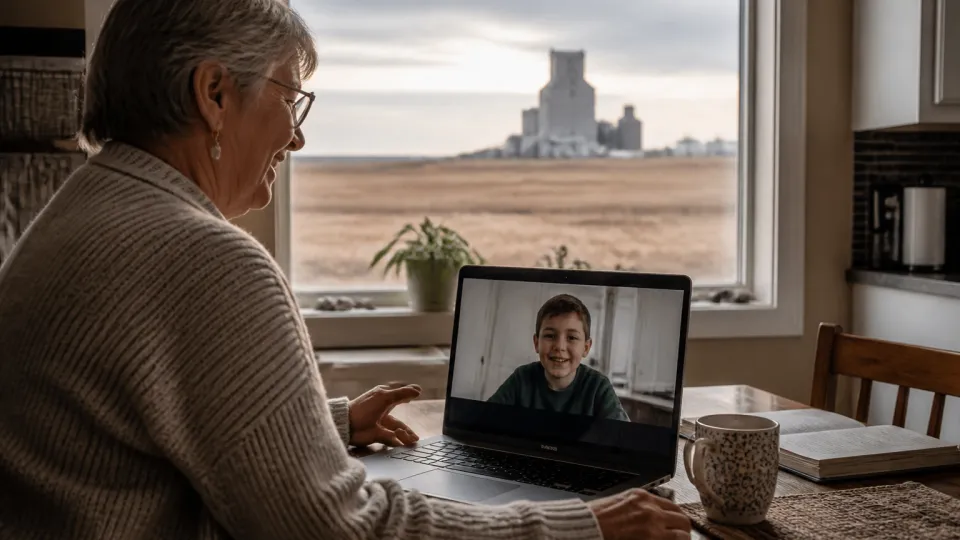
On a late April morning in Rivers, the kitchen table looked like a small, domestic nerve center. A knitted afghan draped the back of a chair; a chipped mug steamed beside a tablet propped on a cereal box. Evelyn Klassen, 68, tapped the screen with a steadiness she hadn't expected. "I was nervous at first—my hands shake sometimes—but when my grandson popped up, I could almost hear the prairie outside through the screen," she said, laughing.
Evelyn's video call was possible because of a modest municipal investment: a Wi-Fi hub housed in the public library that beams a strong signal across Main Street. It is one small example of a larger shift playing out across Westman, where towns from Brandon to Neepawa are layering digital infrastructure onto long-standing social practices.
The story of here is not one of flashy launches or venture capital. It’s quieter—about coaxial cables replaced by fiber strands, about seniors learning to use video calls to keep family ties, about local grocers experimenting with online ordering and small farmers testing drones for crop scouting. Those changes reroute time, attention and hope in ways that are intensely local.
In Brandon, Assiniboine Community College and Brandon University have both become anchors for adult digital literacy programs. "We saw a gap after the pandemic receded," said Joanne Rempel, who directs community outreach at the college. "People had the devices, but lacked the confidence to use them for health appointments, banking, or to access government services. That’s a real barrier to participation." Classes are practical—setting up email, joining a Zoom call, understanding basic privacy settings—and they’re offered in evenings so shift workers can attend.
Healthcare, perhaps more than any sector, reveals the layered benefits and frustrations of rural tech adoption. At the Brandon Regional Health Centre, a telehealth corridor now links patients in satellite clinics to specialists in the city. "We’ve cut travel for fragile patients by weeks at a time," said Dr. Aisha Mohammed, the hospital's telemedicine coordinator. "But effective care still depends on local relationships: a nurse in Souris knowing the family by name, then setting up a relay to a neurologist in Brandon. Technology enables the connection, but the human ties carry the treatment."
For farmers, technology is altering rhythms that once shaped every day. Near Neepawa, farmer Mark Ducharme described a season when he relied on satellite soil maps and a drone that flagged an early sign of blight. "It saved us a crop," he said. "But it took a couple of neighbours to decode the data, and then we fixed the patch together." Precision agriculture tools are expensive and often offered by third-party companies. Where adoption has succeeded, it’s because community-minded co-ops and informal mentorship networks have lowered the learning curve.
Small businesses are experimenting, too. At a hardware store in Virden, owner Lina Perez built an online catalogue to survive slower winter months. "At first we worried it would strip away the hometown feel," she said. "But customers still come in for advice; they just order in advance now, and it's easier to manage inventory." The change is less a revolution than a reallocation of labor and imagination.
These stories reveal a pattern: technology helps where social capital already exists. Libraries, school gyms, grain co-ops and seniors' centers act as translators—places where digital tools are introduced alongside patient instruction. They also expose gaps. In pockets with patchy service, young people report leaving for education or work because they cannot pursue remote careers. Affordability remains a hurdle; a fast connection is useless if monthly costs outrun a household budget.
Local leaders are responding with varied strategies. Some municipalities negotiate community-owned fiber; others lobby for targeted subsidies that prioritize low-income households. Educators press for digital curricula that teach not only coding but also civic media literacy. Health administrators pilot hybrid care models that combine face-to-face visits and remote follow-ups to preserve continuity.
What gives the technology project in Westman its moral shape is a stubborn insistence on people-centered design. "We didn’t want to import solutions from far away and drop them in like a prefab barn," said Sara Bellamy, a community planner in Brandon. "We asked: how does this change the way neighbours check on each other, or how kids learn? That question keeps us honest."
Looking forward, the region's challenge will be scaling without losing intimacy. That means investing in infrastructure, yes, but also in the social scaffolding that makes new tools meaningful: training, shared governance, and deliberate efforts to include those most at risk of being left behind. Technology can expand possibilities, but it will only do so if communities retain the capacity to teach, negotiate and care.
Back in Rivers, Evelyn closed her tablet after an hour of catching up, her face soft with the satisfaction of a conversation that folded distance into a domestic circle. "It’s not the machine that matters," she said. "It’s who you’re talking to." Across Westman, people are building the systems to make that simple truth more possible, pixel by pixel, neighbour by neighbour.