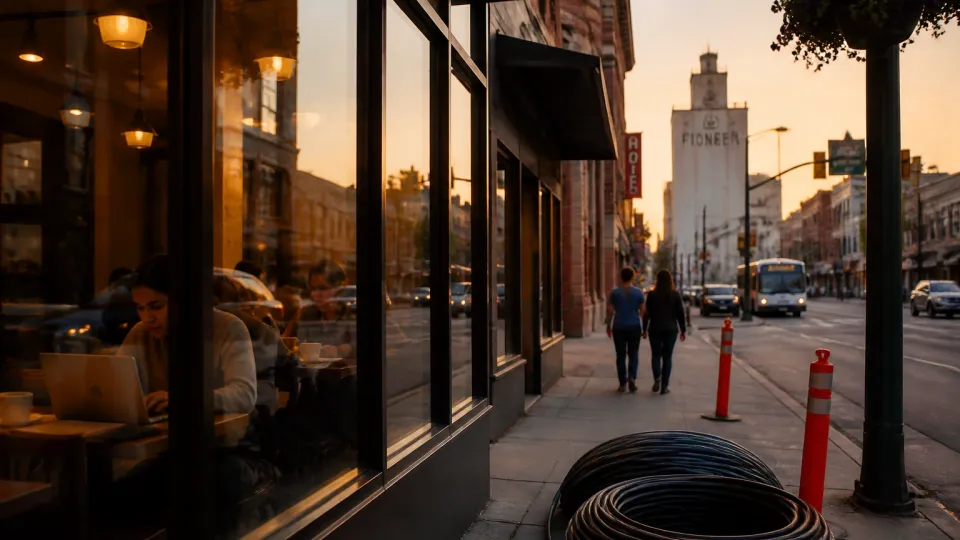
It is a late autumn afternoon on 10th Street in Brandon. Through the café windows, a teacher finalizes slides for a remote lesson, a farmer skims market prices on his tablet, and a nurse returning from a shift pulls up a virtual consult from a small clinic an hour away. The scene is ordinary, and that ordinariness is the achievement: in Westman has stopped being a novelty and begun to feel like infrastructure, like roads or electricity—quiet, indispensable, and in the process remaking daily life.
The move toward connectivity here has been pragmatic rather than mythic. Organizations such as Westman Communications, regional health authorities, Brandon University, and a patchwork of federal and provincial programs have oriented investments toward wires, towers, and training. The federal Universal Broadband Fund and private providers like Xplornet have helped extend service beyond Brandon into towns such as Neepawa, Virden, and Swan River. These are not just statistics on a report; they are the conduits through which new patterns of work, care, and learning travel.
Take health care. Prairie Mountain Health, the provincial body responsible for much of Westman, has leaned into telemedicine as a way to keep specialists virtually present in small clinics. For residents in outlying towns, that means fewer all-day drives to Brandon Regional Health Centre and more continuity of care. "We can get a pediatric specialist on-screen in less than an hour now," says a clinician in a rural clinic. "It changes how families plan their weeks and how we follow chronic conditions." Telehealth has also surfaced limitations: older residents may still prefer in-person conversations, and inconsistent home internet can complicate post-discharge check-ins.
In downtown Brandon, small-business owners have become one of the clearest barometers of change. Amira, who runs a bakery on Rosser Avenue, remembers the moment she decided to digitize orders. "We started with Instagram and then moved to a simple web portal during COVID," she says. "Now 30 percent of our sales come from online orders—and it's allowed me to hire another baker." The migration to e-commerce has been uneven. Where fibre reaches, shops integrate inventory systems and offer curbside pickup; where speeds lag, proprietors rely on phone calls and foot traffic. That contrast is visible in neighboring towns: a main street that hums with online sales sits not far from a hamlet still waiting for reliable mobile service.
Agriculture, the long-standing backbone of Westman, offers another instructive example. Farmers here are not late adopters of precision tools; many use GPS-guided equipment, satellite imagery, and moisture sensors to calibrate inputs and chase margins measured in cents per bushel. On a mixed grain operation outside Brandon, a farmer runs a tablet that overlays yield maps with soil data, making seeding decisions with a level of granularity unavailable a generation ago. Yet the technology raises new questions about ownership and skills. Devices produce data that ends up on corporate platforms; interpreting that data demands either new hires or new training programs in small towns where the labour pool is already thin.
Community spaces have responded to that need. The Brandon Public Library, community centres, and local adult-education programs now offer digital literacy sessions, from basic smartphone use to bookkeeping software for microbusinesses. Brandon University has expanded hybrid offerings, keeping a campus presence while opening channels for students who cannot relocate. These efforts underline an often-overlooked reality: connectivity is not automatic empowerment. It requires mediation—people and institutions that translate code and hardware into local capabilities.
The adoption of technology also changes culture in gentle but meaningful ways. Evening town-hall meetings now include agenda items like municipal data privacy and the siting of new cell towers. Seniors' groups experiment with tablets for virtual choir rehearsals. Youth in neighbouring rural schools collaborate on robotics projects with university labs in Brandon. Technology becomes a scaffold for civic imagination as well as commerce.
Looking forward, the path is neither linear nor purely technical. The immediate task remains physical: closing gaps in last-mile infrastructure so that a clinic in a village or a storefront on an outlying highway gets parity of service. But beyond fibre and towers lie questions about governance and equity. Who controls the platforms that collect community data? How will training programs be sustained after initial grants end? How do towns balance the efficiencies of automation with the desire to preserve local jobs and public-facing services?
Westman offers an instructive model because its adjustments have been incremental, experimental, and community-rooted. Technology arrives, and towns test it, complain about it, shape it, and, in small ways, humanize it. The most important lesson is not that broadband alone lifts a town; it is that reliable connectivity becomes meaningful when coupled with local institutions that teach, translate, and advocate.
If the future of Westman is digital, it will be one built in conversation: between farmers and engineers, nurses and software vendors, small-business owners and municipal planners. The stakes are ordinary—appointments kept, books sold, crops optimized—but their accumulation reshapes opportunity. For places like Brandon and the towns beyond, technology is not a panacea but a new kind of commons: useful only if tended with patience, skill, and a sense of shared stewardship.