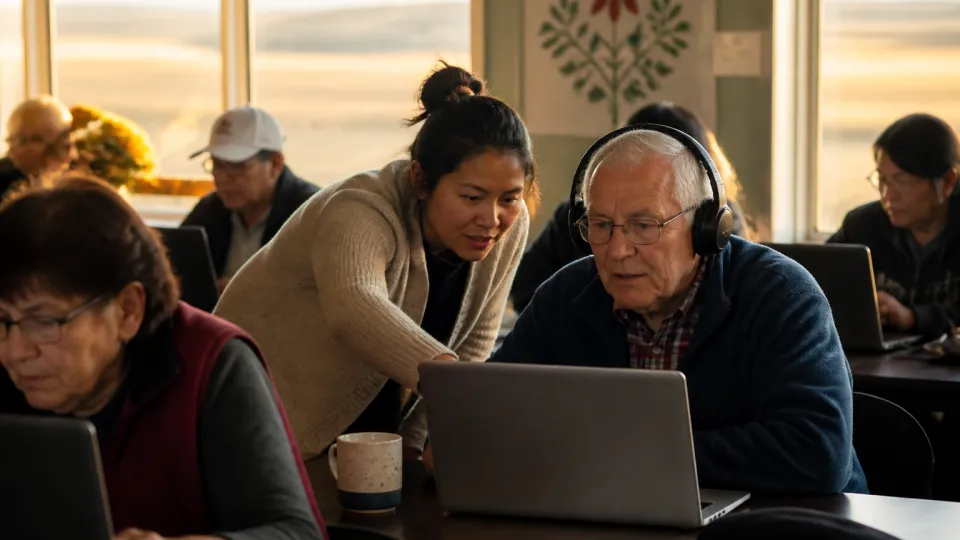
On a bitter March evening, Harold McIntyre, a retired grain farmer from a half-hour drive outside Brandon, sat at a library table and watched his granddaughter’s violin recital streaming from Vancouver. He was not born into the internet; he learned to drive a tractor before he learned to fill an online form. Yet here he was, wiping a teary eye, telling anyone who would listen how the screen made the distance between him and his family feel less like an expanse and more like a hallway.
That hallway is the heart of the Westman Digital Partnership, a loose but determined network of municipal staff, public librarians, high-school teachers, local business owners, and a handful of grantmakers who decided, in the last three years, that in small towns should be a matter of dignity, not novelty. "We wanted to make sure people could get what they needed without the option of moving to a city," said Aisha Khan, coordinator of the Partnership, who helped stitch together training sessions and satellite Wi-Fi nodes across the region.
The work has been granular—an afternoon coding club in Neepawa, a Saturday class on online bookkeeping in Virden, telehealth training at the Brandon Health Centre—but its ripple effects have been vivid. When the local mental-health clinic switched part of its counselling hours to secure video, clients who had missed appointments for lack of reliable transportation suddenly had a way to show up. "I used to cancel because I couldn’t get a ride," said Sarah Dubois, a single mother who travels weekly from Souris for work. "Now I log in from my kitchen. It’s not perfect, but I don’t miss the sessions that keep me steady."
Adoption is never only about pipes and speed. The Partnership treated broadband as the plumbing and digital literacy as the recipe. In Brandon’s main library, under a vaulted ceiling dusted with prairie light, volunteers teach people how to set up email, spot phishing scams, and navigate provincial services online. They also help merchants build shopfronts on regional e-commerce platforms. One of those merchants, Lina Roberts, a seamstress in Carberry, saw her winter income double after the Partnership helped her photograph products, list them, and run a small social-media ad campaign. "I hadn’t wanted to put my work online," she admitted. "Now orders come from Winnipeg and Saskatoon. It pays for heating oil and keeps my studio open."
There have been practical obstacles. Many outlying households still rely on slow satellite connections. Older residents often distrust online payment systems. Youth sometimes mistake access for mastery. To meet these gaps, the Partnership combined on-the-ground instruction with low-tech fixes: scheduled public-use hotspots in community centres, in-person sign-up help, and drop-in hours where residents could bring devices for troubleshooting. "You can’t assume someone will pick up a webinar when they’ve never used a keyboard properly," said Marcus Lefebvre, a high-school IT teacher who runs a weekly "tech help" night. "We teach muscle memory as much as menus."
One of the most unexpected outcomes has been the way technology adoption altered civic life. Town council meetings streamed online attracted family members who live elsewhere but keep a stake in local decisions. Farmers used sensor data to adjust irrigation timing; a cooperative app helped coordinate emergency responses when a summer storm took down a stretch of secondary highway. These aren’t flashy headlines, but they are the daily reallocations of risk and time that make life in the region more resilient.
The Partnership is careful not to claim that technology is a cure-all. Infrastructure funding remains fragile; public attention ebbs and flows; and privacy concerns have surfaced as more services move online. "We always ask, 'Who benefits, and at whose cost?'" Khan said. "If we don’t teach people about data and consent alongside tools, we’ll replicate old inequalities in a new medium."
Looking forward, the initiative is pivoting from emergency upskilling to . Plans include a mentorship program linking students in Brandon’s schools with older residents for ongoing tech support, and a cooperative managed by participating towns that could negotiate better bandwidth deals with providers. There is also a quiet sense that the Partnership’s success has been social as much as technical: neighbors teaching neighbors builds trust that makes new tools usable.
Back at the library, Harold has moved beyond watching recitals. He now pays his property taxes online, attends a virtual town hall, and has started a weekly video call with a cousin he had not spoken to in years. "It’s not about the gadget," he said. "It’s about being part of things." That phrase—part of things—captures the work under way across Westman: a deliberate, patient recalibration of how small towns use technology to preserve ties, create opportunity, and shape the terms of modern rural life.
If the test of a community initiative is lasting change, the Westman approach suggests a quiet prescription: invest in infrastructure, teach the social uses of technology, and build the human scaffolding so that devices serve people rather than the other way around. The prairie remains as wide as ever, but the conversations that cross it now arrive in many forms—by mail, by phone, and increasingly, by light over fiber. For towns that once watched the city set the pace, learning to speak digital has become, unexpectedly, a way to speak to one another.