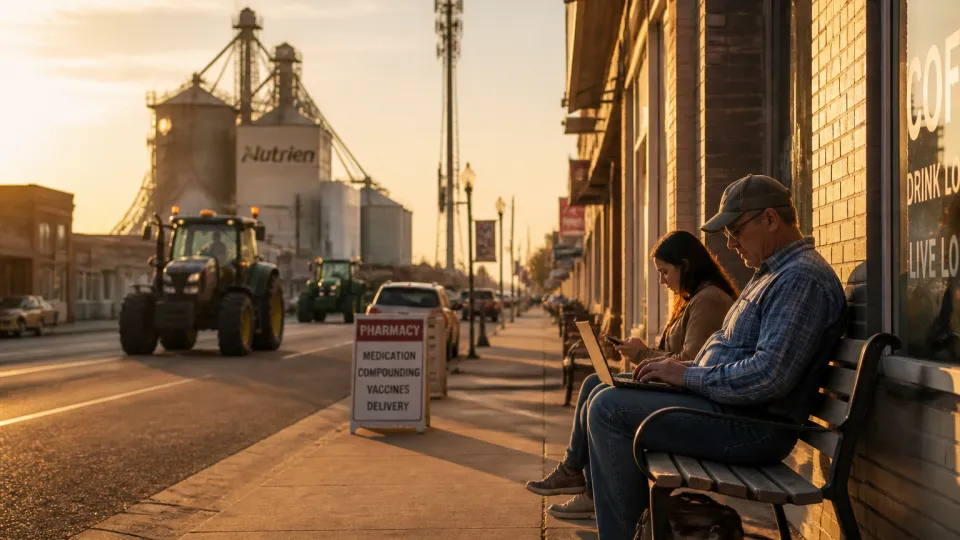
On a bright October morning outside Brandon, an elderly farmer stood on the gravel lane and scrolled through a weather app before climbing into his tractor. He is the fourth generation on this land; he remembers his grandfather running a line of wire to a neighbour's farmhouse to share the first telephone, and he remembers dusk radio programs that gathered a county around the same story. The phone in his hand is simultaneously familiar and foreign: a direct descendant of those wires, but also a gateway to markets, health consultations, and classrooms that were unimaginable a century ago.
The arc of in Westman is not a tale of inevitability. It is a story of local institutions, civic imagination, and the slow accretion of everyday choices. Early in the 20th century, telephones and rural lines were cobbled together by farmers and local cooperatives who could not wait for distant utilities. These grassroots efforts created networks based on reciprocity: a shared line, a neighbour's help fixing a pole, the social expectation to answer when illness and fire demanded it. Electrification followed a similar pattern. When the provincial grid reached the prairies, it did more than power lights; it rebalanced time, enabling milking machines, radios, and, eventually, refrigerators that changed diets and economies.
Radio and television knitted Westman into national conversations—news of drought relief or wartime mobilization arrived in parlours and schoolrooms the same evening it dominated the capital. But it was the locally owned communications enterprises and colleges that turned infrastructure into civic advantage. In Brandon, institutions such as Brandon University and Assiniboine's campuses became laboratories for digital training; they also became employers who demanded better connectivity. Meanwhile, a locally operated cable and internet provider distributed not just entertainment but the infrastructure for entrepreneurs and clinics to experiment with new services.
The human impact of these transitions was not abstract. In Virden, a bakery that had served the town for four decades began shipping boxes of sourdough to neighbouring provinces after investing in a basic e-commerce site. 'We always sold to people who walked in,' the owner told me on a slow afternoon, 'but when the website worked, my neighbour's sister in Calgary became a regular customer.' For small businesses, the internet expanded markets without forcing them to leave the town.
Health care offers perhaps the clearest evidence of technology's double promise. The Brandon Regional Health Centre and Prairie Mountain Health have used telehealth platforms to connect rural patients with specialists in Winnipeg and beyond. For residents of Minnedosa or Neepawa, a virtual appointment can mean the difference between a five-hour round trip and care at the bedside. During the COVID-19 pandemic, virtual consultations, remote monitoring and digital triage were not conveniences but lifelines. Nurses and family doctors learned new workflows overnight; patients learned to trust a screen for conversations they once reserved for a clinic room.
Education, too, was transformed—sometimes painfully. In March 2020, classrooms emptied and students in Westman improvised with a patchwork of tools. Universities and colleges rapidly moved coursework online; schools leaned on library internet pods and family data plans. The crisis laid bare an enduring inequality: not all households had reliable broadband, and the difference showed up in grades, job prospects, and anxiety. The pandemic crystallized a long-standing argument among municipal leaders and school trustees: infrastructure is not neutral. It is a public good that shapes who can work remotely, who can access a virtual specialist, and who can stay and build a career in town.
Looking forward, Westman faces choices about ownership, equity, and purpose. Broadband expansion plans and provincial investments are vital, but so is how communities steward these networks. Local control—through co-ops or municipal partners—has historically meant that priorities are shaped by residents rather than distant shareholders. Digital literacy programs in library basements and community centres remind us that hardware alone does not create opportunity; people do.
There is a new chapter on the horizon. Precision agriculture tools can help a family farm reduce inputs and increase resilience to climate variability. Community microgrids and locally managed data centres could keep critical services running during storms. Remote work offers young people an option to live in Neepawa or Deloraine without forfeiting a career in software, design, or research. But these potentials will be realized only if broadband is fast, affordable, and paired with training and local governance.
The history of technology in Westman is a ledger of choices. The wires that once carried a single voice between farmhouses were built when neighbours took responsibility for one another. Today's networks demand the same civic imagination, but on a larger scale. As towns convert past patterns of cooperation into policies for digital infrastructure, they will decide who benefits from the next wave of . That decision will determine whether the weather app on a farmer's phone is a private convenience or the front door to a more resilient, equitable community.
In the end, technology does not remake places by itself. It reveals the contours of the communities that adopt it—what they value, whom they leave out, and how they plan for the storms ahead. If Westman has a legacy to claim, it is this: the region has repeatedly turned infrastructure into commonwealth by insisting that connectivity be a public project, not merely a private convenience. The next chapter depends on whether residents again choose to build together.