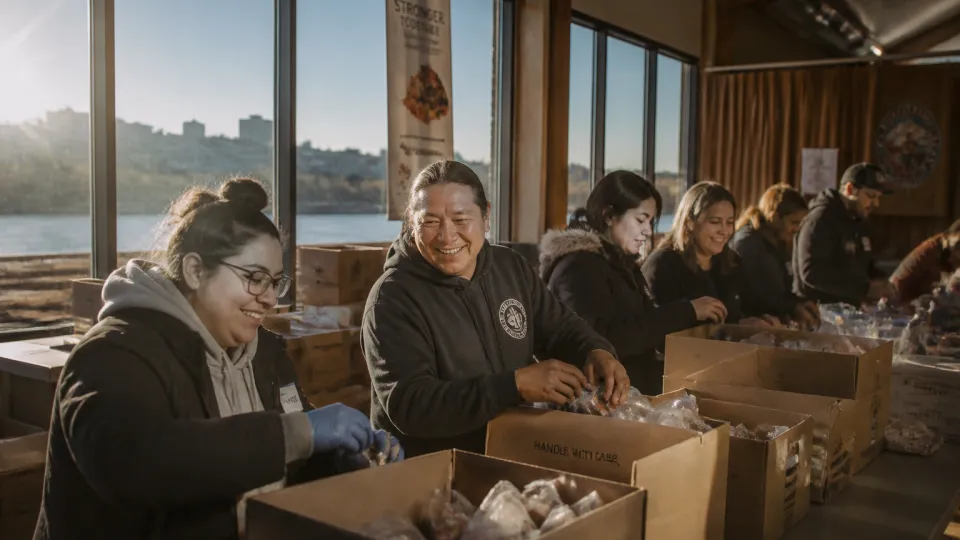
On a cool May morning under the high windows of a hall, a dozen volunteers stack boxes with practiced economy. A woman folds a grocery bag the way a seamstress folds cloth; a young man checks donations against a list on his phone. There is an ease to the choreography that only comes from repetition and care.
Across the Westman region, this choreography is the backbone of everyday life. Volunteerism in Brandon and its neighbouring towns is not merely a supplement to municipal services; it is the means by which social needs are identified, translated into action, and sustained. From emergency sandbag brigades along the Assiniboine to weekly meal deliveries and front-line shifts at the food bank, volunteers mediate the space between institutional capacity and human necessity.
This year an annual gathering — the Westman Volunteer Fair — drew representatives from local food initiatives, hospital auxiliaries, literacy programs, seniors networks, and youth-serving groups. The fair is designed as a recruitment and resource-sharing event, but it also served as an informal census of the region's civic health. Groups traded contact lists and logistical tips; newcomers learned that a few hours a week could be transformed into months or years of steady support.
Take the example of Meals on Wheels in Brandon. For two decades it relied on a rotating cast of retirees. When global disruptions thinned their ranks, college students from Assiniboine Community College and staff from small businesses began filling routes. A coordinator at the fair, who has overseen the program for eight years, described the shift as both challenge and opportunity: 'We can no longer depend on a single demographic,' she said. 'We have to build volunteerism that fits modern lives.' The program now experiments with micro-shifts and app-based scheduling to accommodate workers, parents, and students.
There are moments of urgency where volunteer networks reveal their deepest importance. During a recent spring flood scare, volunteers from Brandon, Souris, and Neepawa mobilized to shore up dikes and deliver supplies. Those responses were improvised but effective, layered on years of neighbor-to-neighbor trust. Volunteers brought not only labour but local knowledge — which roads might ice over, which basements belonged to elderly residents, which families would need pet accommodations. This granular awareness is not easily replicated by external relief agencies.
Human stories make the scale of that impact tangible. At the distribution table at a Brandon food hub, a single mother who had lost a temporary job came in hesitant and left with pantry staples and information about employment services. She later volunteered at a winter coat drive, wanting to give back. Elsewhere, a high school volunteer who began bagging groceries to complete community service hours became a volunteer coordinator at his church, organizing drives that supplied local shelters through the winter months.
These individual arcs matter because they are also recruitment pipelines. Conversation at community events often turns to the same practical question: how to convert goodwill into durable service. Organizations in Westman are experimenting with answers. Some offer modular orientation sessions that allow volunteers to begin with low-commitment tasks. Others are building mentorship structures so novice volunteers are paired with experienced ones, transmitting institutional memory and keeping volunteers engaged beyond a single season.
Yet challenges remain. An aging volunteer base means that many long-time leaders will step back in coming years. Meanwhile, competing demands on younger people's time — paid work, caregiving, schooling — complicate recruitment. Funding constraints limit staff capacity to manage volunteers well. Several organizations at the fair described volunteer-management as the most under-resourced part of their operations, despite being central to service delivery.
The response has been pragmatic. Coalitions across municipal boundaries are sharing training resources; digital platforms are being piloted for matching volunteers with short-term needs; local business sponsors are underwriting administrative coordinator positions. There is also a philosophical shift: volunteer roles are being reframed as reciprocal partnerships, where volunteers receive skills, connection, and social capital, not merely the satisfaction of service.
If the story of volunteerism in Westman is one of deep reliance, it is also one of adaptation. Volunteers are not static fixtures; they are an evolving civic force learning to navigate demographic change, digital tools, and shifting expectations of what meaningful service looks like. The work they do — at food banks, in flood responses, in elder care and literacy — stitches together an often-invisible social safety net.
Looking ahead, the region's resilience will depend on recognizing and investing in that labour. Municipal planners, philanthropic actors, and community leaders can help by funding volunteer coordinators, supporting youth engagement programs, and building platforms for cross-community collaboration. That is a strategic investment in social infrastructure, not an expense.
In the community hall after the fair, volunteers lingered over coffee, swapping phone numbers and emergency checklists. For them, volunteerism is ordinary and extraordinary at once: the mundane repetition of sorting boxes, the sudden intensity of a crisis response, the slow accrual of relationships that make a town livable. In the Wheat City and across Westman, those relationships are the real measure of civic strength.
As one volunteer put it, summarizing the region's ethic, 'We don't wait for someone else to fix things. We show up.'