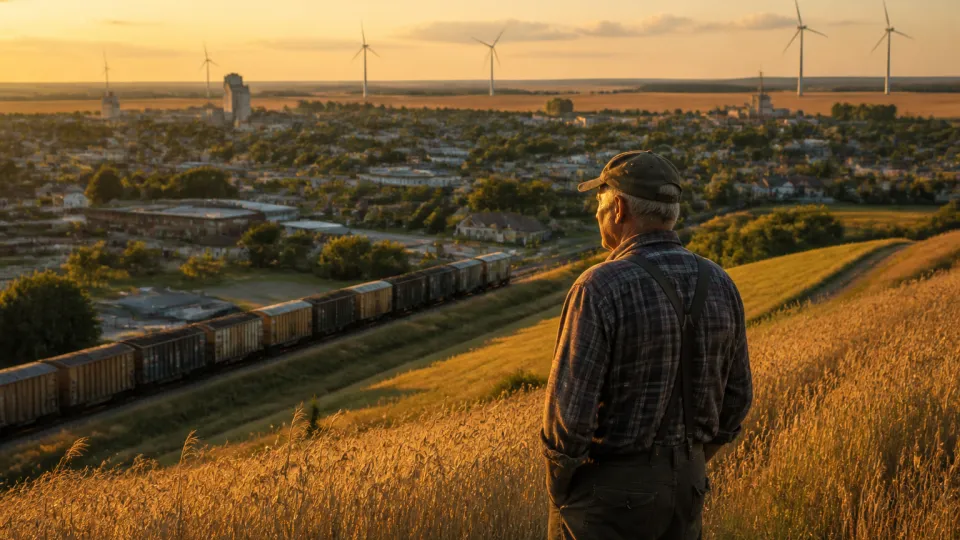
In the early light over the Assiniboine, Brandon looked like a collection of silhouettes: the courthouse dome, the hospital’s angled roof, the thin line of railroad tracks threading west. For more than a century those rails and the wooden teeth of grain elevators defined the rhythms of work and life across Westman: scheduled trains, the smell of propane and wheat, the certainty of seasonal comings and goings. That certainty has been upended and reimagined, and the region that grew around those rhythms offers a lesson in adaptation that is quietly national in scale.
Settlement here accelerated with the arrival of the Canadian Pacific Railway in the late 19th century, which stitched the prairies to markets and invited an influx of settlers. Towns like Rivers, Neepawa, and Virden became nodes where the land’s yield—wheat, oats, later canola—was turned into livelihoods. Grain elevators, some owned by farmer co-ops and others by private companies, rose like totems on the skyline. They were not merely infrastructure; they were community anchors. As one retired elevator operator put it, 'We used to say the elevators were our calendar. You knew a season by which elevator was humming.'
The latter 20th century brought consolidation. Smaller wooden elevators, once a familiar sight, were replaced by larger inland terminals and centralized handling. The sound of a hammer on a silent silo was, for many, a sound of loss. Economically efficient, yes—but the social cost was palpable. Grain shippers moved away from town cores; the jobs that tied fathers to the town’s pulse vanished. In Virden, where oil fields also shaped a different economy, boom-and-bust cycles layered atop agricultural change, remaking local retail and housing demands.
Yet the story of Westman is not only one of decline. It is a study in reinvention. Brandon University and Assiniboine Community College became intellectual anchors, drawing young people into health sciences, agrology, and the arts. The Brandon Regional Health Centre expanded services at times when rural healthcare was contracting elsewhere, anchoring careers and drawing specialists to the city. 'When we opened the new wing, I thought what it meant for my kids—opportunity here rather than away,' a local nurse recalled. Those institutional investments have been quietly transformative: education and health provide not just jobs, but social infrastructure that makes small-town life viable.
Agriculture itself did not stagnate; it digitized. Precision seeding, soil-mapping, and farm-robotics pilots—often coordinated through university partnerships—have changed how fields are managed. Farmers who remember horse teams now manage nutrient plans on tablets. Renewable energy has also arrived in dramatic fashion: the St. Leon wind project and smaller installations around Westman put turbines on landscapes that once only knew grain and sky. Where the elevator once marked modernity, now the slow, steady sweep of blades does.
Indigenous communities—Sioux Valley Dakota, Waywayseecappo, and other Nations near Westman—have always been part of this land’s story. Treaty relationships and the legacies of settler expansion remain central to contemporary development. Collaboration is emerging in land management, education, and cultural programming, though progress is uneven. In Neepawa, arts and shared cultural events have opened spaces for dialogue; in other places, the work of reconciliation is still mostly untaken. Recognizing the past means shaping futures that are equitable.
The human thread through these transitions is what lends the region its particular resilience. Downtown Brandon has seen a careful revitalization not by spectacle but by incremental investments: heritage facades reused for cafés and studios, a theatre that programs local playwrights alongside touring acts, farmers’ markets that reconnect producers to consumers. Small businesses—family-run implement dealers, independent grocers, an enterprising new seed company—speak to an economy woven from local knowledge as much as market forces.
Challenges remain. Broadband access still lags in pockets, limiting the full potential of agri-tech and remote work. Climate variability alters planting windows and water management practices. Regional transportation policy often lags behind local need: rail line rationalizations and highway maintenance decisions can make or break market access for farmers and manufacturers alike.
Yet the region’s path forward is intelligible: meld the technological with the cultural, support education and healthcare as economic anchors, and honor the land’s original stewards through meaningful partnership. Policy that helps preserve feeder rail lines, invest in rural broadband, and finance adaptive farming practices will be decisive. So will the quieter work of civic confidence: local leaders willing to convert an old elevator site into a community garden, or a shuttered storefront into a co-working hub.
Westman’s history is not a linear arc from frontier to modernity but a braided story of losses and inventions, of institutions that endure and everyday people who improvise. When a farmer in Rivers uses satellite data to rescue a failing crop, or when a Brandon student chooses to stay because a hospital job exists, those are the small triumphs that accumulate. The prairie still stretches, but the horizon is being repurposed—not as a place that confines people to an older life, but as a space where rootedness and change coexist. In that balance lies the region’s contemporary relevance: an unfinished, honest experiment in sustaining community on the wide Canadian sweep.