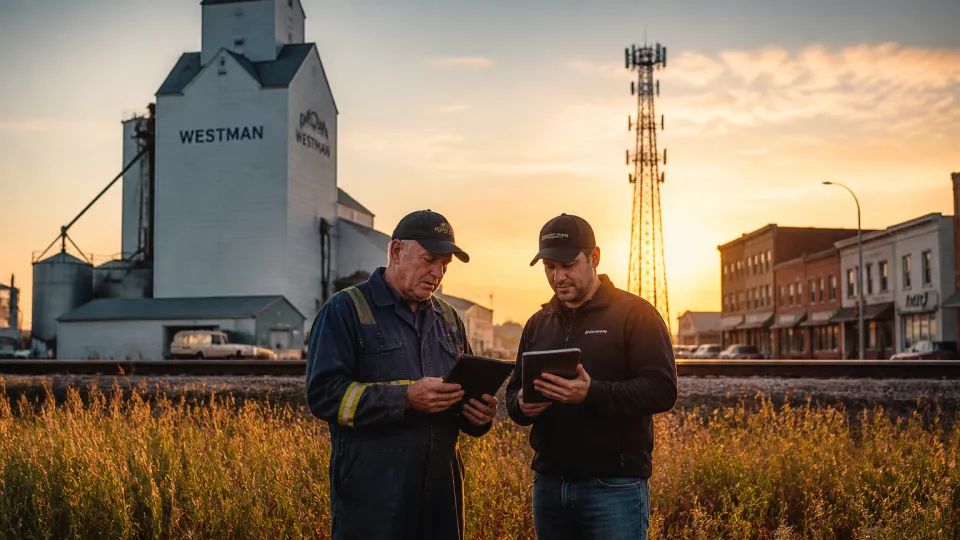
At the edge of town, where the highway thins into prairie and the sky opens wider than seems possible, a rusting grain elevator still stands like an unspoken chronicle. Its silhouette is at once relic and compass: a reminder of an economy once dominated by bulk commodities, and a prompt to ask how a region remade itself when the markets, technologies, and people around it changed.
The story of Westman’s business is not a single invention or a sudden boom. It is a series of adaptations — incremental, often collaborative, sometimes driven by crisis — that together reframed what prosperity could mean for Brandon and the surrounding towns. Economically, the region moved from the rhythm of steam and silo to the cadence of fiber and software. Socially, it shifted from models that shipped raw value outward to ones that capture more value locally. The human effects have been as consequential as the balance sheets.
In the early 20th century, co‑operative grain elevators and railway lines linked prairie farms to world markets. Those elevators were nodes of life: places where farmers negotiated, shared news, and passed on stewardship of the land. The co‑op movement — embodied by organizations such as Manitoba Pool — represented a form of local agency. It answered the question: how can producers pool risks and rewards? That lesson lodged in Westman’s civic memory and resurfaced in later decades as entrepreneurs and civic leaders sought collective responses to new challenges.
When consolidation and deregulation thinned the number of local elevators and centralized processing, towns felt the ripple effects — lost jobs, quieter Main Streets, and fewer places for people to meet. But consolidation also forced a different kind of inventiveness. Farmers invested in precision agriculture: GPS‑guided planting, soil sensors, and data services. Those changes were not only technological upgrades; they were a reconfiguration of knowledge and value. Instead of simply producing bulk commodities, local producers began to offer traceability, quality assurances, and niche products that commanded different margins.
Another pivot came from communications. Westman Communications, a locally grown co‑operative enterprise, illustrates how reinvestment in infrastructure reshapes opportunity. By prioritizing rural broadband and telephony, the company helped bridge the digital divide that once threatened to consign small towns to economic marginalization. Broadband did not simply mean faster streaming; it allowed entrepreneurs to sell to distant customers, enabled telemedicine for aging populations, and gave students in outlying communities access to university courses. Infrastructure, in this sense, became a form of local economic development policy practiced by private citizens and regional leaders.
The human stories in these transitions matter. A third‑generation farmer talked about installing yield monitors on combines and learning to interpret maps of nutrient variability. 'It changed how we thought about stewardship,' she said. 'We weren't just repeating what my grandfather did; we were learning to manage the farm like a business of knowledge.' Elsewhere, a small food processor in Neepawa who once shipped raw grain now bottles local-flour mixes and uses social media to reach artisanal bakers across Canada. These are pragmatic acts of value capture: adding labor, craft, and narrative to raw materials so that money circulates in the region rather than flowing out.
Brandon University and local colleges have played quieter but vital roles. They’ve served as incubators for talent and forums for applied research, connecting students to agri‑tech pilots and small‑business mentorship. The result is a slow fertility: graduates who can return with new skills, networks, and ideas rather than feeling compelled to leave permanently.
There are tensions. Not all innovations distribute benefits equally; some communities remain more precarious than others. Climate change introduces uncertainty into crop choices and freight windows. Yet the pattern in Westman has been to meet those uncertainties with pragmatic experimentation: co‑ops pooling risk, broadband enabling remote services, and farmers using data to make better bets.
Looking forward, the region’s most durable advantage may be its civic muscle. Innovation in Westman has rarely been a Silicon Valley story of solitary genius; it’s been civic, cumulative, and embedded in relationships. That matters for resilience. When global shocks arrive — whether commodity price swings or supply‑chain disruptions — communities that have practiced collaboration can reconfigure faster.
The grain elevator’s shadow is therefore not only a memory of what was lost, but a marker of continuity. It stands where stories intersect: the labor of harvest, the meetings over coffee, the negotiations that built co‑ops, and the young people now coding on laptops in renovated storefronts. In Brandon and its neighbouring towns, business innovation has been less about abandoning the past than about translating local assets — knowledge, trust, shared institutions — into contemporary forms of economic life. That translation, more than any single , is the region’s most important invention.
As Westman looks to the future, the question is not whether it can adopt new technologies — it already has — but whether it will preserve the social and institutional forms that make those technologies work for everyone. The answer will determine whether the next chapter is one of renewed civic prosperity or quiet decline. For now, the elevators, the fiber lines, the classrooms, and the kitchen tables suggest a more hopeful arc: a region learning to make its own future, together.