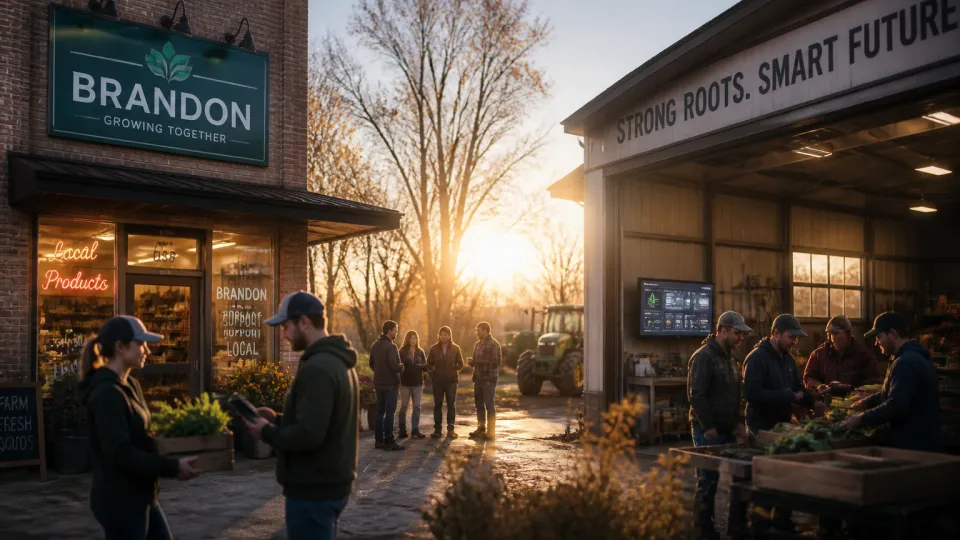
On a raw spring morning just outside Brandon, a battered pickup idles beside a shed where a new sensor array hums quietly on a grain dryer. The pickup belongs to a third-generation farmer—"Ben," he asks to be identified by pseudonym—who until five years ago measured moisture by eye and experience. Today he monitors his dryer from a smartphone, adjusts runs to conserve fuel and uses the savings to hire a local 19-year-old apprentice.
Ben's story is not anecdote so much as emblem. Across Westman, from the city blocks of Brandon to the tight-knit towns that dot the prairie, a new, hybrid economy is taking shape: one that stitches together digital tools, shared physical infrastructure and long-standing social ties. The result is an uneven, improvisational, and deeply human reinvention of local business.
The origins are mundane. Global supply chains gyrated during the pandemic, energy prices rose, and commodity markets stayed volatile. But what followed in Westman was not only contraction; it was local entrepreneurs asking uncomfortable questions: What can we do here, with what we already have? Who can we partner with? How can business serve people as much as profit?
Consider three patterns emerging from months of reporting and conversations with local business leaders, educators and municipal planners.
- Tech that fits the prairie
Precision agriculture is not novel, but what is striking in Westman is who is adopting it and how. Small and medium farms are opting for affordable sensor kits and subscription analytics—less flashy than the million-dollar combines you read about, but far more accessible. "The math works when you can save on one crop-drying season," Ben told me. That accessible tech is often distributed through local implement dealers and co-operatives, creating after-sales support jobs in Brandon and surrounding towns.
Brandon University has quietly played a role: faculty and students helping build low-cost prototypes, and sharing lab space for pilots. Economic Development Brandon, too, has started bridging grant programs with partnership matchmaking, steering capital to projects that promise both productivity gains and local employment.
- Shared infrastructure, shared risk
From shared-use commercial kitchens to multi-tenant maker spaces, Westman businesses are pooling expensive overhead. One such initiative—run out of a renovated brick warehouse in Brandon—offers commercial-grade ovens, cold storage and an on-site food-safety officer for small food entrepreneurs who cannot yet afford their own permits and equipment. A former restaurant chef, now selling frozen pierogis and teaching workshops, calls it "the difference between trying once and building a business."
These communal assets are deliberately social as much as economic. They create mentorship opportunities for youth and newcomers, and they keep revenue local: rather than ship production out to Saskatoon or Winnipeg, food, textiles and small-batch manufacturers remain in the region.
- Recrafting identity to retain talent
Perhaps the most consequential shift is cultural. Where a decade ago the assumption was that young people must leave for opportunity, a generation of entrepreneurs is arguing otherwise. They are coupling remote-work nodes, skill-training cohorts and cultural programming to make staying viable. A small tech firm spun out of a Brandon University practicum now offers hybrid positions and partners with local colleges to create co-op placements.
This is not nostalgia. It is practical retention: when a tech startup promises mentorship plus a chance to ski in Riding Mountain on weekends, it undercuts the brain drain calculus.
Human costs and trade-offs
has winners and losers. Automation can thin out certain labor needs; shared kitchens are difficult to finance and require careful governance; and not every town can host an incubator. There are also structural barriers: inconsistent broadband in outlying hamlets, limited access to patient capital, and an aging population that sometimes resists change.
Local leaders know this. "We can't just drop in a few shiny programs and call it growth," a program director at Economic Development Brandon told me. "We need infrastructure—broadband, training, and patient capital—plus intentional pathways for those displaced by change."
The pulse of
What gives these experiments traction is more than policy. It's the dense social fabric of Westman: church basements doubling as meeting spaces, a farmer lending equipment to a neighbour, former school principals helping run mentorship programs. These social practices turn modest investments into durable enterprises.
A young entrepreneur who launched a crop-insurance analytics tool described how early customers were farmers who had mentored him as a child. "They wanted to see us succeed," he said. "They invested trust before capital."
Looking forward
If Westman is a laboratory for rural innovation, it runs on a set of simple, replicable principles: make affordable and local; create shared physical infrastructure that lowers entry barriers; and bind economic strategy to community resilience. Scaling this requires patient money, more robust internet, and deeper ties between post-secondary institutions and Main Street employers.
But perhaps the most important resource is humility. The most successful entrepreneurs here are not trying to out-tech the world; they are trying to out-care it—designing businesses that serve the economic realities and social expectations of their places. In doing so, they are not just preserving livelihoods; they are quietly reshaping what prosperity can look like on the prairie.
The sensor on the dryer still hums. Outside, the land is a long thing between towns. Inside each small enterprise, reinvention continues, incremental and stubborn, like the work of threshing—separating value from chaff, one small advance at a time.