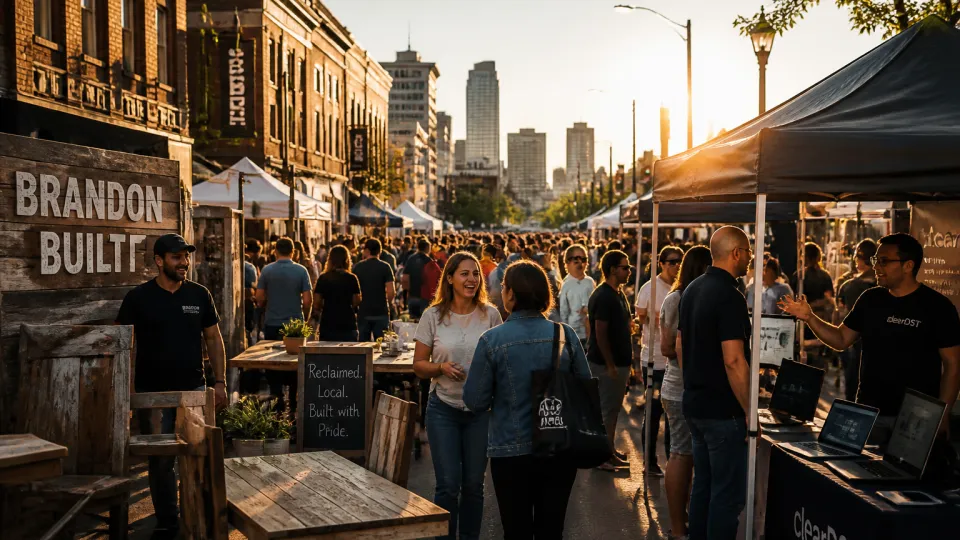
At noon on a blustery Saturday, a converted warehouse a block from the river filled with the sound of foamy coffee machines and the low hum of conversation. Panels had given way to demonstrations: a barber shop owner showing a custom-point-of-sale app on his tablet, a furniture maker sanding the edges of a bench crafted from reclaimed barnwood, a soft-spoken programmer seated beside a poster that read ‘Digital Co-ops for Rural Services.’
The scene—part trade fair, part meeting—was the clearest sign yet that Brandon and the surrounding Westman region are not waiting for solutions from afar. They are making them here. The summit, organized by a loose coalition of local entrepreneurs, business-support organizations, and university-affiliated researchers, assembled a practical agenda: how to keep manufacturing in town, how to make digital services that suit dispersed customers, and how to build revenue models that reward people who stay.
Three threads recur in conversation across the room: that reduces waste and cost; that answers local problems instead of copying urban models; and business structures that distribute ownership and risk.
Consider Little Grain Studio, a family-run maker collective that opened three years ago between the agricultural supply stores and a used-bookshop. Owner Janelle Tran had been a baker and hobby furniture maker before she decided to retrofit an old oven and an industrial press to produce small-batch sourdough and recycled-wood cutting boards. ‘We started because we wanted to feed our neighbours and build something worth passing on,’ she said. Tran’s , however, was less about craft than systems: she partnered with a nearby grain elevator to source unsaleable wheat for experimental flours, and she uses the bakery’s heat to dry wood offcuts for small furniture pieces. 'It cut our waste by more than half,' she told me. 'We save money, and the point of sale becomes a reason for people to come downtown.'
On the tech side, PrairieLoop, a five-person cooperative of developers and designers, has been working with service providers across Westman to build appointment and billing software tuned to rural life. ‘Urban SaaS presumes ten-minute commutes and a lot of walk-in traffic,’ said Maya Kaur, one of PrairieLoop’s co-founders. 'Clinics, barbers, and farm equipment technicians here need scheduling windows that respect long travel times and seasonal rhythms. When we built around that, adoption jumped.' PrairieLoop’s cooperative ownership model means revenues are reinvested into local training programs—a small but meaningful hedge against talent flight.
Brandon University figures quietly into many of these experiments. Faculty and students have offered research on supply-chain inefficiencies and helped prototype tools for small manufacturers. A researcher I spoke with described a semesterlong project that paired business students with an upholstery workshop to map costs and find affordable automation points. The result wasn’t about replacing hands with machines but about simplifying repetitive motions so the shop could take larger orders without compromising quality.
Municipal support, while uneven, surfaced in useful ways: a repurposed storefront grant allowed a street-level maker to expand without moving to a strip mall; a pilot zoning change enabled light manufacturing on a formerly residential corridor. Those small policy pivots—quiet, pragmatic—are exactly the kind of scaffolding local entrepreneurs say matters.
Human stakes pervaded the summit. For many attendees, innovation is a response to attrition: parents who watched their children leave for cities, friends who closed once-vital shops, an economy that long ago outsourced risk to other places. But the mood was not defensive. It was deliberate. There is pride, and there is a steady willingness to experiment.
'Innovation here is less about disruption and more about adaptation,' said Claire Morales, who runs a downtown event space that hosts craft nights and coding workshops. 'We innovate because we have to and—more importantly—because our neighbours are counting on us to succeed.' Her voice carried around the room. People nodded; some muttered about the cost of capital, others about recruiting skilled labor. Those remain real constraints.
The summit did not pretend the challenges aren’t steep. Scaling a furniture shop beyond regional demand, accessing patient capital, and building broadband infrastructure to support more sophisticated digital services are problems that require policy and investment beyond what a weekend of networking can deliver. Yet the conversations were practical: regional procurement strategies to keep institutional spending local, shared equipment hubs to lower startup costs, and workforce pipelines co-designed with high schools and the university.
There is a throughline in the work: an insistence that growth be anchored in local relationships. The businesses that thrived in Brandon’s current moment were those that saw themselves as part of a network—suppliers, customers, municipal actors, and educators—rather than as isolated enterprises chasing outsized returns.
If there is an image that lingers from the summit, it is of a line at a booth where an older farmer and a young designer negotiated a bulk order of shelving, the farmer squinting at measurements while the designer sketched adjustments. They were not inventing a new category of commerce; they were solving a shared problem and, in doing so, knitting the town a little tighter.
Looking forward, the test for Brandon and Westman will be converting these prototypes into durable institutions: co-op incubators with long-term funding, procurement rules that prioritize local capacity, and a civic conversation about what growth should mean. The entrepreneurs I met are candid about the scale of what’s needed and hopeful about the leverage a small, connected region can muster. The vision is modest in tone but expansive in consequence: economies that keep more value where people live, and towns where innovation is a tool for resilience rather than spectacle.
The summit was not a festival of slogans but a working session for craft and code. It revealed a practical truth: local innovation here smells a little like bread and sawdust, and that ordinary materiality may be exactly what keeps communities standing in the years ahead.