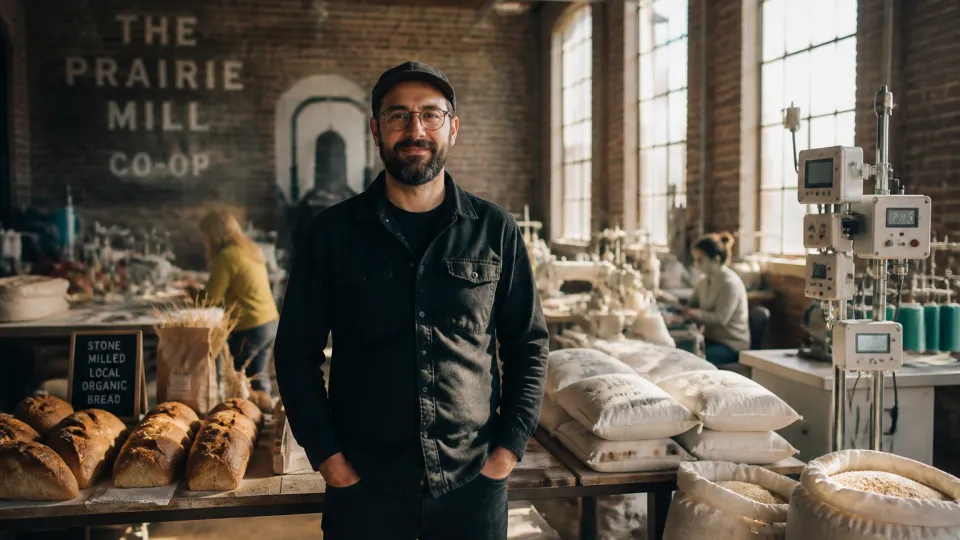
On a rain-slashed Thursday afternoon, the back door of a converted print shop on Rosser Avenue swung open and a current of warm, yeasty air rolled into the street. Inside, sacks of prairie wheat leaned against pallets, a battered Mitchell mixer turned slowly, and sticky hands sorted loaves into paper bags stamped with a logo that looks like a field at sunrise. The proprietor, Maya Sutherland, moved deliberately between stations—measuring, tasting, negotiating a delivery schedule on her phone.
"When the big suppliers hiccupped in 2020, we learned how fragile our assumptions were," she said, wiping flour from her forearm. "So we stopped waiting for someone else to fix the system. We started making things that could be controlled here, by us."
Sutherland’s bakery, Prairie Root, is one of a cluster of small businesses in Brandon that have reimagined the old rules of scale. Rather than chase wholesale contracts that demand margins she cannot meet, she focuses on high-margin, locally-sourced goods sold through a subscription service, farmers’ markets, and a handful of cafés. The margins are modest, but the network is tight: grain from a cooperative an hour west, a packaging social enterprise that employs newcomers, and a small tech startup that helps predict demand.
Across town, at a low-slung industrial park, that startup—SeedSignal—tests inexpensive moisture sensors designed for rural grain bins. Founder Trevor Chen sketches code on a whiteboard, but his frame is not of a Silicon Valley archetype. He grew up on a mixed farm outside Neepawa and jokes that the first server he saw was his father’s Combine. His team has repurposed open-source hardware to produce a device that sends a single-line text when moisture thresholds are crossed—enough to prevent spoilage for smallholders and co-ops.
"We didn't want to sell another platform people couldn't afford," Chen told me. "Our aim was to make something useful that a farmer could use on a phone with limited data."
The device sells for a fraction of comparable systems, and when paired with a cooperative-level dashboard, it has kept several small elevators from losing significant loads during wet summers. Those saved bushels translate directly into payrolls, deliveries, and the steady relationships that feed bakeries like Prairie Root.
Another thread in this emerging ecosystem is social enterprise. Table & Thread, a nonprofit sewing collective started by two newcomers from Pakistan, offers dignified work and a path to Canadian employment for recent arrivals. They produce reusable produce bags and packaging for local food businesses; the income is paired with language coaching and on-site childcare. "We wanted our workspace to be a place where people could feel useful and seen," said co-founder Zahra Ali.
These enterprises are small, idiosyncratic, and interdependent. The tech company’s sensors alert a co-op, which coordinates grain shipments to a mill, which sells flour to a baker who packages in bags sewn by newcomers. The feedback loops are not slick; they are human, filled with phone calls at midnight, a neighbor lending a truck, and volunteers helping load pallets. Yet their cumulative effect is tangible: shorter supply chains, more money retained locally, and employment that reflects the town’s changing demographics.
The political and economic scaffolding that supports these ventures is uneven. There are pockets of grant funding and a local maker-space that provides fabrication tools at low cost, but entrepreneurs complain about regulatory overhead, transportation costs, and the challenge of scaling without losing the behaviors that made them resilient. Still, those constraints have fostered improvisation rather than resignation.
colleges and informal mentorship networks have become hubs for this learning. Students apprentice with small firms, bringing fresh ideas in design, marketing, and data—skills that owners like Sutherland adopt pragmatically. "We don't have the luxury of a big R&D budget, so we experiment in public," she said. "We try things, measure, and adapt. It's messy, but it works."
Looking ahead, the entrepreneurs I spoke with imagine a region that trades dependency for agility. That does not mean rejecting scale entirely; SeedSignal hopes to license its sensors to cooperatives across the Prairies, and Prairie Root considers a micro-milling operation to reduce freight costs. But each growth plan is tethered to local values: a commitment to jobs, predictable supply, and the kind of relationships that survive bad weather and bad markets.
What unites these stories is neither novelty nor a Bloomberg headline—it is an ethic of repair. In Brandon, is not measured only by patents or valuations, but by the number of people who can pay rent because a bushel didn't spoil, or by a mother who found steady work without sacrificing language classes for her kids. The future the region is building is pragmatic, networked, and quietly ambitious: a model not of escape from place, but of renewed investment in it.
"We are learning to be a city that makes things that matter to us," Sutherland said as she slid a tray of loaves into a cooling rack. Outside, the rain had stopped and a pale light fell across Rosser Avenue. For a moment, the downtown felt less like a remnant and more like a laboratory—small, deliberate experiments knitting a community back together, one loaf, one sensor, and one stitched bag at a time.