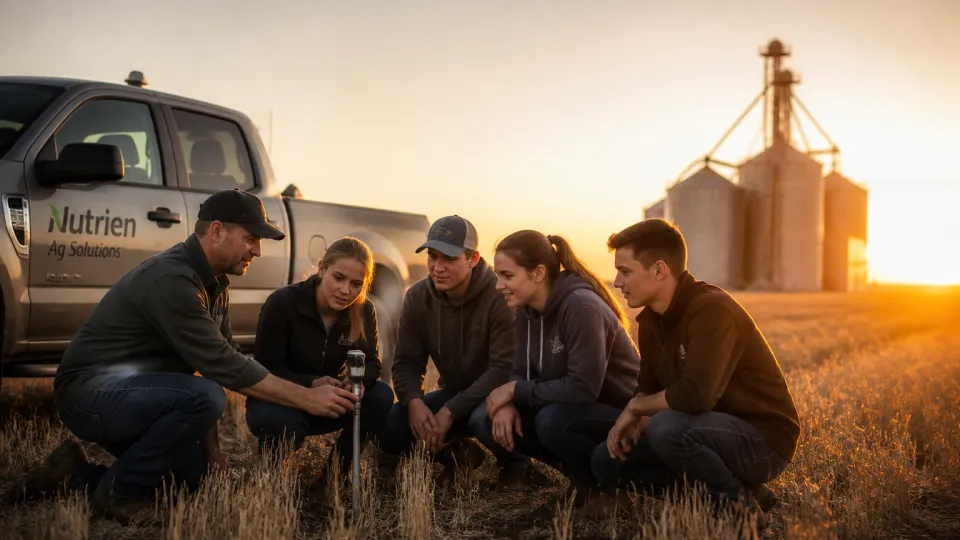
On a raw morning at the edge of a canola field west of Brandon, a cluster of people huddled under an oilcloth awning looked not like the usual assembly of farmers but like a neighborhood lab. A weathered pickup idled nearby, a student from Assiniboine Community College adjusted a handheld soil probe, and an older farmer, hands still stained from the last season, squinted at a tablet screen showing data points he had never cared to read before. This is where the Westman Ag Collective meets: a scaffolding of people, , and quiet determination, built as much out of necessity as curiosity.
The Collective began three years ago when a handful of producers, educators, and municipal planners realized that the old model — single-family operations, rising input costs, and increasingly unpredictable weather — would not sustain the region’s small and mid-sized farms. What started as a handful of test plots and shared webinars has become a cooperative network that blends low-cost sensors, shared machinery, experimental trials, and apprenticeship opportunities for young people returning to the country.
At the core of the work is a pragmatic question: how much can intelligent, affordable technology and local knowledge reduce risk while improving margins? On one demonstration farm, a row of soil moisture sensors relays real-time data to a communal dashboard. The result, participants say, is a sharper timing of irrigation and fertilizer applications that can cut unnecessary passes across a field. 'We used to guess by feel and history,' said Erin McAllister, who farms 900 acres and joined the Collective in its second year. 'Now we see the soil talking to us. It has saved fuel and cut our worry when the sky won't cooperate.'
But technology here is married to collaboration. The Collective runs a shared-equipment library: a modest yard stocked with precision seeders, cover-crop rollers, and a drone for aerial scouting. Smaller operations that could not justify the expense of a precision seeder can borrow one for a day during planting. The library is managed by a rotating board, and fees are reinvested into maintenance and training. Farmers reported fewer missed planting windows and more experimental plantings of legumes and cover crops because the barrier to trial was lower.
The initiative’s human dimension is visible everywhere. Youth apprentices, many recent graduates or students from local post-secondary institutions, are integral to day-to-day research. They install sensors, run soil assays, and teach workshops. Their presence has helped bridge a generational gap: older farmers offer a century of embodied practices; younger participants bring fluency in data and software. 'I didn’t know I’d want to come home and farm,' said Marcus Olson, 24, who moved back from Winnipeg after an internship with the Collective. 'But being able to use technology that helps the land and still respects the way my grandparents worked — that’s what kept me.'
Specific experiments are pragmatic and locally tailored. One site is testing combinations of cover-crop mixes that promise both better soil carbon retention and reduced winter erosion. Another is piloting a manure-to-energy digester on a mixed livestock/crop operation; the digester offsets propane use and provides a digestate that is easy to spread and store. None of these projects is purely academic — farmers track time saved, input reductions, and harvest quality as much as ecological indicators.
The Collective has also become a conduit for small grants and municipal planning, securing modest funding for a community-scale grain-hub study and for an incubator that helps farmers add value through on-farm processing. Still, organizers are cautious about growth. 'We want to scale the impact, not the bureaucracy,' said Dr. Marlene Chen, an applied researcher at Assiniboine Community College who consults with the Collective. 'Our job is to make sure innovation is accessible and accountable to the people who will live with it.'
Impact is measured in ways that matter locally: fewer emergency late-season tillage operations, a modest but steady increase in youth employment in agriculture, and a more resilient conversation about diversification. For one family farm, adding a small pulse-cleaning operation — arranged through a collective cooperative agreement — created a new revenue stream that buffered three poor years of canola prices. For another, precision nutrient management reduced fertilizer costs enough to invest in a second-generation harvester.
There are limits and trade-offs. Not every technology is right for every operation. Data management has raised privacy questions. And the county-wide nature of weather events means that no amount of sensor data will control drought. Still, the Collective’s approach — low-cost entry points, peer-led training, and a willingness to fail fast — has reshaped the local imagination about what prairie agriculture could be.
Looking forward, members envision a regional network that ties into carbon markets, regional food systems, and exportable know-how for other prairie communities. That requires policy alignment, continued investment in rural broadband, and patient stewardship of local governance structures. For now, the work remains tactile: mending a fence, calibrating a seeder, teaching a teenager to read a soil profile.
What unites these acts is not novelty for novelty’s sake but a modest, stubborn attention to place. In a province where weather and market swings have long been the backdrop of everyday decisions, the Collective has given Westman farmers tools to decide more of their fate. The story here is less about technology triumphing over hardship and more about people — farmers, students, and small-town organizers — choosing to learn together and, in doing so, inventing a quieter, steadier future for the prairie.