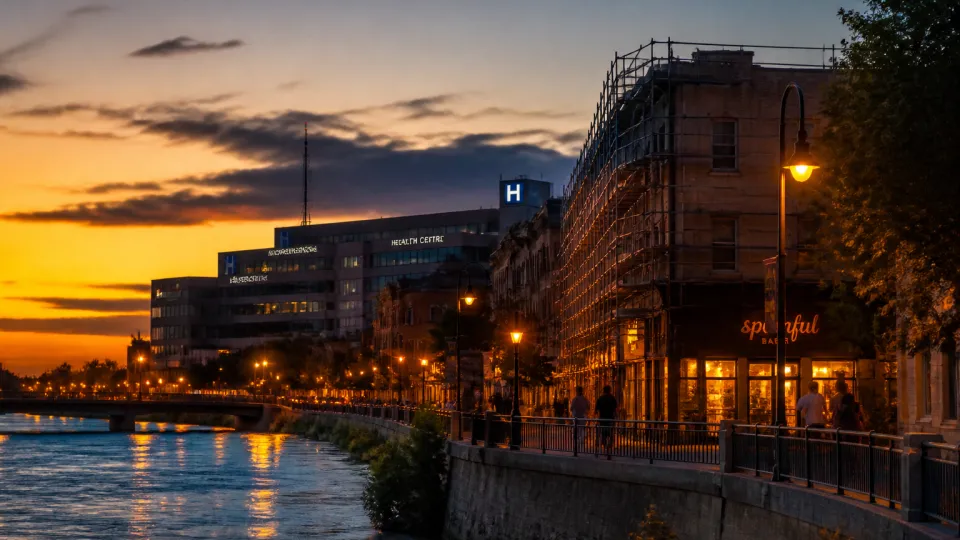
On a late spring morning the Assiniboine River moves like memory through Brandon: slow, steady, bordered by newly planted willows and the scaffolding of projects that promise different tomorrows. For years the conversation about Westman development has been dominated by numbers—population growth statistics, employment rates, square footage of new industrial parks. What has begun to change, slowly and insistently, is the conversation about people.
At the corner of a busy downtown block, a small bakery prepares the morning’s first loaves. Across the street, municipal workers replace a curb while an organizer from a neighbourhood housing co-op counts names on a waiting list. In that intersection of trades and needs you see, in miniature, how development here is being rethought: not as the triumphant arrival of capital, but as a negotiation among the public, private and sectors to protect the small, the essential and the human.
"We used to ask what we could get," says Marianne Dupuis, a social planner who has worked in Brandon for nearly two decades. "Now people ask what’s fair. That’s a different kind of development conversation." Dupuis points to recent investments in the Brandon Regional Health Centre, where expansions meant to shorten wait times have been paired with outreach clinics in surrounding towns. "Health care is a baseline for everything else—if you feel healthy and secure, you can start a or look after your aging parents."
The health centre’s incremental upgrades are practical: more physiotherapy spaces, expanded outpatient clinics, and a telehealth suite that links specialists in Winnipeg to patients here. But the human consequences—easier postpartum care for young mothers, quicker diagnostics for seniors living three-quarters of an hour away—are what residents cite first. "When my mother had a fall last winter," says Andrea Sinclair, a caregiver from a nearby farming community, "it was the visiting geriatric clinic that kept her at home instead of moving into the city. That matters."
Housing, long the region’s stubborn shortfall, has likewise shifted from headline figures to life-changing particulars. A mix of municipal incentives, non-profit partnerships and private developers has produced infill projects that preserve streetscapes while creating affordable units. In one project repurposing an old warehouse near the Keystone Centre, architects kept original timber beams and added modular apartments above a ground-floor community hub. "We design where people already know the neighbours," says architect Tariq Malik, whose firm consulted on the project. "It saves communities from displacement and keeps local businesses in place."
Equally important is the work happening beyond Brandon’s city limits. Small towns across Westman—where grain elevators punctuate the horizon and Main Streets still pulse on market days—are experimenting with agritech hubs and co-operative commercial spaces that tie farmers, students and entrepreneurs to shared resources. At a rural incubator outside of Virden, a group of young entrepreneurs are testing value-added processes for pulses and barley, working with researchers from Brandon University and mentors from local elevators. "We used to send our harvests away and lose the profit margin," says one participant, smiling over a crate of packaged barley snacks. "Now we can build a brand from our own soil."
Indigenous leadership is an essential and often overdue part of Westman’s development narrative. Partnerships between municipalities and Indigenous governments and organizations are increasingly serving as frameworks for land use, cultural programming and economic opportunity. "Development that goes forward without our voice will not last," says Elder Mary Cardinal of a local First Nation. "When we’re at the table, our young people see a path that respects our knowledge and our responsibilities."
None of this erases the region’s ongoing challenges. Workforce retention remains a worry—many young graduates still leave for larger centres—and climate pressures are altering farming rhythms and municipal planning alike. But the texture of the response in Westman distinguishes it. Rather than one large infusion of capital, the region is marshaling dozens of smaller, interlocking decisions: a clinic expansion here, a co-op kitchen there, a transit route adjusted to connect a new affordable complex to employment nodes. The cumulative effect is what residents describe as a new sense of agency.
The future that local leaders imagine is patient and iterative. It asks for civic humility: that officials listen, that developers design for the community that already exists, and that institutions like Brandon University and the Keystone Centre act not as isolated anchors but as collaborators. "Growth should be an invitation, not a takeover," Dupuis says. "We’re still figuring out the right balance, but more people are now part of the conversation."
Walking back toward the river that evening, you see children playing by the new trail, a group of seniors meeting under a restored elm, and a young farmer loading produce into a van for a downtown market. Development in Westman is no longer an abstract goal measured in square metres. It is the thread that ties these moments together—fragile, deliberate, and, crucially, attuned to the lives it is meant to improve.
If there is an argument being tested here, it is that sustainable regional development grows from the everyday: clinics that keep elders home, apartments that welcome families, cooperatives that let farmers capture their share. In Westman, the work of building a future has become, at last, a communal project.