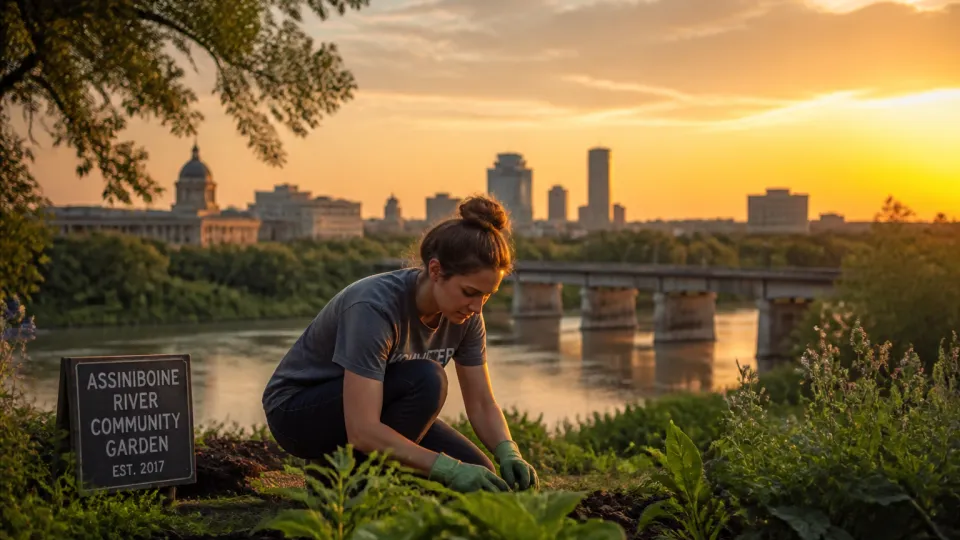
On a late spring morning in Brandon, a volunteer hefts burlap sacks to a raised bed while the Assiniboine glints in the distance. The garden is small—three plots, a row of tomato cages, a scattering of sunflowers—but it is also a signal: a patchwork approach to a region reckoning with new weather, new costs, and new expectations.
For years the prairie has been defined by extremes. Heat and drought set fields alight in some seasons; the river runs high and slow in others. In Westman, the conversation about is not an abstract debate among academics; it is a daily conversation among neighbours, farmers, councilors, and teachers about how to keep livelihoods intact and towns livable.
Change here is pragmatic and often homegrown. On the edge of Brandon, a group of farmers has quietly shifted practices that once seemed radical: cover crops after harvest, minimal tillage, and rotational grazing. These decisions grew out of necessity—volatile input prices, erratic rainfall, and mounting soil erosion—and out of hard-won observation. "We started trying to keep the ground covered so we didn't lose a season to wind," said a farm operator I spoke with. "It costs some different money upfront, but the soil remembers."
Those soil-first practices ripple beyond the field. Farmers report steadier yields through dry spells, fewer dust storms, and lower fuel bills. Local agronomists, when asked, pointed out that the environmental return on these changes is interlaced with economic survival. Yet barriers persist. Without larger pooling mechanisms for equipment, and with limited access to affordable financing, many small operations find the transition slow and uneven.
Cities are testing their own forms of resilience. Brandon’s downtown storefronts and older housing stock present both a challenge and an opportunity: energy retrofits could shave months of demand and loosen household budgets, but the upfront cost and fragmented ownership patterns stall action. In community centers, workshops on insulation and heat-pump basics draw homeowners looking for practical guidance. "People want things that make sense on their bills and in their lives," a municipal staffer said. "The question is how to make those options available equitably across the region."
Water shapes every strategy here. Community-led riparian projects on tributaries feeding the Assiniboine show how residents are trying to translate local knowledge into landscape-level change. Volunteers wade into small creeks to plant willows and rebuild banks—low-tech work that keeps silt and nutrients from flowing downstream and softens the blow of spring freshets. Those efforts are hands-on and visible; they also reveal a patchwork approach to governance. Funding moves in fits and starts, and when provincial or federal grants lag, momentum ebbs.
Circular economy experiments are cropping up too. A micro-scale composting initiative in a west side neighborhood diverts food scraps from the landfill and supplies municipal flowerbeds. A brewery in a nearby town began repurposing spent grain into cattle feed and bakery partnerships. These are small wins—modest in scale, powerful in message—demonstrating how waste can be a resource if systems are built to capture it.
But not all stories are neatly optimistic. In conversations across the region, a common strain emerges: the uneven distribution of resources and the friction between short-term survival and long-term planning. Young people leave for education and jobs elsewhere; towns lose tax base and the volunteer energy that sustains grassroots projects. Farmers weigh whether to invest in carbon-credit markets that promise future revenue but demand documentation and risk. Municipal leaders wrestle with whether to subsidize home retrofits, expand composting, or prioritize flood infrastructure with limited budgets.
What is striking is the social infrastructure being built alongside technical solutions. Neighbourhood meetings, farmers' kitchen-table gatherings, school projects restoring wetlands—these create trust networks that are the real scaffolding of resilience. "It isn't just about ," a long-time resident observed. "It's about knowing who will be at the other end of the phone when the river rises."
Looking forward, Westman's resilience will depend on a few practical shifts. Aggregating demand—joint purchasing for solar arrays or retrofit loans—could lower costs. Regional coordination of watershed-level planning could align riparian restoration with agricultural incentives. And investment in knowledge exchange, so that successful practices scale from one farm or neighbourhood to twenty, will be essential.
Ultimately, the region’s path is not a single project or policy. It is a mosaic of small, sometimes improvisational efforts stitched together by people who refuse to treat the prairie as an immutable backdrop. Their work acknowledges limits—financial, institutional, climatic—while insisting on possibility. In the face of weather that confounds forecasts and budgets that tighten, Westman’s sustainability movement is less about grand pronouncements and more about the patient, practical work of keeping a place livable for the next season and the next generation.
As the sun drops behind the river on that late spring day, the volunteer in the garden tucks in a row of seedlings and pauses. "It's small," she said, "but tomorrow we eat from this, and the kids see it. That's how it starts."