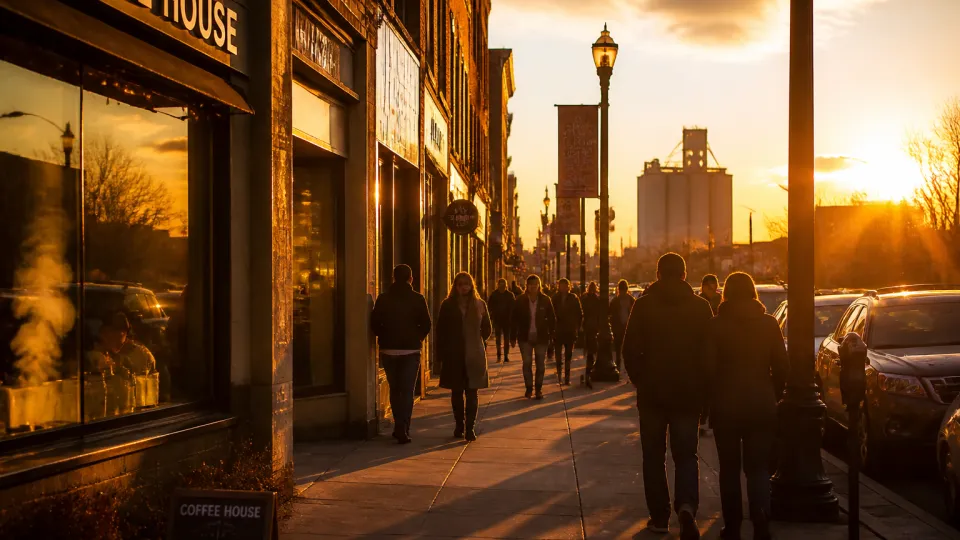
On a late autumn morning in downtown Brandon, steam lifts from a café window and a delivery truck backs into a narrow laneway where a century-old brick façade meets a neon sign for a newer co‑working space. That adjacency—past and future colliding in small-block increments—captures the story of Westman business : incremental, stubborn, and deeply tied to life.
The story begins with grain. For most of the 20th century, Westman towns revolved around elevators and rail spurs. Those cedar and corrugated structures were not simply storage; they were public stages where farmers, merchants, and neighbours negotiated the rhythms of the season. As mechanization and consolidation arrived, elevators fell silent and many small towns watched services and population ebb. But rather than accept decline as inevitable, local leaders and entrepreneurs rewired the economics that supported rural life.
A critical strand in that rewiring has been the cooperative impulse. Farmers organized co-ops to secure better prices and shared infrastructure; independently owned merchants pooled buying power to keep downtowns viable; and, later, community investors built utilities to solve connectivity gaps. The result was a network of institutions that could absorb shocks and channel local capital back into the region.
Telecommunications offers a particularly instructive example. Where national carriers often saw thin profitability, regional initiatives pursued a different equation: service as civic investment. A cooperative-grown regional broadband provider in Brandon pushed fiber and wireless solutions into places that might otherwise have remained unconnected. That effort matters not only for Netflix and Zoom; it matters for remote diagnostics in rural clinics, for agri-tech tools that require real-time telemetry, and for small manufacturers able to partner with distant firms without uprooting.
Agriculture itself has become a laboratory for innovation. The pivot has been away from monoculture nostalgia toward layered enterprises: on‑farm processing, specialty cropping, and precision agriculture. Local agronomists and equipment dealers introduced GPS-guided seeding, variable-rate fertilizer, and yield-mapping long before such technologies became household words. Those investments were expensive and culturally disruptive; they required farmers to think like managers of information as much as managers of land. The payoff has been steadier margins and the ability to participate in value chains, rather than simply sell raw commodities into volatile markets.
Equally important have been the human decisions behind the statistics. Take the third-generation hardware store that converted part of its backroom into a makerspace for students, or the livestock auction house that pivoted to an online bidding model during drought and never turned back. These are not grand transformations but iterative adaptations that multiply across a region. As one long-time entrepreneur, asked to remain unnamed, put it, the smartest innovations here are those that solve a local problem and then scale horizontally, town to town.
Institutions have evolved too. Brandon University and regional colleges widened their curricula to include applied research, business incubation, and skills training tailored to local employers. Annual events such as the Royal Manitoba Winter Fair reinforce agrarian expertise while convening supply chains, buyers, and families. Public-private partnerships have upgraded water treatment plants, kept downtown rental stock viable, and funded heritage rehabilitation that marries aesthetics with new uses.
The COVID era accelerated experiments that were already underway. Restaurants added pickup and delivery logistics, retailers adopted e-commerce platforms, and health providers expanded remote care. Those moves blurred the line between urban and rural possibilities: a boutique in Virden can reach customers in Vancouver as easily as in Winnipeg, but only if the last-mile internet exists and the logistics are in place. That interdependence is both an economic opportunity and a policy challenge.
Looking ahead, the most consequential innovations will not be flashy start-ups but connective tissue. How Westman handles climate variability will depend on research-driven crop choices, insurance instruments that reward resilience, and regional grain handling that values traceability. Workforce transitions will hinge on training programs that translate local knowledge into new careers, from ag‑data analysis to renewable energy maintenance. And civic finance will need to keep reinventing itself—blending public grants, cooperative equity, and private investment—to fund infrastructure without sacrificing local control.
The resilience of Westman’s economy is not accidental. It is the product of a culture that treats businesses as civic assets, not just profit centers. That ethic produces innovation that is incremental, place-centered, and durable: a hardware store that becomes a community maker-hub; a cooperative that brings fiber to a township; a farmer who becomes an entrepreneur processing on the farm. These are small revolutions, repeated enough times to change the landscape.
If there is a lesson for other regions, it is this: reinvention succeeds when it is tethered to community purpose. Westman’s future will be written not by a single tech breakthrough but by hundreds of pragmatic choices that bind to stewardship. In the spaces where sunlight hits the old brick and the new glass of a co-working window, that future is already being assembled, one adaptive decision at a time.