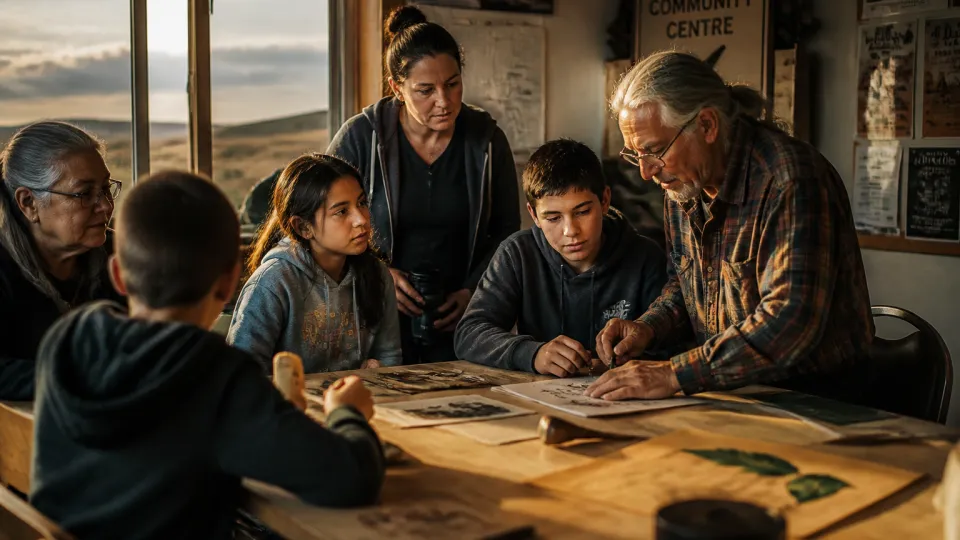
On an October afternoon at the South End Centre in Brandon, a room that usually hosts badminton and church luncheons hums with something different: a geometry circle for Grade 8 students, an adult English conversation group, and, tucked in the corner, a table where an elder is teaching Dakota place names. The project is called the Westman Learning Collective, a loose network of pop-up hubs and programmes that have appeared in libraries, community centres, farms and workshops across the region over the last three years.
The Collective began, the coordinator Maya Sinclair explains, out of a stubborn practical question: how do communities stitch learning back together after a decade of cuts, pandemic disruption and a shrinking rural school population? 'We wanted to stop thinking about schools as islands,' she says. 'People learn in kitchens, in shop bays, at kitchen tables and in the field. If we acknowledge that, we can reach far more learners.'
What the Collective offers now is deliberately simple and place-based: free tutoring and homework clubs in satellite towns; mentorship pairings that link high schoolers to tradespeople and local business owners; and cultural programming developed in partnership with Indigenous Elders and Métis knowledge keepers. It is not a single building or bureaucracy but a shared practice: a calendar, a set of learning modules co-created with teachers and community members, and a rotating fund used to seed new local initiatives.
The human scale is what makes the work compelling and visible. Trevor Hiebert, a physics teacher who leads an evening robotics club in Rivers, had been frustrated by the gap between classroom concepts and students planning to enter the workforce directly. 'When we build a robot to sort grain samples, suddenly algebra means something,' he says. Trevor's students have presented at a regional agriculture fair and several have taken part-time jobs with local co-ops — not because the programme promised jobs, but because learning became recognizable and useful.
Elsewhere, in the village of Souris, an older immigrant woman named Fatima uses the Collective's adult literacy sessions to practice English and bookkeeping for a catering business she hopes to launch. 'Before, I felt alone with my papers,' she says. 'Now I can write a label, call a supplier, and my grandchildren are proud.' Her tutor, a university student from Brandon University, speaks of a reciprocal relationship: 'I came to help with reading,' she admits, 'but I'm learning about Ethiopian recipes and patience.'
The Collective's most deliberate intervention has been in reconciling formal curricula with local knowledge. In collaboration with the Brandon School Division and a small grant from municipal seed funding, they developed a unit where students learn land stewardship through shoreland restoration on the Assiniboine tributaries. Students measure, map and then present findings to council. 'That was the first time I saw kids truly engaged in science,' says principal Angela Moreau. 'They understood consequences beyond a textbook.'
Partnerships have been practical as well as pedagogical. Assiniboine Community College offers credentialed short courses at community hubs; local employers, from agricultural co-ops to manufacturing shops, host worksite learning. These micro-pathways, Sinclair says, make transitions smoother for young people who want to stay in Westman but need training that fits local economies.
The Collective is not without struggles. Sustainable funding remains fragile, and volunteer fatigue is real. Transportation between small towns and the hubs limits participation for some, and broadband gaps make hybrid programming uneven. The project is candid about these limits; a recent needs assessment acknowledged that without durable operational funding and improved rural transit, gains will stall.
Yet there are early, measurable signs of impact that move beyond anecdotes. Attendance at afterschool hubs is steady in towns where they operate; several employers report a clearer pipeline to hire locally trained apprentices; and perhaps most importantly, people are naming learning as a communal responsibility again. For many residents, the Collective has altered a bleak narrative about rural decline into something more constructive: adaptive reinvention.
Looking ahead, the Collective is pursuing a threefold strategy: deepen local partnerships with Indigenous communities so curricula reflect Treaty 2 perspectives; formalize micro-credentials with colleges and employers; and advocate for a regional learning fund that would stabilize operations and support transportation. 'If we can secure two or three years of core funding,' Sinclair says, 'we can move from improvisation to sustained impact.'
What remains striking is how this modest initiative changes what education looks like: not only as credentialing for the job market, but as lifelong, place-rooted activity that knits generations together. In the South End Community Centre, as dusk falls and the robotics team pushes a prototype across a gym floor, a grandfather watches his granddaughter explain torque in a tone of unmistakable pride. That, more than any grant or policy, is the Collective's quiet metric of success — learning that returns to the family, the shop, the land, and to a community intent on keeping its young people learning and staying connected.
In Westman, education is becoming something you do with your neighbours, not just for them. The path ahead will require money and policy, but also the patience to let local knowledge lead. If the last few years are any guide, the region is ready to take that long view.