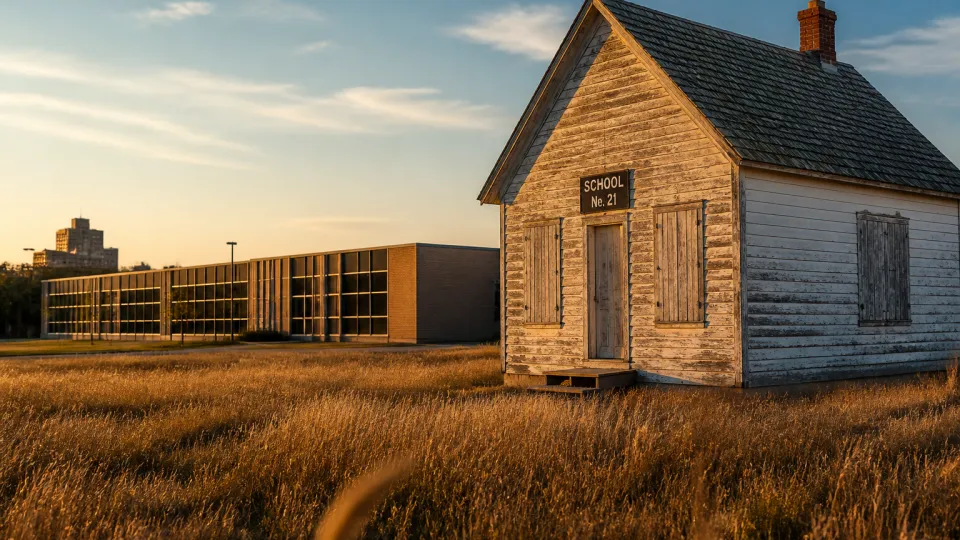
On a late autumn afternoon outside Brandon, a low wind lifts stubble across a former schoolyard. The clapboard shell of a one-room schoolhouse leans against memory; inside, a single chalkboard remains, the faint ghost of cursive still visible when the light hits. For a century such rooms were the incubators of civic habit — punctuality, literacy, and the awkward democracy of shared desks. They were also the beginning of a social contract between families and place: that education would help a child stay and make something of the prairie, or leave and return with new skills to transform it.
This is the story of education in Westman, and why its arc matters now more than ever. The region’s schools evolved not as monoliths but as a patchwork of responses to migration, mechanization, and cultural change. In Brandon, agrarian roots gave rise to institutional experiments: small colleges and vocational programs that sought to keep talent local while opening windows to the wider world. Institutions like Brandon University and Assiniboine Community College became anchors, offering both the liberal arts and pragmatic trades that sustained farms, hospitals and local businesses.
What is striking in the historical record is how adaptive these institutions have been. During the consolidation waves of the mid‑20th century, one-room classrooms gave way to larger consolidated schools with buses crossing miles of prairie. That logistical change did more than centralize resources; it transformed social patterns. Children who once spent long days under a single teacher now encountered specialists in science, art and physical education. Community identity shifted from a small hamlet’s rhythms to a shared regional life centered around school divisions and extracurricular leagues.
Human stories illuminate that transition. Margaret, a retired teacher who began her career in the 1960s, remembers filling a bus manifest by stroke of memory: "You knew the whole family. You knew who brought lunch and who needed a warm sweater." She later taught in Brandon where classes were larger but the curriculum broader. Her recollection is not nostalgia for simplicity but an account of different kinds of neighborhood-making. "We were still a community," she says, "but it was now a community that could offer a laboratory and a library."
Equally important has been education’s relationship with Indigenous communities. Westman sits on lands covered by Treaty relationships and has experienced the long reach of colonial schooling policies. That history is visible in both absence and ongoing effort: absence in curricula that for decades minimized Indigenous languages and perspectives; effort in contemporary partnerships that bring Indigenous knowledge into classrooms, support reconciliation mandates, and expand post‑secondary pathways for Indigenous students. These are not easy transitions. They are, crucially, local and often led by educators and community organizers whose work foregrounds restoration over tokenism.
By the 21st century, two additional forces reshaped learning in Brandon and surrounding towns: demographic change and . New Canadians and temporary workers brought multilingual families into schools, prompting bilingual programming and cultural supports once uncommon in these parts. At the same time, digital learning — accelerated by the COVID-19 pandemic — collapsed distances that had once made rural education precarious. Remote tutoring, hybrid college courses, and online professional certificates allowed residents to upskill without uprooting.
Assiniboine Community College’s programs in health care and trades, for example, have fed local clinics and industries, and local employers in turn have invested in apprenticeships and co‑ops. Brandon University’s small‑scale research and teacher education programs have steered graduates into rural classrooms where retention matters. The real impact is cumulative: better‑trained nurses stabilize small hospitals; effective teachers lower dropout rates; community‑based adult education improves employment trajectories.
Looking forward, the challenges are pragmatic and ethical. Rural depopulation pressures mean that schools must justify every square foot of funding, yet the social return on education often defies short budget cycles. Climate change introduces new curriculum imperatives — from land stewardship to infrastructure resilience — that local programs are uniquely positioned to teach. And reconciliation requires deep institutional change: embedding Indigenous governance in school boards, remunerating elders for language instruction, and rethinking assessment models to respect different epistemologies.
What gives cause for optimism is the region’s culture of civic improvisation. Schools, colleges and families in Westman have repeatedly rebuilt themselves around community needs: pivoting curricula during economic shifts, partnering across municipal borders, and welcoming new residents whose ambitions reframe what it means to learn on the prairie. Those choices matter because education here is not only about individual advancement; it is the mechanism by which a dispersed population sustains public life.
Ultimately, the legacy of learning in Westman is less a set of buildings than a series of commitments: to adapt, to include, and to keep knowledge tethered to place. If the next generation of students emerges from classrooms that marry vocational rigor with cultural awareness, that will be less an homage to the past schoolhouse than a renewal of the social compact that first put a chalkboard under a prairie sky.
"We taught kids to read the land," Margaret says, now smiling, "and to read a book. The trick has always been doing both."