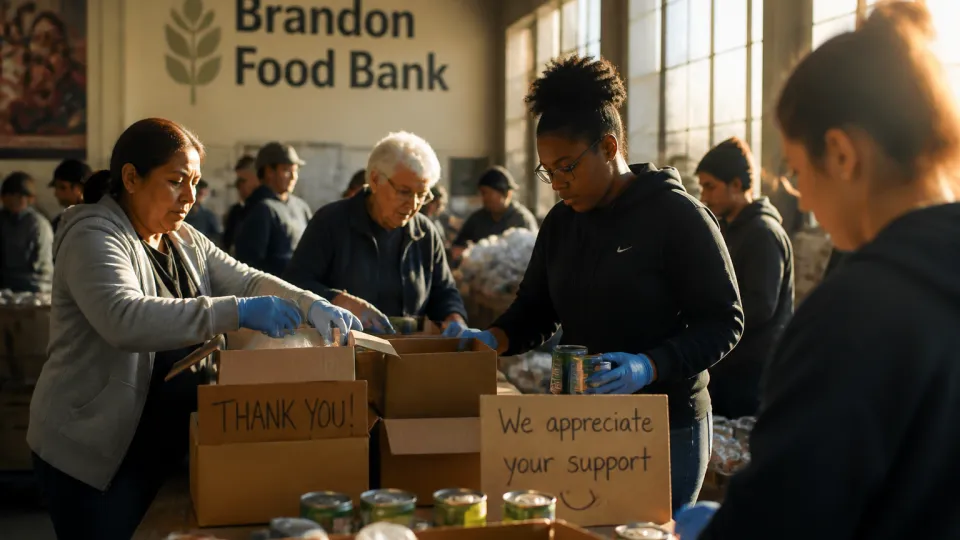
On a rainy Thursday in late October, the loading bay behind a modest warehouse near Brandon’s industrial edge feels less like a logistics hub and more like an orchestrated neighborhood. Older volunteers fold boxes with practiced efficiency. Two young parents arrive between daycare pickups, offering an hour of hands to label and sort. A woman who arrived in Manitoba three years ago hands out thermoses of coffee while translating instructions into Dari.
"I used to teach mathematics back home," she says, adjusting a box so the label faces out. "Here, volunteering helps me learn the town — and the town learns me." Her name is Amina; the Food Bank has become, for her, a bridge to both language and community.
This scene repeats across Westman: in community kitchens in Virden, in an after-school mentorship program at Assiniboine Community College, in the sparse but steady hum of the Brandon Native Friendship Centre. Yet what looks like a steady rhythm masks a thoroughgoing transformation. Over the past five years, volunteerism in the region has been quietly reinvented by demographic shifts, pandemic-era habits, and a local economy that demands new forms of civic labor.
Volunteers have always carried the practical weight of community services, but the character of that labor is changing. Longtime coordinators describe an aging volunteer base that remains loyal and skilled but less able to take on physically demanding or frequent shifts. "We still have Harold packing hampers every Tuesday for the last fifteen years," a volunteer coordinator at a Westman shelter told me, "but we increasingly rely on younger, episodic volunteers for weekend drives and point-in-time crises."
Younger people, for their part, say they want to contribute on terms that fit precarious work and family patterns. Short, well-defined shifts, skills-based projects, and opportunities that provide professional development are more attractive than open-ended commitments. Volunteer-driven opportunities that once relied on steady weekly attendance are reconfiguring into micro-volunteering modules: two-hour event shifts, remote admin tasks, and short-term mentorship placements.
The pandemic accelerated these tendencies. Informal mutual aid networks blossomed during lockdown, with neighbours coordinating grocery drops and medication pickups via social media. "There was an outpouring of neighborly labor that never went through a registration desk," recalls a community organizer in Brandon. Many of those spontaneous volunteers did not convert into long-term commitments. Meanwhile, service organizations saw demand for basic needs surge — creating a paradox of greater need but less consistent supply of volunteers.
For organizations, the result has been both strain and . Food banks and shelters have invested in volunteer management systems, allowing volunteers to sign up online for specific tasks and windows. Cross-sector partnerships—between municipal offices, schools, and local businesses—have softened capacity shortages. Employers in Brandon are piloting paid volunteering days; Assiniboine Community College has expanded service-learning credits, making volunteerism both an academic and civic practice.
Newcomers and immigrants are quietly reshaping the volunteer profile, bringing language skills, cultural knowledge, and different expectations about civic life. Programs that once recruited predominantly through parish halls now see volunteers come via settlement agencies, ESL classes, and newcomer social networks. This is not simply a matter of raw numbers. It changes how services are delivered: multilingual intake, culturally appropriate food hampers, and outreach that meets people where they are.
Still, pressure points remain. Volunteer coordinators cite burnout and recruitment fatigue. Rural towns struggle with thin volunteer pools when seasonal work peaks. And the nature of modern need—mental-health crises, addictions, poverty—requires training and supports that go beyond goodwill. "You can’t ask volunteers to be therapists," one coordinator said. "They need supervision, training, and time off."
Looking ahead, the communities of Westman are experimenting with structural answers. Municipal councils are exploring modest stipends for volunteers in essential roles, a formal recognition of the economic value they contribute. Nonprofits are pooling resources to create shared volunteer hubs that rotate volunteers through multiple organizations, reducing redundancy and smoothing schedules. Digital platforms are being used not only to schedule shifts but to create learning modules and safety training that make episodic service more effective.
Perhaps the most promising change lies in reframing volunteerism as a plural, flexible ecosystem rather than a singular moral duty. Older volunteers still carry institutional memory and steady hands. Younger volunteers bring energy and new skills. Newcomers bring connections and perspectives that renew programs. When those strands are purposefully braided—through training, fiscal support, and collaboration—they yield a durable civic fabric.
Back behind the warehouse, as rain eases and light spills across labeled boxes, Amina pauses and watches a teenage volunteer hand a package to an elderly man taking his first steps toward a winter of food insecurity. "We all have different gifts," she says. "We just need ways to share them." In Brandon and across Westman, communities are slowly building those ways—sometimes awkwardly, sometimes brilliantly—and, in doing so, are redefining what neighborliness can look like in the 21st century.
If the region can sustain investments in coordination, training, and inclusive recruitment, the next decade may not simply replace an old volunteer model; it may expand civic life to include more people, more forms of service, and a resilience grounded in pragmatic generosity rather than nostalgically imagined reciprocity.