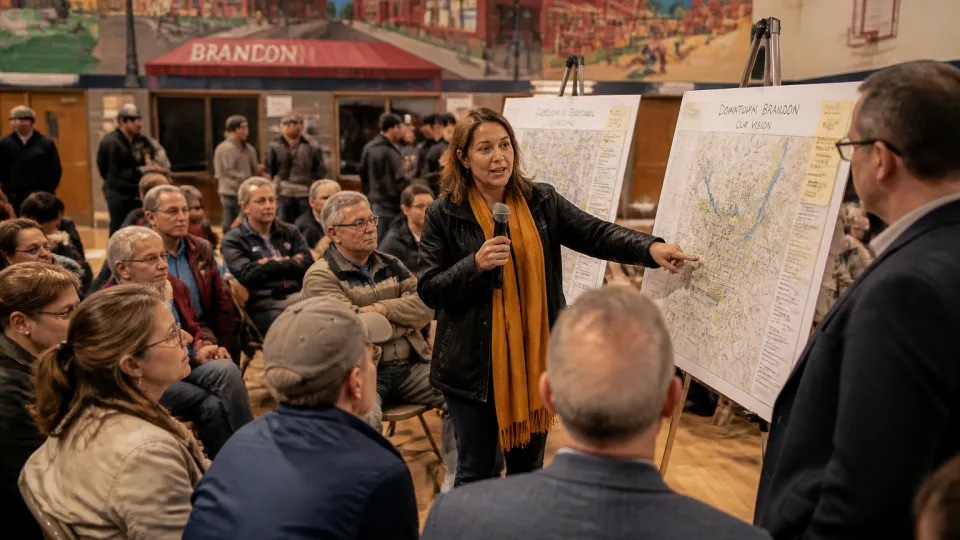
In mid‑September, a modest gymnasium at a Brandon centre filled with folding chairs, hand‑drawn maps and a hum of conversation that sounded less like a town hall and more like a neighbourhood reunion. Residents came with coffee and questions: Where will our young people find work? How will seniors stay in their homes when property taxes rise? Can we create places that feel like they belong to all of us?
The meeting was part of a season of public events that have quietly recast development across Westman — not as a question of builders and bank ledgers, but as an ongoing conversation about identity and future. Over the last five years, civic planners, Indigenous leaders, artists, farmers and owners have layered practical proposals onto a larger cultural project: realigning growth so it serves everyday life rather than displacing it.
At the heart of this shift are small, deliberate experiments. On a block near downtown, an empty storefront became a weekend food hub run by a coalition of cooks, high school students and newcomers. It started with a community grant and the willingness of a local landlord to take a modest rent hit. 'We wanted to make sure someone could grab a hot meal and see a familiar face,' said one volunteer. The space has since coalesced into an employment pipeline for youth interested in hospitality, and a gathering spot where languages overlap and neighbours patch hiring leads into conversations.
Elsewhere, efforts to knit housing policy to cultural needs are becoming tangible. A pilot housing co‑operative, organized by elder groups and a consortium of non‑profits, prioritizes multigenerational units with communal gardens and visiting spaces for ceremonial gatherings. One resident, a retired teacher who grew up in the region, described the project as 'the kind of neighbourhood my parents imagined — not just shelter, but a place to pass stories and recipes down.' If the co‑op scales, it would offer a template that many smaller Prairie towns can adapt without relying solely on market incentives.
Indigenous leadership has also shifted the tone of development. Conversations at recent forums have foregrounded land stewardship and economic partnerships rooted in sovereignty. One initiative pairs municipal planners with Indigenous knowledge‑keepers to evaluate floodplain restoration and prairie regeneration as infrastructure. Rather than treating parks and drainage as separate technical problems, these collaborations see them as shared landscapes with social and cultural value — places for ceremony, for harvest, and for climate resilience.
Artists and cultural organizers have been instrumental in translating these ideas into public life. Murals commissioned through neighbourhood funds now anchor conversations about history and migration. A mobile theatre troupe travels to farm towns, staging short plays about labour, harvest and memory; these productions are followed by community meals that double as listening sessions for municipal plans. Such cultural work, far from being decorative, functions as a social laboratory: it invites residents to test what they want development to look like before concrete is poured.
The economic side is decidedly pragmatic. Local business incubators, many in partnership with educational institutions like Brandon University and regional colleges, emphasize small‑scale manufacturing, value‑added agriculture and digital services that can be located outside dense urban cores. Young entrepreneurs I spoke with cited the advantage of lower overheads here, but they worried about connectivity — reliable high‑speed internet, training, and access to markets remain barriers. Municipal leaders acknowledge the need for coordinated investments that bring infrastructure, skills and community goals into alignment.
What ties these projects together is not a single master plan but a set of practices: inclusive consultation, pilot projects that can scale, and the deliberate centring of cultural life in urban design. There are tensions — property owners who fear regulation, youths who feel opportunities are still too scarce, and older residents wary of rapid change. Those tensions show why this work is more craft than blueprint.
Looking forward, the question for Westman is less whether development will happen and more who will be invited to shape what it becomes. The region's recent pattern suggests a modest but meaningful redefinition: development celebrated not just for new buildings, but for the ways projects cultivate belonging and local capacity. As one planner observed, 'When a city starts measuring success by how often neighbours borrow sugar from each other, not just by how many units it builds, you know priorities are shifting.'
If that sounds sentimental, the tests are concrete. Will pilot co‑ops turn into replicable models? Can Indigenous‑led stewardship projects secure long‑term funding? Will cultural programming continue to be recognized as infrastructure? The answers will emerge slowly, through more gymnasiums full of folding chairs, more storefronts converted into living rooms, and the patient work of aligning policy with the rhythms of everyday life. In Westman, development is becoming, quietly and insistently, a project of community-making.